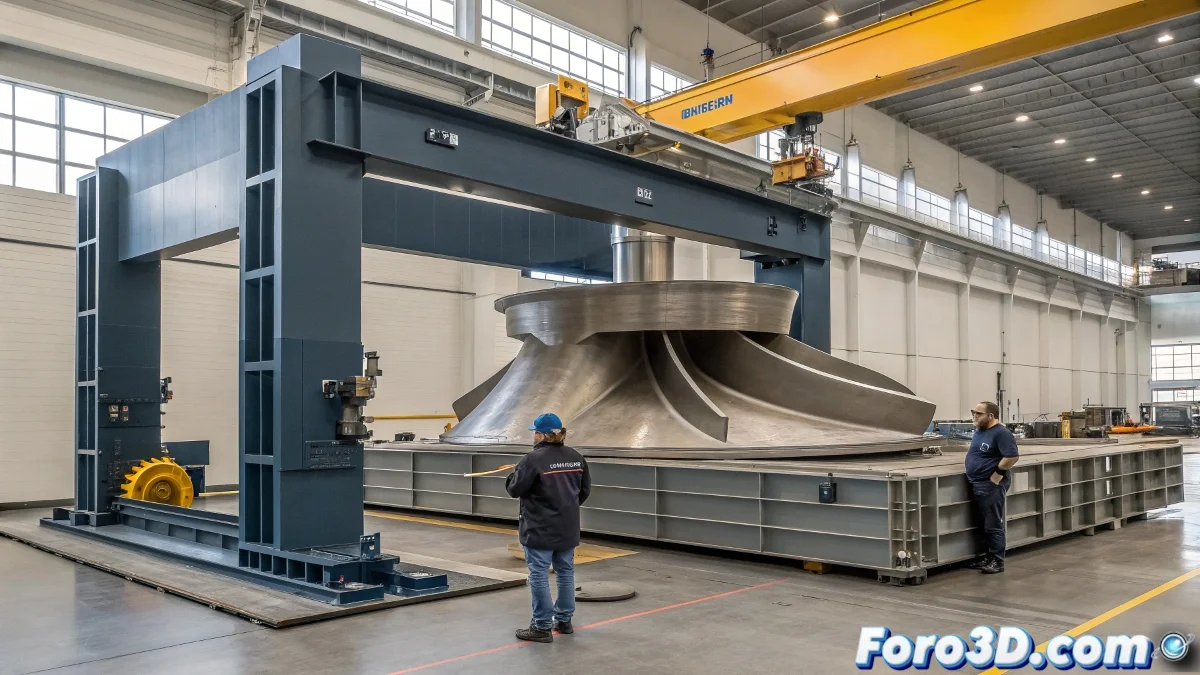
When Additive Manufacturing Dives into Renewable Energy
The National Renewable Energy Laboratory (NREL) has taken a significant leap in oceanic energy research with the acquisition of a large-scale metal 3D printer. 🌊🔧 This technology will enable the manufacture of customized, corrosion-resistant components for marine energy systems, addressing one of the greatest challenges in this field: durability in extreme oceanic environments. The advancement will accelerate the development of tidal turbines, wave energy devices, and other critical technologies for the energy transition.
Revolution in Marine Component Manufacturing
The large-format metal 3D printer allows the creation of significant-sized parts with complex geometries optimized for hydrodynamic and structural efficiency. ⚙️ Additive manufacturing drastically reduces production times compared to traditional casting and machining methods, enabling rapid design iterations and accelerated prototyping. This is particularly valuable in research, where the ability to quickly test different configurations accelerates innovation.
This acquisition positions NREL at the forefront of applying additive manufacturing to marine renewable energies, a field where corrosion resistance and durability are critical for economic and technical viability.
Technical and Operational Advantages
The system offers specific benefits for marine applications: 🛡️ Use of special alloys resistant to saline corrosion, ability to print monolithic structures that reduce weak points from joints, and geometric freedom to optimize components for maximum hydrodynamic efficiency. Weight reduction through internal lattice structures is especially valuable for floating or submerged devices.
Applications in Marine Renewable Energy
- Tidal Turbines: Blades and structural components optimized for marine currents.
- Wave Energy: Wave energy converter devices with complex geometries.
- Support Structures: Components for platforms and fatigue-resistant anchoring systems.
- Sensors and Instrumentation: Protective housings for oceanographic monitoring equipment.
Impact on Research and Development
The rapid prototyping capability will allow NREL to validate new marine energy concepts with unprecedented speed. 📊 Researchers will be able to print, test, and refine designs in short cycles, potentially reducing development time from years to months. The technology will also facilitate the creation of customized components for specific installation site conditions, addressing one of the key challenges in marine energy: adaptation to variable local conditions.
Collaboration and Technology Transfer
NREL plans to collaborate with industry and academia to maximize the impact of this technology. 🤝 The laboratory will serve as a hub for developing standards and best practices in additive manufacturing for marine applications, facilitating adoption by manufacturers and project developers. The data generated will help qualify materials and processes for oceanic environments, reducing entry barriers for this emerging technology.
Thus, as the world seeks to harness the vast energy of the oceans, NREL ensures we have the tools to build devices that can withstand the force of the sea… though Neptune might feel a bit jealous of our growing ability to tame his realm. Because in the marine energy of the future, the only thing that should be submerged is the technology, not the hopes. 😉