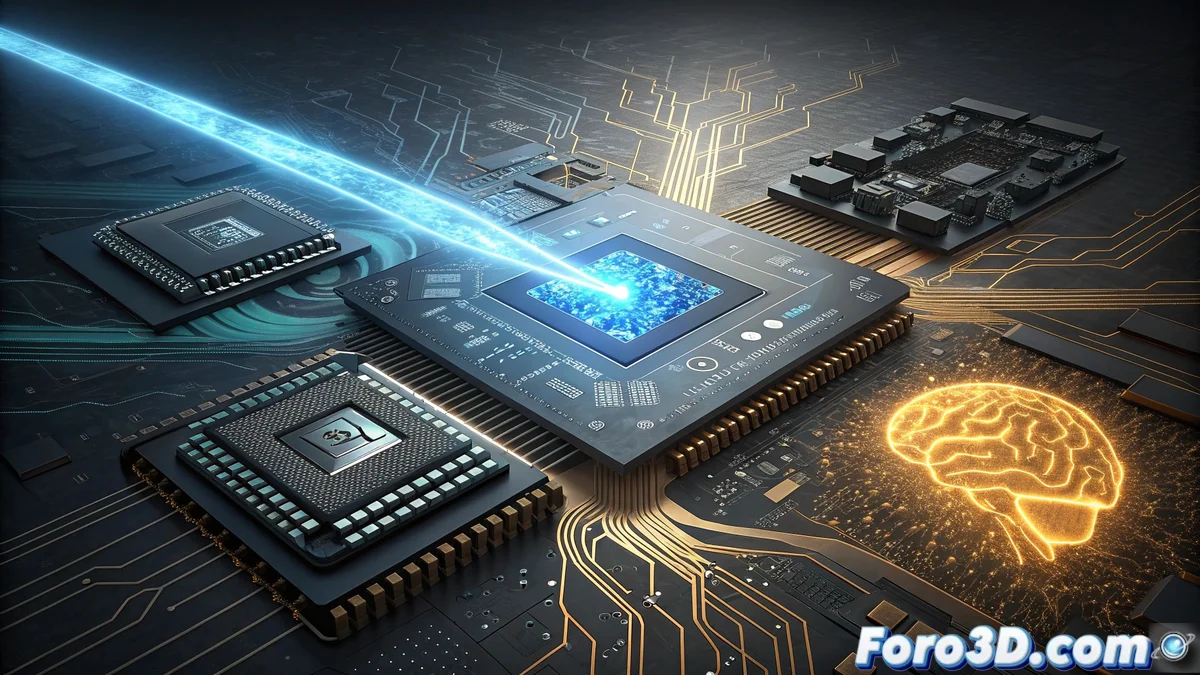
The Coexistence of Specialists in the Processing World
The emergence of NPUs as specialized artificial intelligence units has sparked a fascinating debate about the future of GPUs in professional workflows. While marketing promises revolutions, technical reality reveals a landscape of complementarity where each architecture finds its optimal application niche. An evolution rather than a revolution in the parallel processing ecosystem.
Different Architectures for Distinct Challenges
NPUs are meticulously optimized for specific neural network operations, excelling in matrix multiplications and convolution calculations with remarkable energy efficiency. However, this specialization comes with limitations: they lack the versatility of GPUs to handle the wide variety of workloads that characterize 3D design and visual production. The strength of GPUs lies precisely in their general-purpose capability for massive parallel processing.
Specific Strengths of Each Architecture
- NPU: extreme efficiency in AI inference
- GPU: versatility in rendering and simulations
- NPU: low consumption for specialized tasks
- GPU: massive bandwidth for textures and geometry
The Professional Workflow as a Battlefield
In professional Foro3D environments, the superiority of GPUs for tasks like photorealistic rendering, complex physical simulations, and character-driven animation remains indisputable. While NPUs accelerate specific processes like intelligent denoising or procedural texture generation, the bulk of the heavy work continues to rely on the brute power of traditional GPUs.
Practical Applications in 3D Production
- GPU: final rendering and interactive viewport
- NPU: intelligent upscaling and asset optimization
- GPU: fluid simulations and dynamics
- NPU: AI-assisted tools in 3D software
A demonstration of how technological specialization creates complementary ecosystems rather than direct substitutes, enriching technical possibilities without invalidating previous investments.
For studios and professional artists, the immediate future involves learning to orchestrate both types of processors within their pipelines. The ability to delegate specific AI tasks to NPUs while GPUs focus on graphics could mean significant efficiency gains without requiring radical changes in established workflows 🚀.
And so we end with NPUs capable of processing complex neural networks in milliseconds, while GPUs continue sweating to render that scene the artist decided to fill with particles and volumetrics... because in the end, specialization is wonderful until you need a generalist to do the heavy lifting 😅.