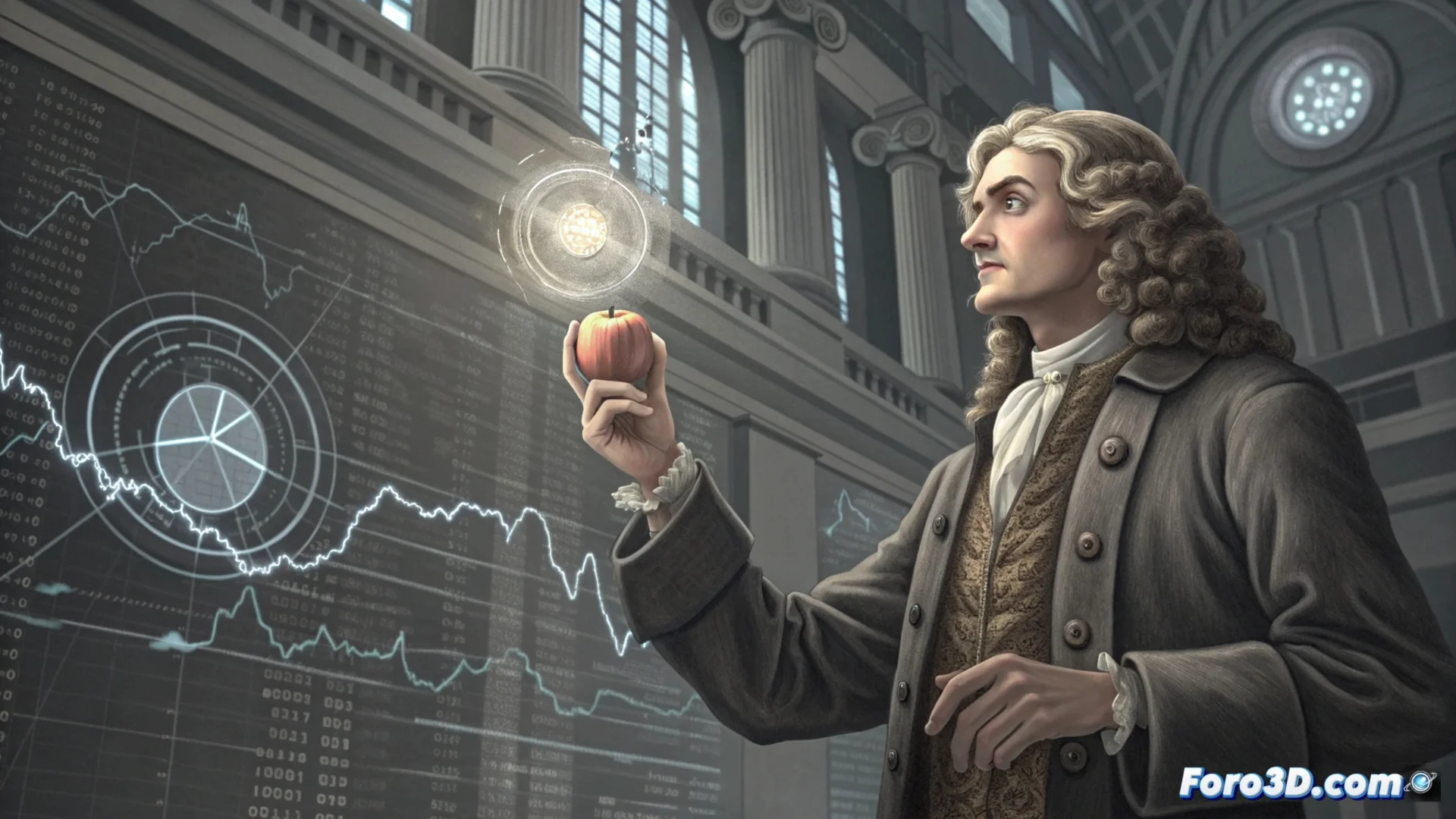
Newton Applies His Physical Laws to Stabilize Financial Markets
Imagine Isaac Newton examining the ups and downs in financial markets and cryptocurrencies. His scientific approach rejects the visible disorder and seeks universal rules that govern price changes. He transposes concepts from classical physics to economics, with forces and masses that clarify the flow of values.
The Three Laws That Govern Economic Motion
Newton creates the Three Laws of Economic Motion to impose logic. The first states that an asset maintains its stable value or constant change until a speculative force alters it. The second asserts that the rate of price change increases with the net investment force and decreases with the asset's mass. The third establishes that every speculative purchase generates an opposite sale of equal force.
Key Laws in Action:- Maintains value without external forces
- Accelerates with proportional investment ⚙️
- Balances opposing purchases and sales
Newton links prices to real causes so that speculative bubbles become as rare as an apple rising to the sky.
System Anchored in Tangible Mass and Force
He proposes assigning to each digital asset a mass based on something concrete, like the energy it generates or the resources it backs. To move the price, a force equal to that mass is required, through measurable and real investment. This bond prevents abrupt rises or falls without a solid material basis.
System Elements:- Mass linked to tangible physical value
- Force as quantifiable investment
- Stability against empty speculation
Conclusion
In such a world, instead of mining crypto, we measure the gravity of each token to verify if its value supports real weight. Newton transforms volatility into predictable order with physical laws applied to economics.