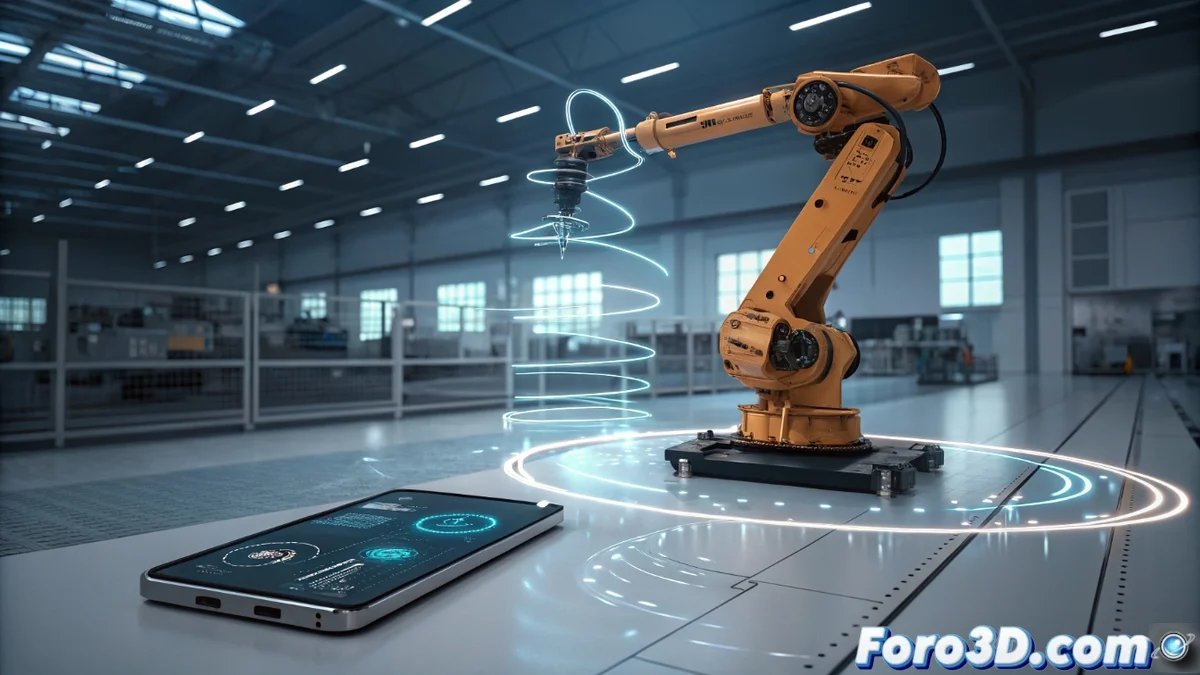
New technique allows robots to learn tasks with few demonstrations
Research in robotics has made a qualitative leap with a revolutionary approach that trains robots to acquire complex skills through a reduced number of visual examples. This advance overcomes the traditional barriers of compatibility between disparate sources of information, working effectively with both human and robotic recordings made in completely different contexts 🦾.
The trace-space concept: a common language for movements
The core innovation lies in the trace-space, a three-dimensional representation that encodes the kinematic essence of actions without superfluous visual details. This abstraction eliminates variations in appearance, camera configuration, and environmental conditions, focusing exclusively on the fundamental trajectory of the movement. Upon this foundation is built TraceGen, a predictive model that anticipates evolutions within the symbolic space, facilitating generalized learning of transferable manipulation skills across diverse robotic platforms.
Key system components:- Trace-space: Unified 3D representation that abstracts essential movements by eliminating visual noise
- TraceGen: Predictive model that generates future trajectories within the symbolic space
- TraceForge: Converter system that transforms heterogeneous videos into coherent three-dimensional traces
The ability to transfer skills between visually disparate domains represents a fundamental advance in practical robotics
Massive data generation for accelerated training
The training process is based on TraceForge, a specialized architecture that converts diverse video material into standardized three-dimensional traces, automatically generating a massive and varied data corpus. This extensive pretraining allows TraceGen to adapt subsequently with just five recordings from the target robot, achieving high success rates in real tasks at speeds far superior to systems based directly on video analysis.
Demonstrated advantages:- Data efficiency: Adaptation with only five demonstrations from the specific robot
- Cross-transfer: Effective operation with human recordings made with smartphones
- Environmental robustness: Overcoming bodily differences and variable environmental conditions
Implications for the future of human-robot interaction
This disruptive technology establishes a new paradigm in robotic teaching, where systems can learn directly from human demonstrations without requiring perfect capture conditions. The elimination of technical barriers such as camera movements or imperfect techniques brings robotics closer to everyday scenarios, facilitating the natural transfer of knowledge between humans and machines 🤖.