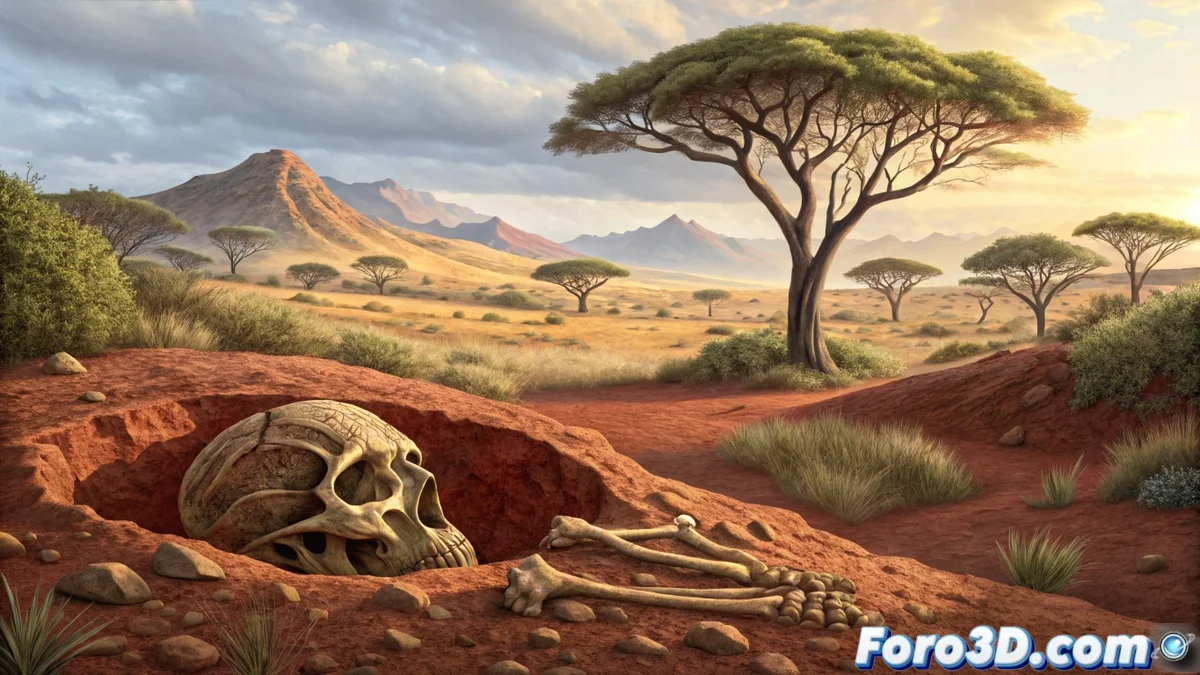
New Finding in Ethiopia Reveals Coexistence of Multiple Hominid Species Alongside Lucy
A revolutionary discovery in Ethiopia's paleontological sites is transforming our understanding of hominid diversity during the Pliocene. The famous Australopithecus afarensis, known worldwide as Lucy, now we know shared her habitat with at least one other human ancestor species, evidencing a much more complex evolutionary scenario than previously believed 🦴
The Metatarsal That Changes the Evolutionary Story
The key fossil, a perfectly preserved metatarsal bone, was found in the Woranso-Mille region and dates back approximately 3.4 million years. The extraordinary aspect of this finding lies in its distinctive morphology, which shows clear adaptations for more arboreal locomotion compared to Lucy's predominantly bipedal gait. This contrast suggests that both species occupied different ecological niches, minimizing direct competition for resources 🏞️
Key characteristics of the discovery:- The bone exhibits a curved structure typical of hominids with greater adaptation to tree-dwelling life
- Temporal coexistence is confirmed by precise dating that matches Lucy's period
- The morphological differences are so significant that they rule out belonging to the same species
This finding forces us to completely rethink the narrative of human evolution as a simple tree with a single dominant branch
Repercussions on the Human Family Tree
The confirmed coexistence of multiple hominid species in East Africa during the same geological period suggests that human evolution followed a pattern of adaptive radiation rather than a simple linear progression. This diversification likely responded to significant environmental changes that created opportunities for different survival strategies 🌍
Main implications for paleoanthropology:- The human family tree takes on a structure more like a bush with multiple coexisting branches
- The diversity of locomotor adaptations suggests different responses to similar environmental pressures
- New questions arise about interspecies interactions and the factors that determined which lineages survived
Future Directions for Research
Researchers are now focusing on identifying more fossil remains of this newly discovered species to better understand its complete anatomy and ecological behavior. The mystery of why only some lineages gave rise to the Homo genus while others went extinct becomes one of the most fascinating questions in modern paleoanthropology. It seems that our prehistoric ancestors were already practicing habitat sharing much earlier than imagined, though without the rental contracts we know today 🏡