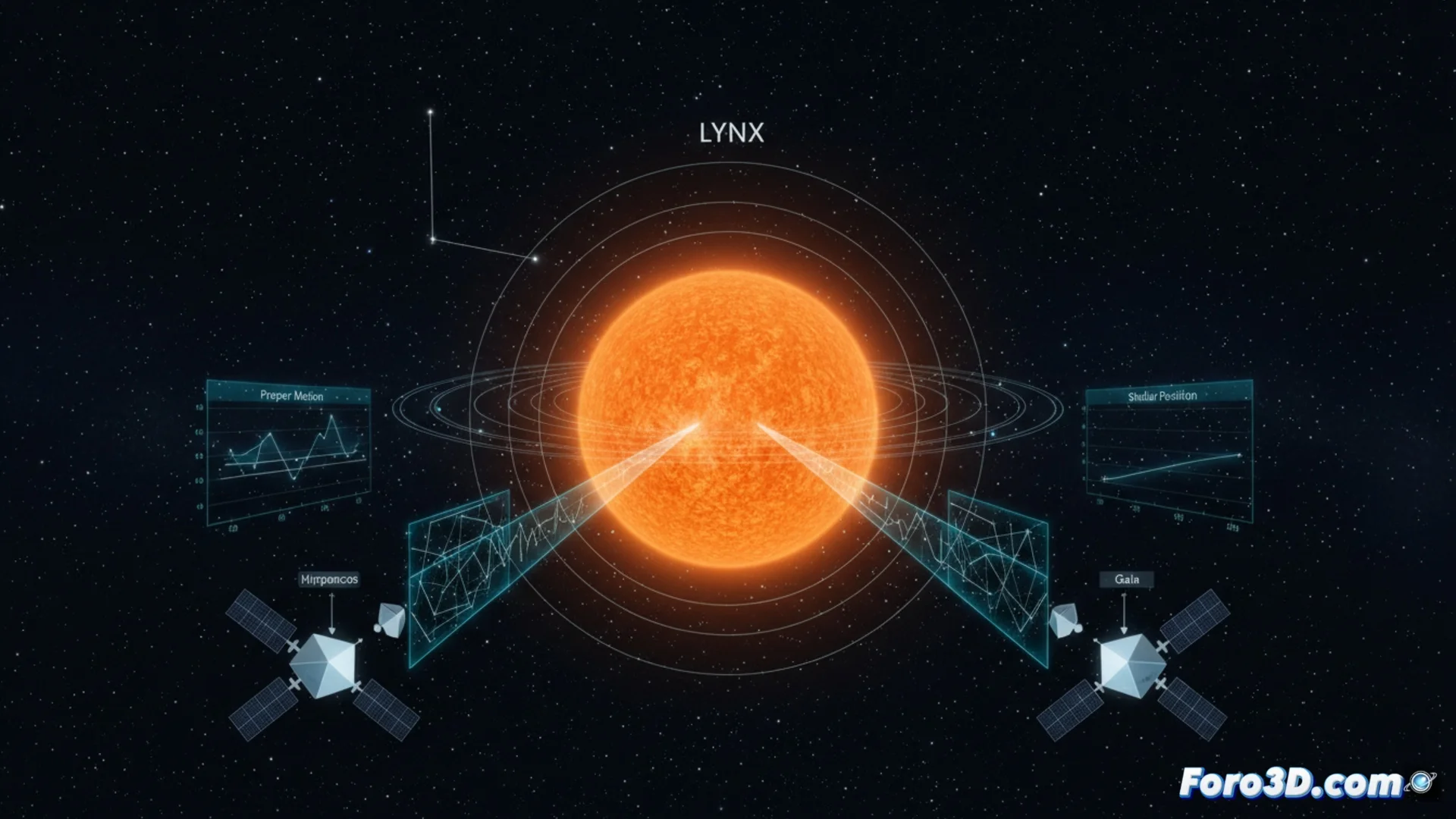
New Data Rules Out a Black Hole in the BE Lyncis System
A recent astronomical investigation has tested the intriguing idea that the variable star BE Lyncis hides a massive black hole as a companion. However, by scrutinizing data from the Hipparcos and Gaia missions, scientists found no gravitational signatures that such a dense object would leave. Sometimes, the cosmos chooses simplicity over cosmic drama. 🪐
Astrometry Doesn't Lie: Absence of Key Signals
Measurements of position and proper motion are extremely precise. If a high-mass black hole were present, its gravitational pull would clearly deform the star's trajectory. The data reveal that BE Lyncis experiences no acceleration or dynamic wobbles anticipated in such a scenario. The initially proposed eccentric orbit is physically impossible, as at its periastron the star would cross its survival limit and be destroyed.
Evidence Refuting the Black Hole Hypothesis:- Lack of any measurable astrometric perturbation in Gaia and Hipparcos data.
- Total absence of orbital acceleration betraying a massive and compact companion.
- The proposed orbit is incompatible with the stability of the stellar system.
The current conclusion is that there is no evidence supporting the presence of a black hole as a companion in this system.
A More Conventional Explanation for the Variability
With the black hole hypothesis ruled out, the regular changes in BE Lyncis's brightness require a new interpretation. Most likely, they are due to natural internal pulsations of the star itself or, alternatively, some instrumental noise in the collected observations. The universe prefers, on this occasion, ordinary stellar behavior.
Possible Causes for the Variable Brightness:- Intrinsic pulsations inherent to the star's evolution and structure.
- Artifacts or noise in the data from photometric observations.
- Stellar atmospheric phenomena that do not imply a binary companion.
Conclusion: A Solitary Stellar System
The study demonstrates the power of precision astrometry to verify or refute bold theories. In the case of BE Lyncis, the numbers don't add up to harbor an invisible monster. This closes a speculative chapter, reminding us that, often, the simplest answer is the correct one. The star pulses on its own, without a dark neighbor in its immediate surroundings. 🔭