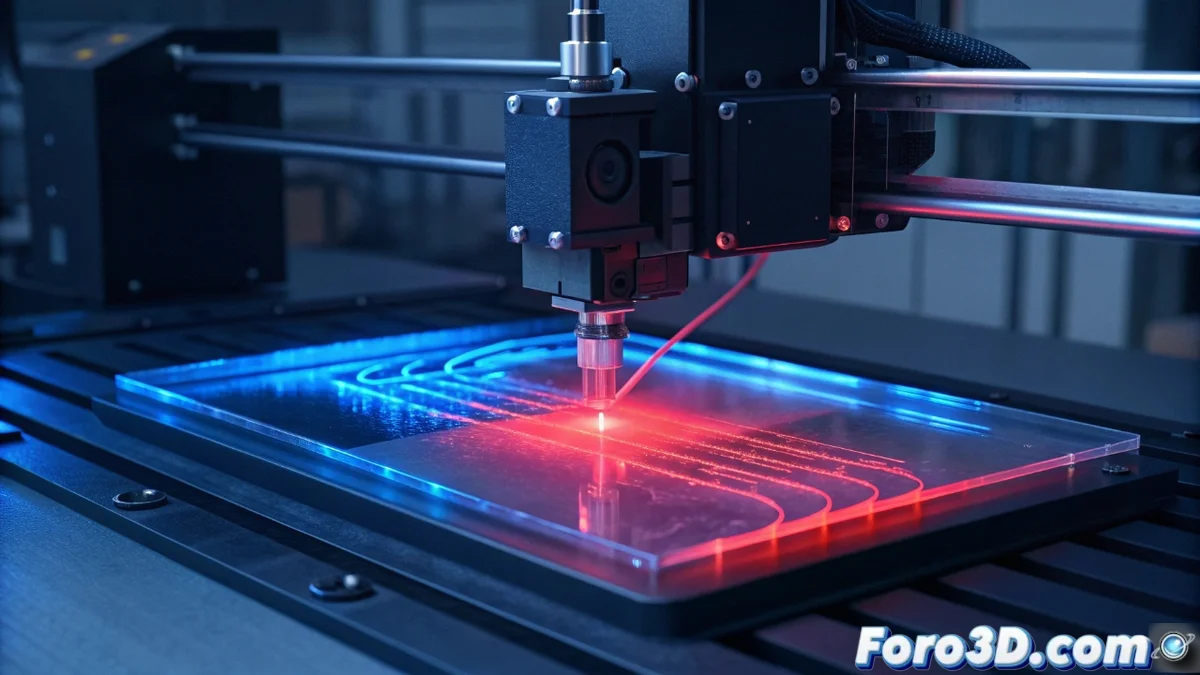
New Conductive Polymeric Ink for 3D Printing of Chromatic Devices
A multidisciplinary team of researchers has developed a revolutionary polymeric ink with conductive properties that enables the manufacturing of electronic components via 3D printing with the ability to modify their coloration in response to various environmental stimuli 🌈.
Innovative Applications in Wearable Technology
This disruptive technology finds immediate implementation in the field of smart wearables that can monitor physiological parameters and alter their tone to signal significant changes. It also integrates into human-machine interfaces where chromatic variations provide intuitive visual feedback, and in smart packaging that detects inappropriate storage conditions through perceptible color transformations.
Main Fields of Application:- Wearable medical devices that change color according to body variables
- Tactile interfaces with immediate visual response through chromatic changes
- Packaging systems that alert about inadequate temperatures or humidity
The versatility of this material exceeds initial expectations, combining conductive polymers with particles sensitive to temperature, humidity, and electric fields in a comprehensive solution for additive manufacturing.
Competitive Advantages Over Conventional Methods
This innovative approach significantly overcomes the limitations of traditional manufacturing processes by allowing the creation of complex structures with integrated functionality in a single printing process. The ink demonstrates excellent adhesion on multiple flexible substrates and retains its conductive properties even after numerous deformation cycles, a fundamental characteristic for applications in soft robotics and electronic textiles.
Highlighted Technological Benefits:- Manufacturing of complex geometries with integrated electronics in a single step
- Compatibility with diverse flexible substrates while maintaining conductivity
- Resistance to repeated deformations without loss of functionality
Immediate Future of Interactive Technology
This promising technology paves the way for clothing that changes color according to our emotional state, although it raises interesting considerations about privacy when we might not want everyone to know our mood before the first morning coffee ☕. The customization potential and applications in continuous monitoring represent only the beginning of what this innovation can offer to the world of printed electronics.