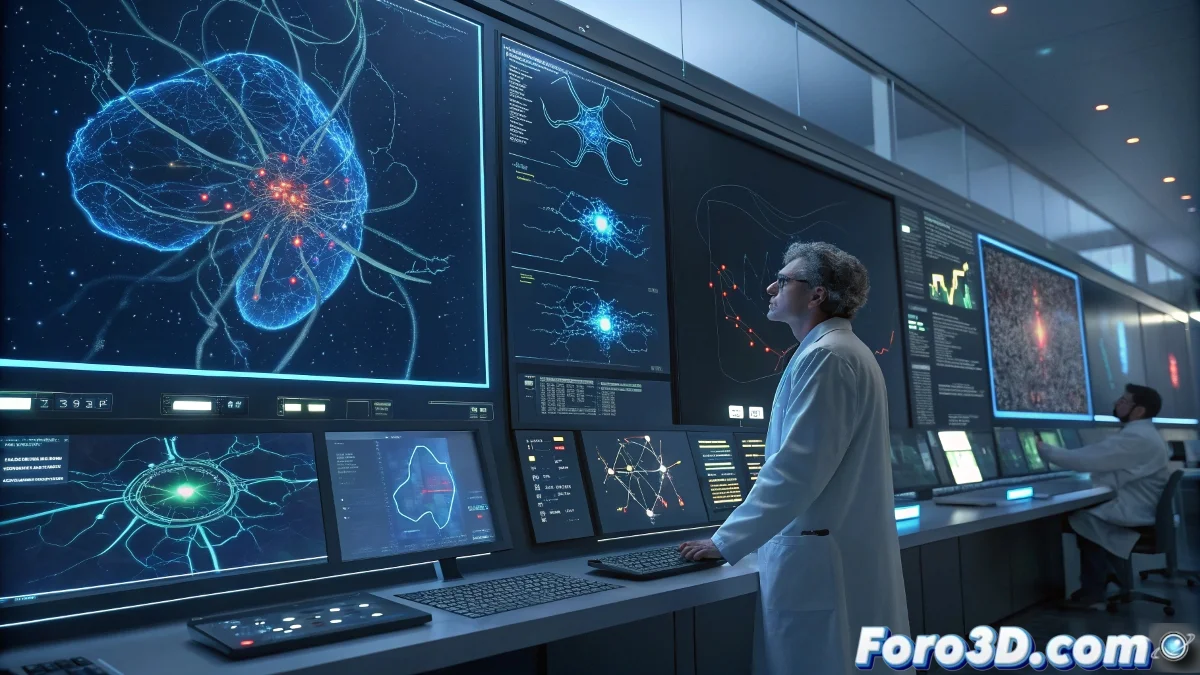
🧠 When Science and 3D Unite to Decode the Brain
The recent achievement of ETH Zurich - culturing over 400 types of neurons - is not only a medical milestone, but also a 3D visualization challenge. Now, technical artists and scientists collaborate to represent these complex neural networks with unprecedented detail.
"Visualizing neurons is like rendering the universe: every time you zoom in, more complexity appears" - Bioartist specialized in neurovisualization.
🔬 From Petri Dishes to 4K Renders
- Houdini:
- Neural network simulation with particle systems
- Procedural geometry for axons and dendrites
- Unreal Engine 5:
- Interactive visualizations for research
- Nanite to handle millions of synaptic connections
- ZBrush/Blender:
- Detailed modeling of neural structures
- PBR texturing for cell membranes
🎨 The Art of Neurovisualization
Creating accurate representations involves:
- Importing microscopic data into 3D software
- Establishing neural connection hierarchies
- Developing custom shaders for synapses
- Optimizing geometries for real-time rendering
⚠️ The Technical Challenges
- Data Density: 1mm³ of brain contains ≈50,000 neurons
- Render Times: Full simulations can take days
- Scientific Accuracy: Every connection must reflect real data
This breakthrough not only allows for a better understanding of neurological diseases, but also creates the most accurate brain visualizations in history. Although, as with everything in 3D, there will always be some render that ends up looking like "a plate of fluorescent spaghetti" due to a configuration error. 🍝✨
P.S.: If your neural simulation looks like an explosion in a wire factory, you probably forgot to adjust the physics parameters.