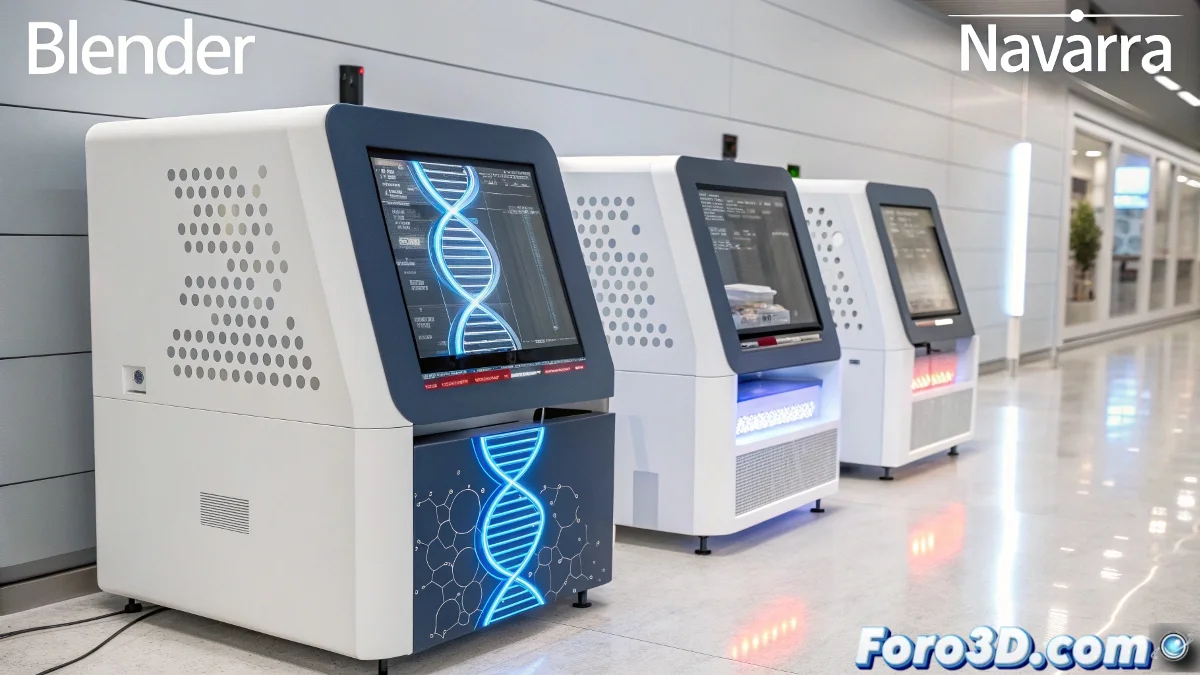
Navarra Incorporates Massive DNA Sequencing and Its Visualization in Blender
The foral community of Navarra has taken a significant leap in biomedicine with the incorporation of three new massive DNA sequencing machines 🧬. This cutting-edge technology allows analyzing the human genome with unprecedented detail, improving the diagnosis of rare diseases, optimizing oncological treatments, and boosting local biomedical research. Massive sequencing represents the frontier of personalized medicine, where therapies are specifically tailored to each patient's genetic profile. To visualize and communicate this complex technological process, Blender offers powerful tools that allow recreating both the sequencing equipment and the genetic data flow in an educational and visually impactful way.
When you render genomes faster than Blender renders your scenes.
Modeling Futuristic Sequencing Equipment
The first step consists of recreating the three massive sequencing machines using basic primitives in Blender. We start with cubes and cylinders that we extrude and scale to achieve shapes that suggest advanced technology, incorporating geometric details that represent screens, control panels, and technical components. Each machine is modeled with a futuristic yet functional aesthetic, maintaining clean and organized geometry so that the final wireframe render clearly shows the structure of each device. The parallel arrangement of the three machines creates a visually balanced composition that reflects the simultaneous processing capacity of massive sequencing. 🔬
Creating DNA Helices and Genetic Structures
To represent the genetic material processed by these machines, we model double DNA helices using curves and Screw modifiers. We carefully adjust the parameters to achieve the characteristic helical structure with its well-defined base pairs, creating clean meshes that will be perfectly visualized in wireframe mode. The DNA strands are arranged in curved paths that connect to the sequencing machines, suggesting the flow of genetic material toward the analysis process. Precision in modeling these structures is crucial to convey scientific authenticity in the visualization.
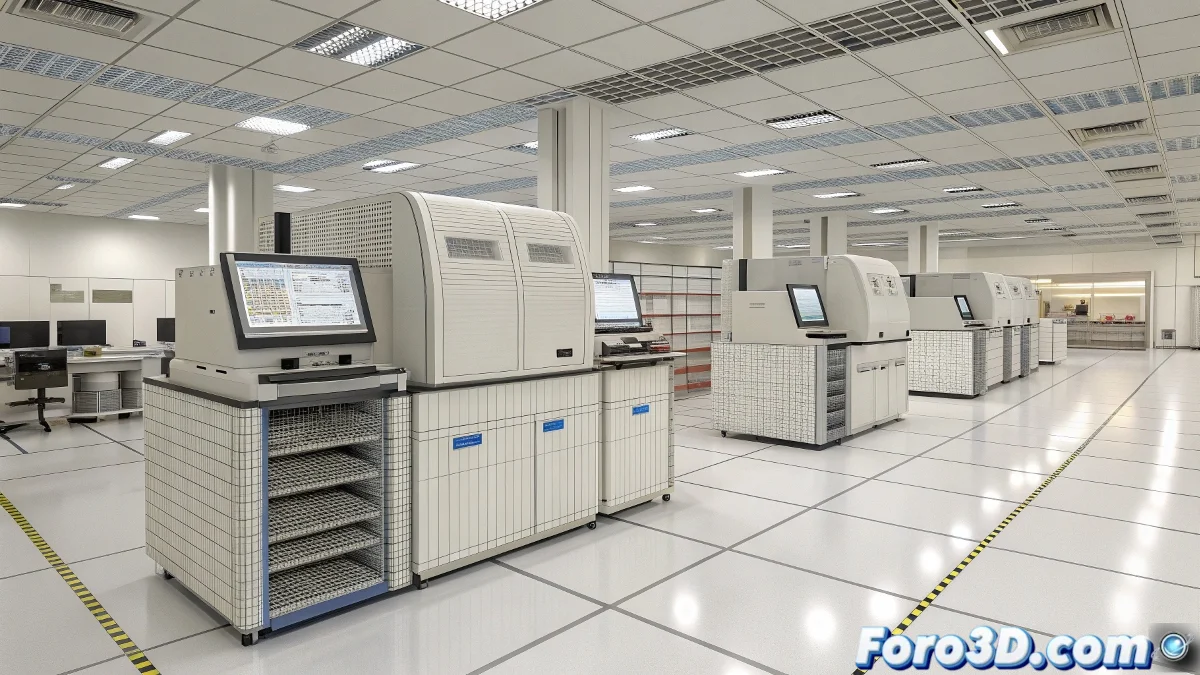
Particle Systems for Genetic Data Flow
The magic of sequencing is captured through particle systems that simulate the transformation of DNA into digital data. We set up emitters that generate particles along the DNA helices, animating them to flow into the sequencing machines. We adjust the speed, rotation, and lifespan of the particles to create the effect of genetic information being read and processed. In the wireframe render, these particles appear as simple but effective geometry, clearly communicating the concept of transforming biological material into digital information without the need for complex shaders.
Camera Setup and Visual Narrative
We establish a multi-camera system that tells the sequencing story from different perspectives. A general camera shows the three machines in context, while close-up shots focus on specific details: the entry of DNA helices into the machines, data visualization screens, and particle flow representing genetic information. We animate the cameras to create a narrative sequence that guides the viewer through the entire process, from the entry of genetic material to the generation of sequenced data.
Wireframe Rendering and Educational Applications
We use specialized wireframe materials for all objects in the scene, adjusting line thickness according to their narrative importance. We render with Eevee for quick iterations or Cycles for maximum quality, setting up lighting for optimal contrast between different elements. The final result is a technically precise yet visually accessible visualization that can be used in educational contexts, medical presentations, and outreach materials, helping to understand how massive sequencing transforms modern medicine.
In Navarra, the machines decipher millions of DNA bases in minutes, but in Blender we still wait for a simple wireframe viewport to stop flickering when we rotate the camera too fast... at least our virtual sequencings never have genetic reading errors. 😉