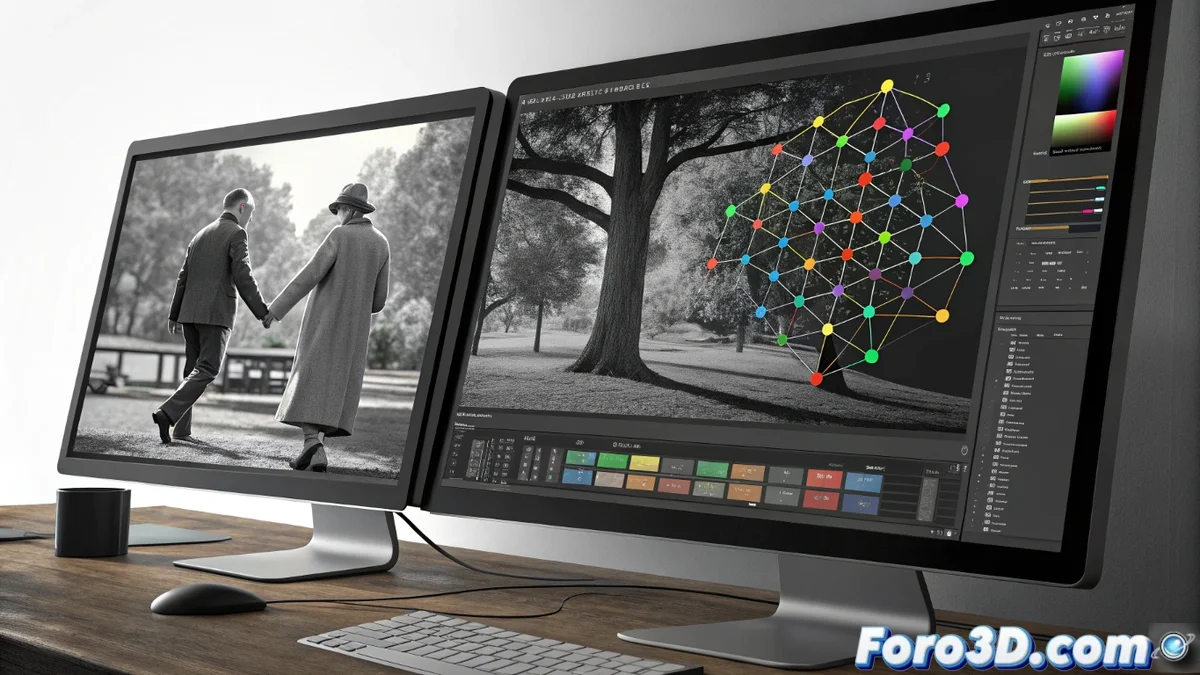
Natron: an unexpected ally for audiovisual restoration
Generally associated with the creation of visual effects and digital compositing, Natron reveals a surprising facet as a tool for professional restoration. Its node graph architecture, far from being a barrier, becomes the foundation for building complex, non-destructive, and highly customizable repair pipelines to bring damaged films back to life 🎞️✨.
The power of nodes at the service of memory
The true power for this task lies in repurposing classic VFX nodes. Tools like the Tracker (tracking) and Roto (rotoscoping), designed to integrate creatures or explosions, become essential for intelligently isolating and correcting defects. They allow pixel-perfect tracking of a moving scratch or creating detailed masks to protect healthy areas of the footage while applying cleaning filters only where needed.
Key advantages of the nodal approach for restoration:- Millimetric control: Each operation (denoising, cloning, stabilization) is an independent node that can be adjusted, disabled, or reorganized at any time.
- Non-destructive process: The original footage remains intact; all corrections are applied in upper layers, allowing easy reversal.
- Automation of repetitive tasks: A track applied to a defect can drive multiple corrections throughout an entire sequence automatically.
Some defects are historical heritage, but others can be removed with surgical precision thanks to nodal control.
Building a repair workflow
A typical pipeline in Natron starts with importing and analyzing the footage to identify recurring defects. From there, a logical graph is built. Nodes like Denoise or RemoveGrain combat grain and noise, while Grade and Clamp recover the dynamic range, extracting detail from shadows and faded highlights. For those annoying vertical or horizontal scratches, directional blur techniques or interpolation of adjacent frames can be employed, connected in a chain for a clean result.
Essential nodes in your restoration kit:- Tracker & Stabilize: To correct camera shakes and make moving defects "stay still" for treatment.
- Roto and Paint: For manual masking of damaged areas with complex shapes and cloning of healthy pixels.
- Filter and Blur: To selectively smooth imperfections without affecting the overall image sharpness.
From theory to practice: rescuing memories
The beauty of this system is its direct applicability. With a bit of patience and a well-planned node graph, you're one simple Merge node away from transforming that constant flicker and jumps in the family wedding film into a visually impeccable memory. Natron democratizes correction tools that were previously reserved for specialized and very expensive software, putting high-level restoration power in the hands of archivists, enthusiasts, and VFX artists who want to tackle historical rescue projects. The final result is not just a clean image, but the preservation of memory with unsuspected technical quality 🛠️💾.