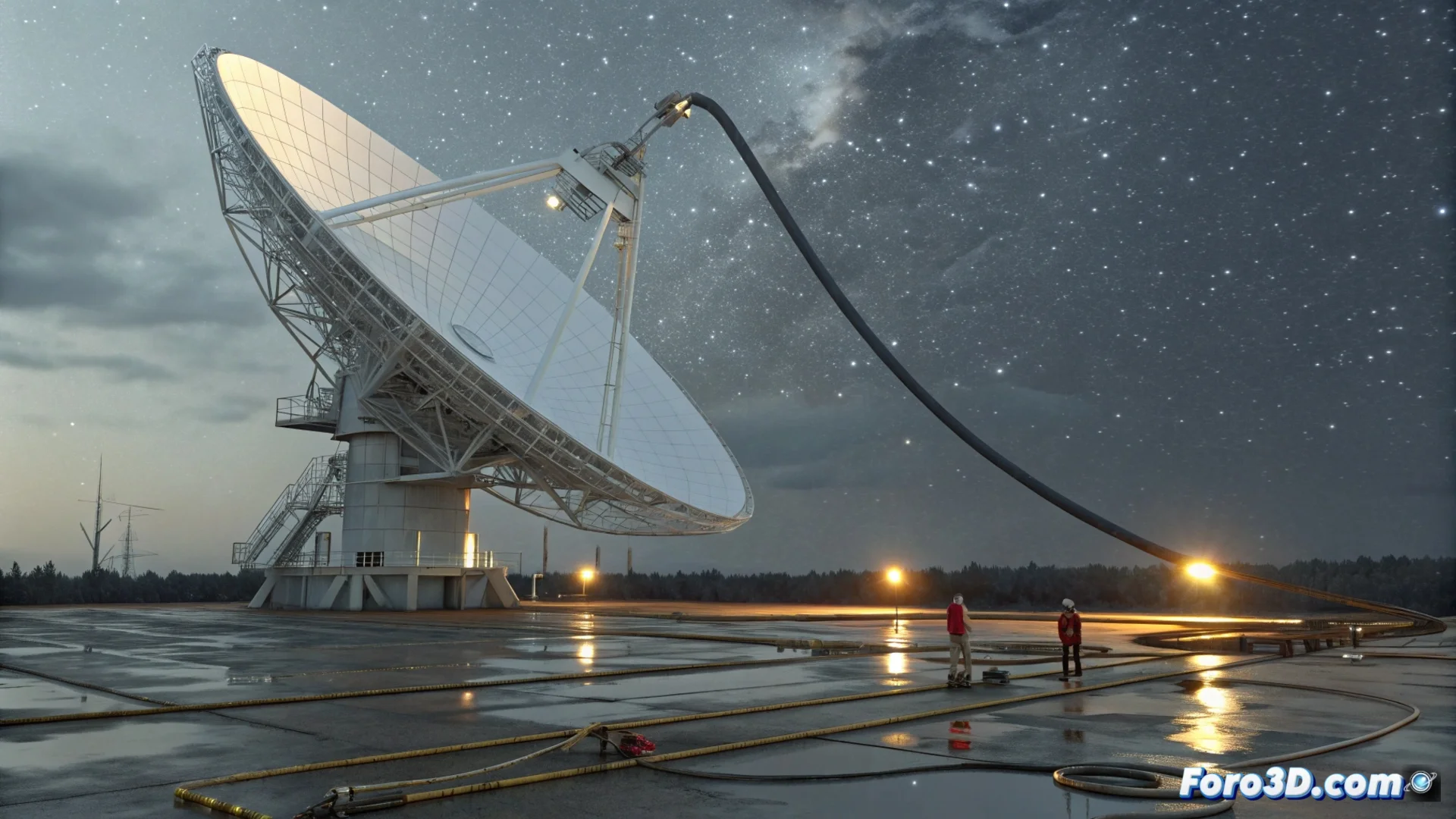
NASA's DSS-14 Antenna Suffers Serious Failure and Remains Inoperative
The U.S. space agency still cannot identify what caused the DSS-14 antenna, a crucial element for communicating with spacecraft in deep space, to suddenly rotate and self-damage. This event, which was kept undisclosed for several months, occurred on September 16, 2025. While rotating with anomalous power, the structure tore all the electrical conduits and water pipes that supported it, causing the system to flood completely. 🛰️
The Search for the Root Cause Progresses Without Definitive Findings
Engineering experts have been working since the incident to understand the origin of the antenna's uncontrolled movement, although progress is complicated and slow. A failure of this nature, where the rotation system operates with such force that it ends up ruining its own support infrastructure, had never been recorded before in the Deep Space Network. The main objective at this time is to examine telemetry data and mechanical parts to prevent a similar event from recurring.
Immediate Consequences of the Failure:- The communications equipment was completely flooded, requiring components to be dried.
- Multiple broken cables and pipes need to be located and repaired.
- The antenna, one of the most powerful, remains out of service.
This type of failure, where the mechanism acts with self-destructive violence, has no precedents in the network.
The Global Deep Space Contact Network Suffers
The DSS-14 antenna, located at the Goldstone complex in California, is the only one in U.S. territory capable of operating in certain frequency and power ranges. Being without it forces NASA to rely more on partner facilities in other countries, such as those managed by the European Space Agency (ESA) in Spain and Australia, to avoid losing contact with distant probes. This situation reduces operational flexibility and backup resources for ongoing scientific projects, although no critical links have been lost so far. 🌐
Impact on Active Missions:- Reduction in backup capacity and redundancy in communications.
- Increased dependence on associated international stations.
- Concern about maintaining signals with probes in distant regions of the solar system.
An Uncertain Future for Critical Communications
While technical teams continue with drying work and damage assessments, numerous space missions watch anxiously to ensure their transmissions do not dissipate into the cosmic vastness. The inability to solve this technical enigma poses a significant challenge for the infrastructure that supports deep space exploration, underscoring the vulnerability of these complex systems. The scientific community hopes the investigation will soon yield clear answers. 🔍