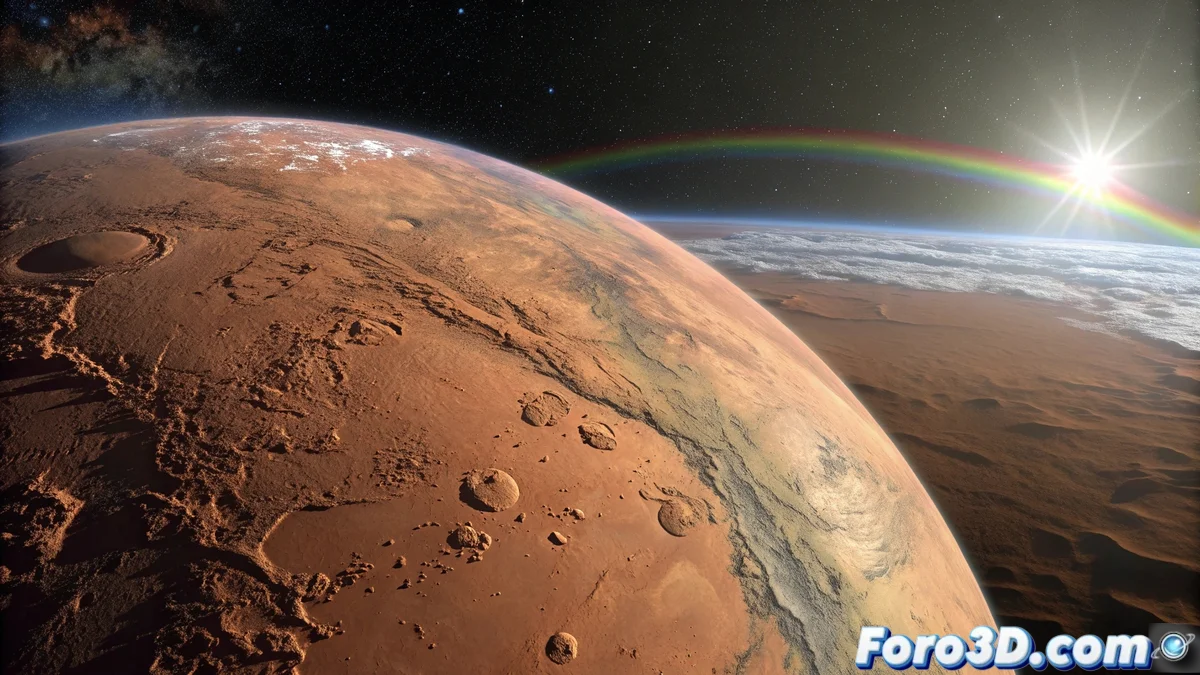
Mars Revealed as Never Seen Before
The NASA has shared an image of the planet Mars with unprecedented resolution that offers new evidence about its potential habitability in the distant past. Additionally, in an equally fascinating discovery, a solar rainbow has been captured for the first time in space, an optical phenomenon that illuminates the Martian atmosphere and provides valuable information about planetary conditions. These combined discoveries represent a significant advance in our understanding of the red planet. 🪐
Geological Details Speaking of a Watery Past
The high-resolution image allows observation of geological formations with exceptional clarity, including what appear to be beds of ancient rivers and erosion patterns consistent with liquid water flows. These data substantially reinforce the hypothesis that Mars contained large amounts of water on its surface for prolonged periods, creating potentially suitable conditions for the development of microbial life.
The Mysterious Space Solar Rainbow
This unique optical phenomenon occurred when sunlight scattered through microscopic particles present in the thin Martian atmosphere and the surrounding space dust cloud. Unlike terrestrial rainbows that depend on water droplets, this space phenomenon offers crucial information about the chemical composition and physical properties of the Martian atmosphere, acting as a natural spectrometer.
- Past Habitability: Evidence of stable liquid water.
- Revealing Geology: Formations compatible with hydrological activity.
- Optical Phenomena: New tools for atmospheric analysis.
- Future Missions: Crucial data for exploratory planning.
Every new high-resolution image of Mars is like an additional page in the book of the solar system's planetary history.
Dual Scientific Importance
These observations contribute simultaneously to two fundamental fields of astronomy: the study of planetary evolution and the search for habitable environments beyond Earth. The combination of detailed geological images with atmospheric optical phenomena creates an unprecedented multidimensional dataset for astrobiological research.
Revolutionary Imaging Technology
The technical achievement behind this image represents a significant advance in planetary photography. The resolution achieved allows distinguishing geological features as small as a few meters in size from Martian orbit, far surpassing the capabilities of previous instruments. This precision is crucial for identifying potential landing zones for future missions. 📡
Implications for Astrobiology
The detection of patterns consistent with past hydrological activity will guide the selection of sites for the direct search for signs of ancient life. The identified riverbeds represent priority targets for future sample collection missions, as on Earth these environments often preserve fossil evidence of microscopic organisms.
Optical Phenomena as Scientific Tools
The observed solar rainbow establishes a precedent for using atmospheric phenomena as remote diagnostic tools. By analyzing the properties of this light scattering, scientists can deduce information about the size, composition, and concentration of particles in the Martian atmosphere without the need for direct contact instruments.
It seems Mars decided to wear its best rainbow for the photo, proving that even the driest planets have their moments of astronomical glamour. Who would have thought the red planet had so much color hidden away. 🌈