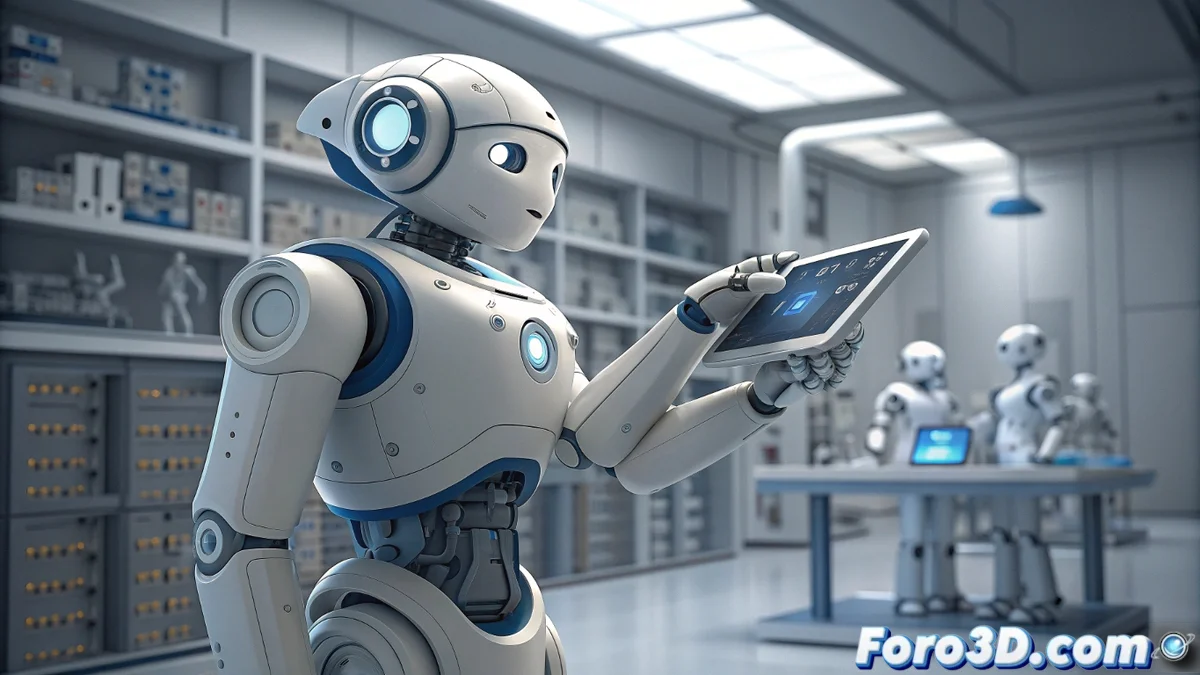
Nao: the humanoid robot revolutionizing education and research
In the landscape of modern robotics, a 58-centimeter figure has achieved a monumental feat: becoming a fundamental pillar for academics and scientists. Developed by SoftBank Robotics, the robot Nao has transcended its hardware status to become the de facto standard in countless universities and research centers worldwide. Its success lies in offering a comprehensive, accessible, and extraordinarily versatile platform that materializes abstract concepts of artificial intelligence and robotics. 🤖
A complete laboratory on two legs
The genius of Nao's design lies in its open and modular architecture. Despite its compact stature, it houses a dense network of sensors (cameras, microphones, gyroscopes, tactile sensors), high-precision actuators, and advanced connectivity capabilities. This combination transforms it into an autonomous bipedal laboratory, where students and researchers can experiment tangibly with real-life challenges. From programming stable bipedal locomotion to developing environmental perception systems or algorithms for natural human-robot interaction, Nao provides the perfect physical testbed.
Key components of its versatility:- Open development platform: Allows low-level control access, facilitating advanced experiments in kinematics and dynamics.
- Integrated sensor suite: Includes stereoscopic vision, sonar, force and inertial sensors, essential for autonomous navigation.
- Active global community: An ecosystem that shares libraries, behaviors, and solutions, accelerating the development and innovation process.
Nao is not just a robot; it is a catalyst that democratizes access to high-level robotics research, making the complex affordable and practical.
From classrooms to the playing field: the RoboCup challenge
Nao's impact is magnified in the international competitive scenario. Its starring role in RoboCup, especially in the humanoid soccer league, has made it a standardized testbed for cutting-edge algorithms. Programming a team of Naos to play an autonomous match involves solving extremely complex problems: real-time computer vision to locate the ball, multi-robot cooperation for team strategies, decision-making under pressure, and dynamic navigation in an unpredictable environment. This competition has driven spectacular and comparable advances, as all teams start from the same hardware platform. ⚽
Research areas driven by the competition:- Planning and coordination algorithms: How multiple robots decide and execute tactics collaboratively without human intervention.
- Stability and dynamic control: Maintaining balance while running, turning, or kicking a ball, replicating human locomotion challenges.
- Sensor data fusion: Integrating information from multiple sensors to create a coherent and accurate understanding of the playing environment.
The software ecosystem: accessibility from beginner to PhD
Nao's true power and longevity are supported by its diversified and well-documented software ecosystem. For newcomers, Choregraphe offers a visual programming environment based on flow diagrams, ideal for creating complex behaviors without writing a single line of code. For experts and researchers, Python and C++ APIs allow granular control over every motor and sensor, ideal for implementing research papers or custom algorithms. This formative scalability ensures that the same platform serves for a high school class and a doctoral project in reinforcement learning. Its applications extend beyond academia, exploring areas such as motor rehabilitation, person assistance, and interactive entertainment.
Finally, there is a human lesson in its design. Its innocent charm and sometimes clumsy movements when an algorithm fails are a powerful reminder. They show us that artificial intelligence and advanced robotics are, at their core, a work in progress. Each stumble of Nao reflects the complex path of learning, resembling more the hesitant first steps of a child than the infallible coldness of a supercomputer. In this journey, Nao is not just a tool; it is a learning companion for an entire generation of engineers and scientists. 🧠