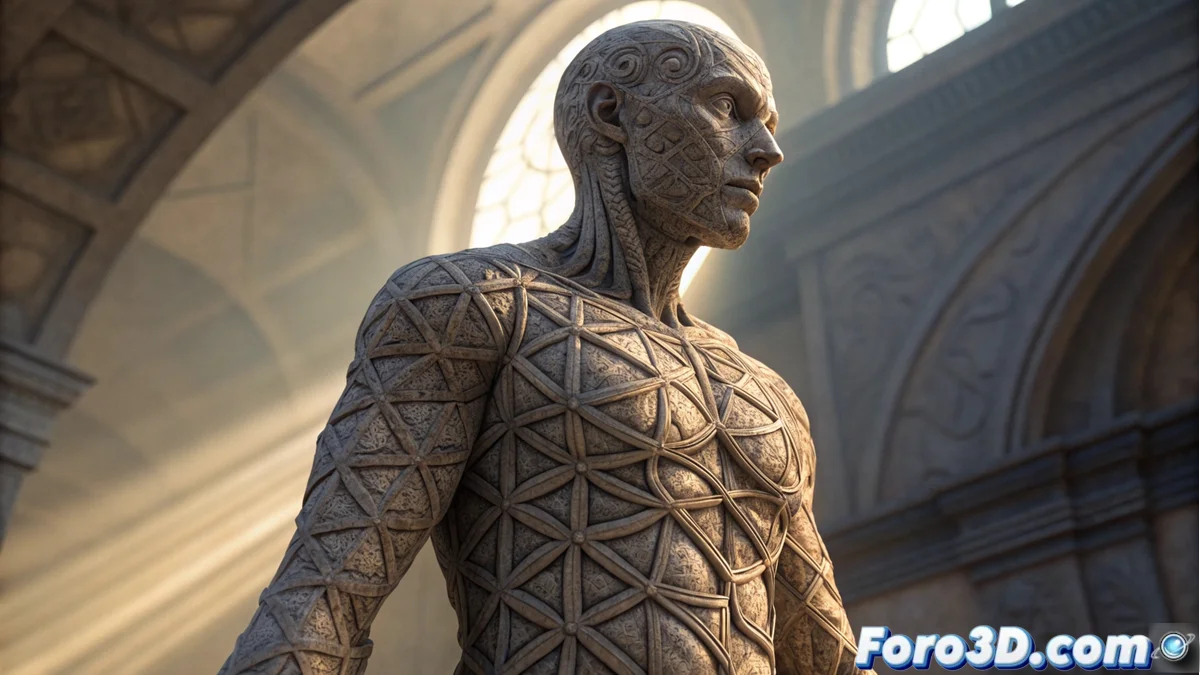
Nanite in Unreal Engine 5: Revolutionary Virtualized Geometry
The Nanite technology represents a monumental advancement in real-time rendering, allowing developers to import and visualize assets with extraordinary polygonal densities without compromising the smoothness of the experience. This intelligent system automatically manages geometric complexity through a virtualized representation that completely transforms the traditional workflow 🚀.
Architecture and Internal Functioning
Nanite operates through a virtualized data structure that stores geometry at multiple resolutions, selectively accessing only the components needed for each frame. It implements a completely renewed rendering pipeline that overcomes conventional graphics hardware limitations, processing geometry through triangle clusters that are rasterized with maximum computational efficiency.
Main features of the system:- Automatic level of detail management without manual developer intervention
- Intelligent geometric data streaming that loads and unloads LODs according to visualization needs
- Ability to handle cinematic-scale scenes with consistent and stable performance
Nanite eliminates traditional polygon count barriers, allowing artists to focus on creative vision rather than technical limitations
Impact on Project Development
This revolutionary technology frees developers from the polygonal restrictions that have historically defined computer graphics projects. Artists can directly import real-world scans or extremely dense models from applications like ZBrush and Maya, without requiring tedious manual optimization processes.
Applications and Practical Considerations:- Excellent performance with hard surfaces and complex static geometry
- Current limitations with transparent materials and geometry requiring real-time deformation
- Native integration with Lumen for dynamic global illumination and cinematic quality
Evolution of the Creative Workflow
The paradigm shift introduced by Nanite redefines development priorities, where artistic creation takes precedence over exhaustive technical optimization. Although some experienced professionals may miss the era when counting polygons was a specialized skill, the new generation of tools enables achieving unprecedented levels of realism with more intuitive and efficient workflows ✨.