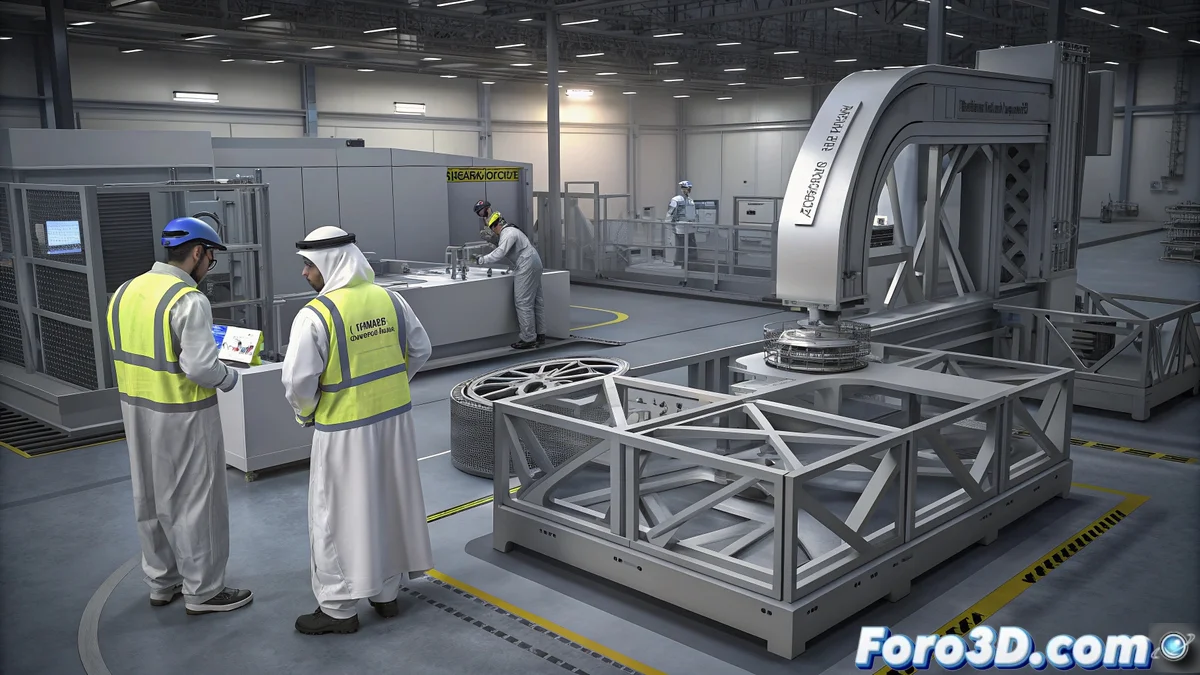
A Strategic Alliance for Additive Manufacturing in Saudi Arabia
The National Additive Manufacturing and Innovation Company (NAMI), a joint venture between Dussur and 3D Systems, has announced a partnership with Lockheed Martin to qualify and manufacture critical aerospace and military components using 3D printing in Saudi Arabia 🛩️. This project will begin with aluminum parts that will undergo rigorous qualification testing to meet international industry standards. The collaboration is framed within Saudi Arabia's vision to strengthen its local industrial capacity, particularly in the defense and aerospace sectors, reducing reliance on imports and fostering technological sovereignty. Because in today's geopolitics, even parts manufacturing is strategic 💡.
Industrial Localization and Knowledge Transfer
This initiative not only seeks to produce locally but also to transfer technological knowledge and enhance supply chain resilience. NAMI will produce 3D-printed aluminum parts that will be qualified under Lockheed Martin's stringent standards, ensuring they meet the performance and safety requirements necessary for critical applications. This qualification process is crucial to gaining industry trust and demonstrating that additive manufacturing can be as reliable as traditional methods, even in high-demand environments. One more step toward Saudi industrial autonomy 🏭.
This project is framed within Saudi Arabia's vision to strengthen its industrial capacity, particularly in defense and aerospace.
Impact on the Supply Chain and Strategic Objectives
The collaboration between NAMI and Lockheed Martin has profound implications for the global supply chain. By producing critical components locally, Saudi Arabia not only reduces its dependence on imports but also positions itself as a regional hub for advanced manufacturing. These parts will generate value for both the defense market and the international aerospace sector, contributing to the objectives of Saudi Vision 2030 for economic diversification and technological development. Eng. Mohammed Swaidan, CEO of NAMI, highlights the commitment to excellence in additive manufacturing as a pillar for the Kingdom's industrial future 🌍.
Technical and Qualification Aspects
The project initially focuses on aluminum components, a material chosen for its lightness and strength in aerospace applications. The process involves:
- Alloy Selection: Aluminum optimized for 3D printing and mechanical performance.
- Rigorous Qualification: Fatigue testing, thermal resistance, and certification under MIL and AS9100 standards.
- Quality Control: Non-destructive inspection and dimensional verification with 3D scanners.
- Digital Integration: Digital twins and full traceability of each manufactured part.
Vision for the Future and Industrial Sustainability
NAMI aims to become a global benchmark in additive manufacturing, not only for aluminum but for a wide range of materials and applications. The partnership with Lockheed Martin sets a precedent for future collaborations with other industrial and defense giants. In the long term, this could lead Saudi Arabia to export high-tech components, rather than just raw materials, radically transforming its economic profile. 3D printing thus becomes a tool for national sovereignty and innovation 🚀.
The Irony of Strategic Printing
While many choose home 3D printers to make figurines, Saudi Arabia prints military components that could define regional security... all with the same technology, but with a bit more responsibility 😅.