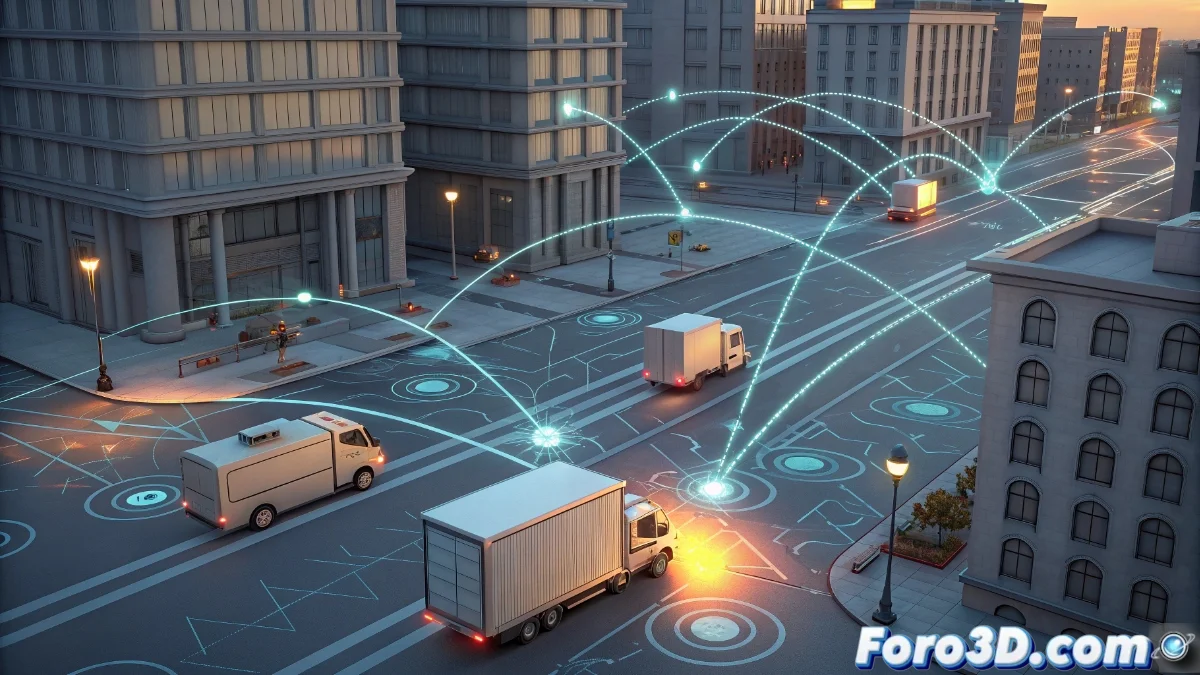
Multi-Agent Transformer for Real-Time Urban Logistics Optimization
Contemporary urban logistics faces the constant challenge of managing on-demand deliveries in highly unpredictable environments, where requests appear stochastically and require immediate responses. The cooperative dynamic pickup and delivery problem with multiple vehicles represents one of the most complex challenges in spatiotemporal optimization, creating an ecosystem where decisions must integrate numerous constantly evolving variables 🚚.
Innovative Architecture with Transformer and Pointer Network
To overcome the limitations of traditional methods, MAPT (Multi-Agent Pointer Transformer) has been developed, a centralized decision-making framework that operates through autoregressive action sequences. The architecture employs a specialized Transformer encoder that processes complete representations of all system entities: vehicles, packages, and geographic locations. Subsequently, a Transformer decoder combined with Pointer Network generates joint action sequences, enabling highly efficient vehicle coordination.
Key components of the MAPT system:- Relation-aware attention module that captures complex interactions between logistic system elements
- Prior information mechanism that guides exploration toward optimal solutions
- Intelligent reduction of the joint action space that traditionally complicated reinforcement learning algorithms
MAPT's ability to model coordinated actions between vehicles represents a significant advance in urban fleet optimization, eliminating route conflicts and improving overall operational efficiency.
Experimental Validation and Competitive Advantages
Exhaustive tests conducted on eight different datasets demonstrate that MAPT consistently outperforms existing methods in both operational performance and computational efficiency. The approach achieves a drastic reduction in decision times, making it viable for implementation in real-time logistics scenarios where every second directly impacts service quality.
Main demonstrated advantages:- Decision processing in significantly shorter times than classical operations research methods
- Effective modeling of coordinated actions among multiple delivery vehicles
- Adaptability to urban logistics environments with high variability and unpredictability
Impact on the Urban Logistics of the Future
With the implementation of systems like MAPT, delivery vehicles could finally avoid chance encounters at the same delivery points, eliminating the contradictory route assignments that characterized traditional systems. This technology transforms urban logistics operations from a poorly rehearsed choreography into a perfectly orchestrated symphony, where every vehicular movement responds to intelligent and coordinated real-time planning 🎯.