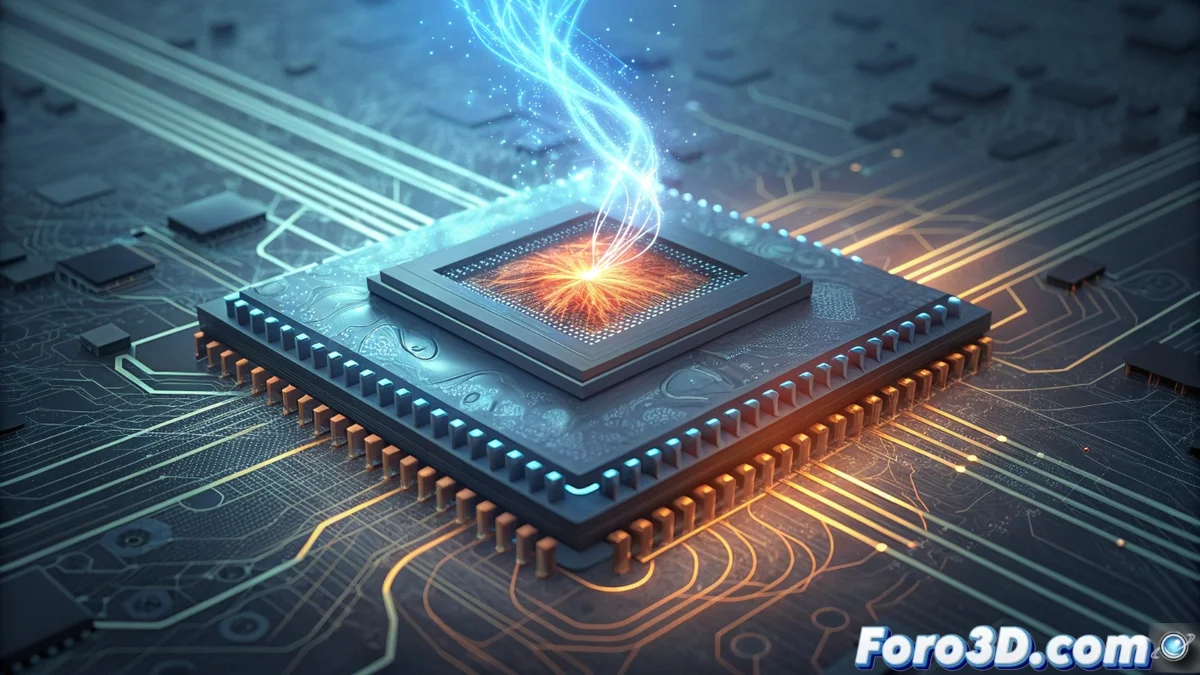
MRAM or Magnetoresistive Memory, a Revolution in Computing Architecture
At the core of computational evolution, memory architecture is undergoing a paradigm shift. MRAM (Magnetoresistive Random-Access Memory) emerges as a disruptive technology that challenges conventional data storage principles. Unlike memories based on transistors and electrical charges, this solution is based on magnetic orientation at the nanoscale, promising a future where memory volatility is no longer an issue. 🧲
A Different Physical Principle for Storing Information
The operation of magnetoresistive memory relies on a physical phenomenon called magnetoresistance. Essentially, the electrical resistance of a nanocell changes according to the magnetic orientation of its ferromagnetic layers. This resistance difference is interpreted as a bit of information, representing a 0 or a 1. This mechanism is radically different from that of DRAM, which requires constant charge refresh, or NAND flash, which traps electrons in a floating gate. The most immediate and powerful consequence is non-volatility: data remains intact even without electrical power.
Key advantages over established technologies:- Data persistence: Eliminates the need for refresh and retains information without power, like an SSD.
- Exceptional speed: Offers access times in the nanosecond range, rivaling DRAM.
- Extreme durability: Supports a practically unlimited number of write cycles, far surpassing flash cell fatigue.
MRAM aspires to be the universal memory, fusing storage and working memory layers into one.
The Path to Mass Adoption and Its Challenges
Despite its revolutionary potential, MRAM technology is not without obstacles that slow its integration into the general consumer market. For years, its storage density (bits per area) has been lower than that of its competitors, a critical factor for miniaturization. However, advanced variants like STT-MRAM (Spin-Transfer Torque) are significantly improving this aspect. The other major hurdle is the manufacturing cost per bit, which currently confines it to specialized applications where its benefits justify the investment. 💡
Current and future application areas:- Industrial electronics and automotive: Where reliability, persistence, and resistance to adverse environments are paramount.
- High-performance cache: Integrated into some enterprise SSDs to accelerate operations and increase durability.
- Edge computing and IoT devices: For systems requiring instant boot and low power consumption.
A Promising Horizon for Computing
Research and development continue at an accelerated pace, focusing on improving scalability and reducing production costs. The ultimate goal is clear: converge toward a unified memory architecture that drastically simplifies system designs, eliminating the complex hierarchy between fast volatile memory and slower non-volatile storage. In the meantime, we will continue to rely on the combination of volatile DRAM and flash with limited lifespans. MRAM represents not just an incremental improvement, but a conceptual leap that could redefine how we interact with data, making the dreaded "Did I save the changes?" a thing of the past. 🚀