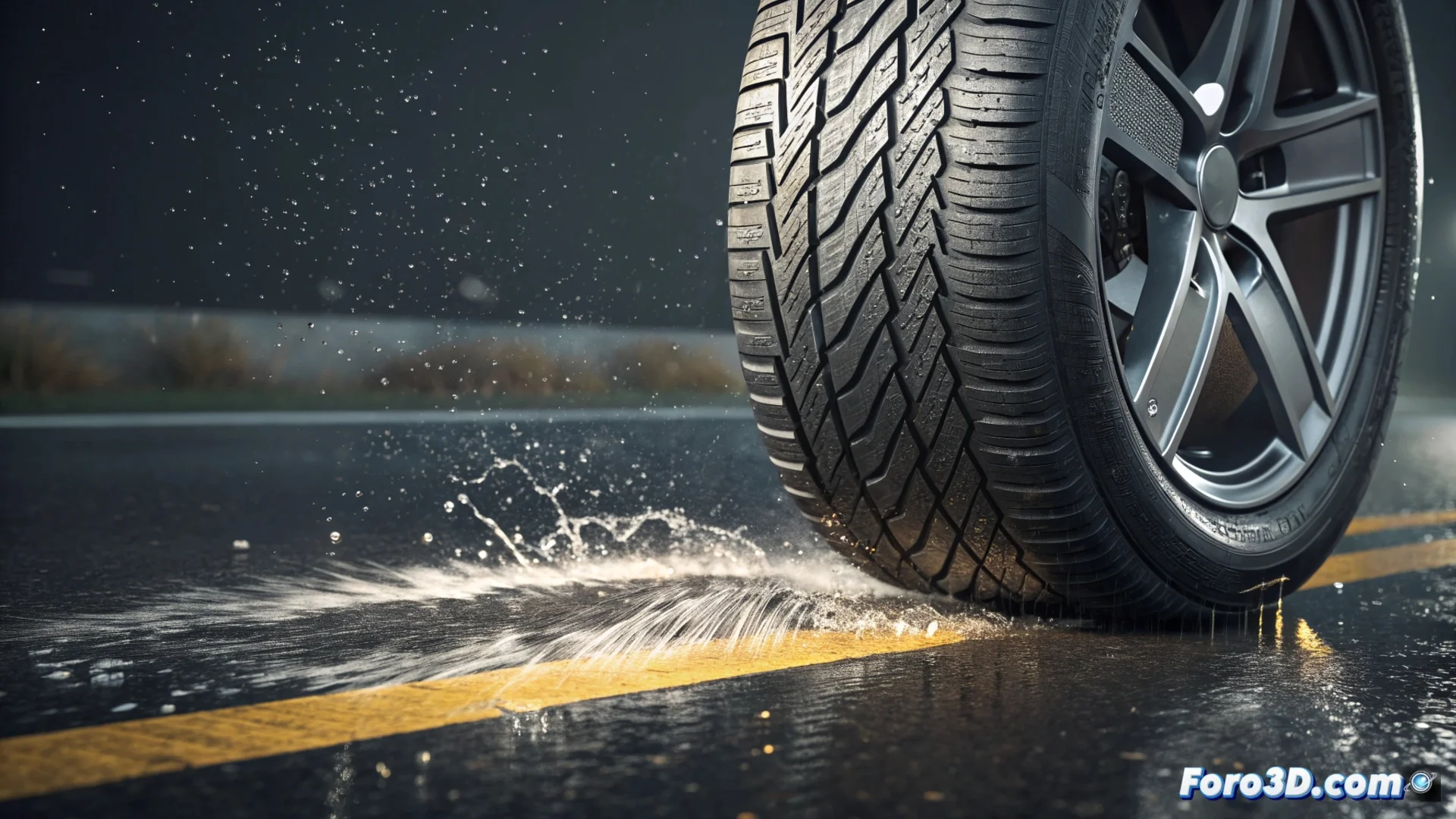
Mounting Tires Backwards Affects Water Drainage
Placing a directional tire in the wrong rotation direction is not a simple mounting error. Its tread design is specifically calculated to work in one direction only, and altering it has direct consequences on safety. The most critical effect is perceived when driving on wet asphalt. 🚗💨
The Mechanism of Compromised Drainage
The main channels and sipes in the rubber are not symmetrical. Their shape and angle are designed to open and expel water effectively when the wheel rotates forward. If the tire rotates backwards, these channels cannot displace the liquid. Instead of throwing it to the sides, they retain it under the contact surface. This causes a layer of water to form between the rubber and the road, eliminating grip and potentially causing the vehicle to skid uncontrollably, a phenomenon known as hydroplaning.
Immediate consequences of inverted mounting:- Loss of water evacuation: The ability to clear water from the footprint is drastically reduced.
- Increased risk of hydroplaning: The water film under the tire makes it float, losing all contact with the ground.
- Unpredictable behavior on wet surfaces: The vehicle's stability and directional response are seriously affected.
"You only realize the mistake when the car decides to start skidding like a surfboard. At that moment, you think that maybe the arrows on the tires weren't just a decorative suggestion."
How to Verify the Correct Direction
Identifying the proper orientation is simple if you know where to look. The key information is printed on the tire sidewall. Don't rely solely on the tread pattern's appearance; look for the manufacturer's markings.
Signs to check on the sidewall:- Arrow and "ROTATION" word: The clearest indicator. An arrow next to this word points to the correct forward rotation direction.
- Directional "V" pattern: Many winter or high-performance tires show a pattern resembling an arrow or an open "V" that should point toward the front of the vehicle.
- Channel direction: If there are no markings, observe the major channels. They should converge toward the outside of the car, designed to expel water. If they seem to collect it toward the center, the wheel is mounted backwards.
Impact on Wear and Overall Performance
Driving with inverted tires is not only dangerous in the rain. It also causes irregular and anomalous wear that prematurely shortens their lifespan. The tire's structure is optimized to work in one direction, and forcing it in the opposite accelerates tread deterioration. Additionally, an increase in rolling noise can be perceived, and under certain conditions, a slight decrease in cornering stability on dry ground. The difference in vehicle behavior is more noticeable at high speeds and under heavy rain, where every fraction of grip is decisive. 🔧