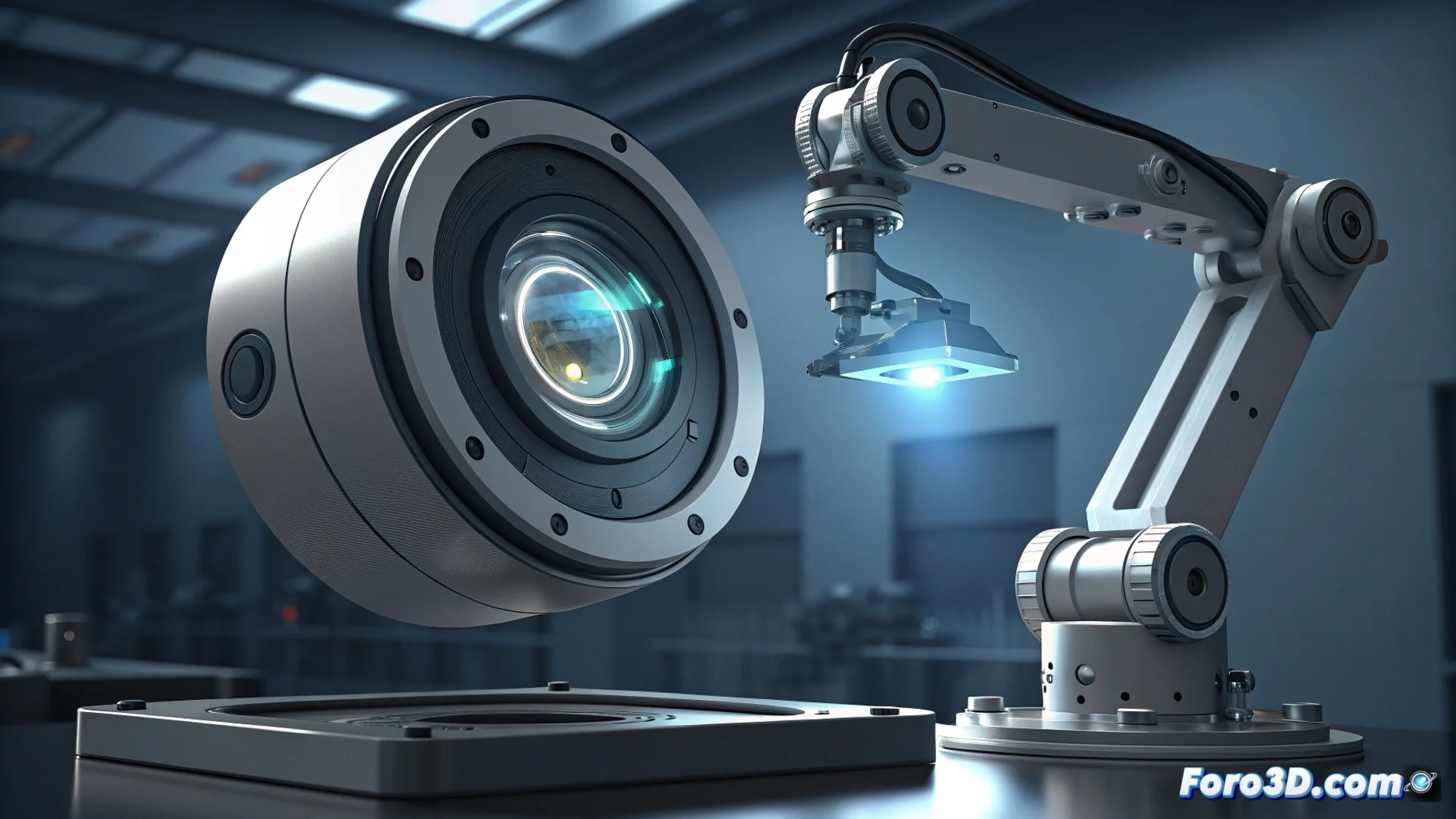
MorphEyes: a robotic vision system inspired by the human eye
A team from the University of Zurich has presented a breakthrough that brings machine perception closer to biology. It is MorphEyes, a vision system for robots that copies the functioning of the human lens. Its core consists of liquid lenses capable of adjusting their focal length in milliseconds, a process known in robotics as active accommodation. This approach allows a robot to process visual information with much higher speed and energy savings compared to conventional cameras. 👁️⚡
The secret lies in the flowing lenses
While a traditional camera needs motors to move solid glass lenses, MorphEyes operates in a radically different way. It applies an electric current to modify the curvature of its liquid lenses. This shape change is almost instantaneous and consumes minimal power. By eliminating the mechanical movement of heavy parts, the system responds agilely to dynamic scenes and reduces inertia. For a robot that must move in unpredictable environments, this quality is essential for interacting with moving objects or navigating complex spaces without collisions.
Key advantages of liquid lens technology:- Extreme speed: They change shape and focus in milliseconds, surpassing motorized mechanisms.
- Low consumption: The electro-active action uses much less energy than moving motors and gears.
- Less inertia: Without heavy moving parts, the system can react and adjust faster.
This innovation brings machine perception closer to the speed and adaptability of biological vision, solving a common bottleneck in computer vision.
Impact on robotics and automation
The arrival of MorphEyes has direct implications in several cutting-edge fields. In service robotics, autonomous vehicles, and industrial automation, the ability to calculate depth maps and focus instantly is transformative. A robot equipped with this system can process what it sees more efficiently, making real-time decisions. This represents a significant step toward more integrated perception systems with minimal latency, essential for machines to operate safely and autonomously in our world.
Potential applications of adaptive vision:- Automated logistics: Robots that identify and manipulate packages of different sizes and at various distances without pause.
- Assisted surgery: Surgical systems that can focus and measure depths in organic tissues instantly.
- Exploration in hostile environments: Drones or rovers that navigate irregular terrain with fast and precise depth perception.
A future with robots that see like us
MorphEyes is not just a faster camera; it is a paradigm shift in how machines perceive. By being inspired by the active accommodation of the human eye, researchers have created a tool that overcomes persistent technical limitations. The combination of speed, energy efficiency, and adaptability positions this technology as a pillar for the next generation of intelligent robots. Perhaps, in the near future, robots will need their own "progressive glasses" not for reading, but to move through our world at full speed and with total precision. 🤖✨