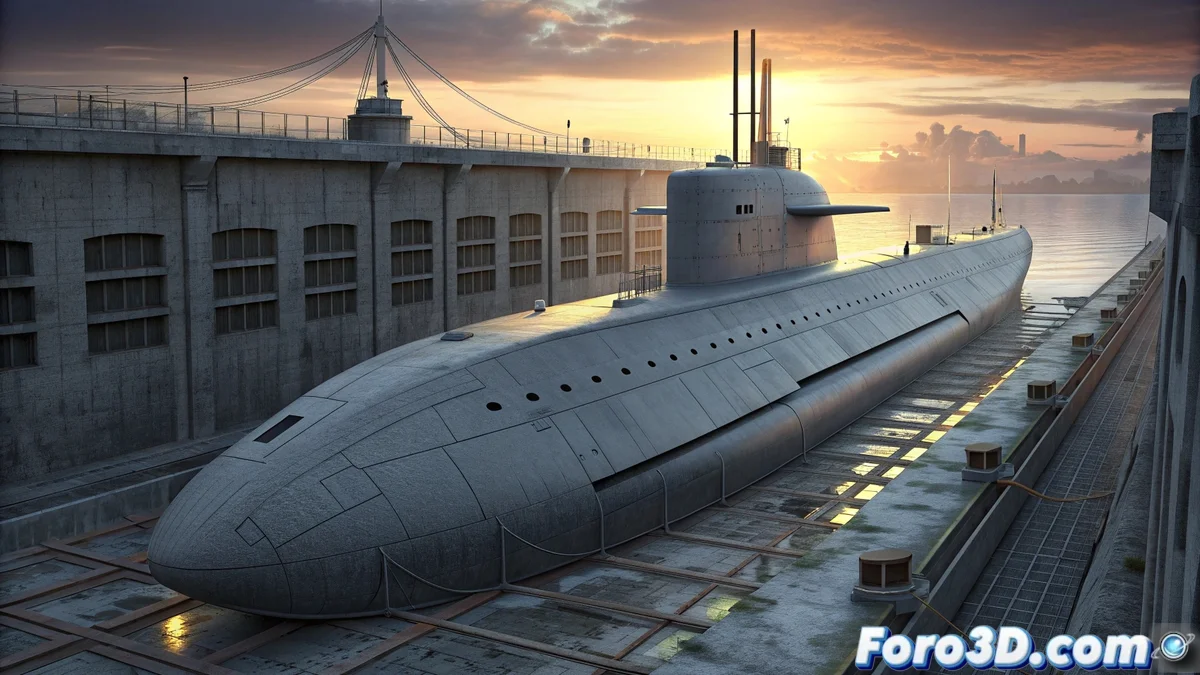
Modeling the Type 212A Submarine for 3D: Guide to Key Features
The Type 212A attack submarine, used by the German and Italian navies, represents an interesting challenge for 3D modeling due to its advanced and stealthy design. Its propulsion system allows it to operate submerged for long periods, a crucial detail for representing its operability. 🚤
Geometry and Main Dimensions
To capture its essence in a 3D model, you must start with its exact measurements: 56 meters in length, 7 in beam, and 6 in draft. Its outer hull features clean lines and a sail (or conning tower) with a highly integrated hydrodynamic profile that reduces water resistance. Forgetting this smoothed integration is a common mistake.
Defining Elements of the Silhouette:- X-Stern Rudder: This configuration, different from the traditional cross, is a distinctive feature that provides exceptional maneuverability and must be modeled precisely.
- Anechoic Coating: The hull is covered with a special material designed to absorb and disperse sonar waves, drastically reducing the submarine's acoustic signature.
- Clean Lines: The absence of protrusions is key; the entire geometry flows to optimize hydrodynamic stealth.
A generic submarine model often overlooks the X-rudder, a detail that immediately reveals the lack of specific reference to the Type 212A.
Weapons Systems and Capabilities
Its offensive power is centered on six 533 mm torpedo tubes. This arrangement is not only for launching heavy torpedoes like the DM2A4, but is also prepared to deploy missiles from depth, such as the IDAS system.
Weapons Features:- Munition Versatility: It can engage submarine targets as well as aerial threats, expanding its tactical role.
- Hull Integration: The tubes are integrated in a way that maintains the submarine's smooth profile, without compromising its hydrodynamics.
- Missile Readiness: The ability to launch the IDAS missile underscores its modern and multifunctional design.
Final Tips for 3D Modeling
When modeling this submarine, prioritize capturing its smooth profile and the integration of all elements. Pay special attention to the X-rudder and the smooth transition between the hull and the sail. Representing the anechoic coating may involve using specific textures or shaders to simulate its absorbent property. Mastering these details will transform a basic model into a faithful and technical representation of the Type 212A. ⚓