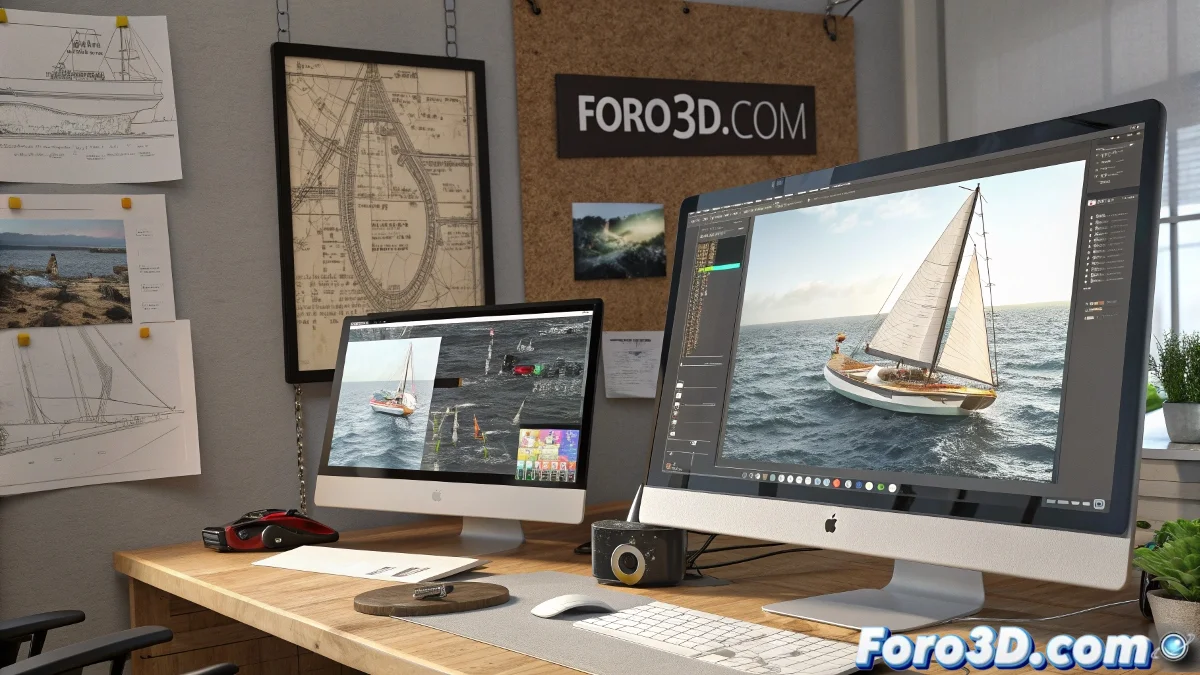
When Maritime Tradition Becomes Polygons
The classic sailboats of the Puig Vela Clásica are not just floating beauty, they are lessons in design for any 3D artist. Capturing their essence digitally requires as much art as the shipwrights put into the originals... but with more CTRL+Z. ⛵💻
The Art of Digitizing Nautical Heritage
Modeling these vessels goes beyond the obvious:
- Textures with history: Wood aged by sun and salt
- Precise naval geometry: Hull curves that challenge modelers
- Craftsmanship details: Ropes, pulleys, and fittings that tell stories
- Realistic materials: From canvas sails to shiny varnishes
"I recreated a 1962 sailboat and now I have new respect for those who built them without undo" - 3D modeler with a topological headache.
The Four Major Technical Challenges
1. Water simulation: Houdini for believable waves, not moving soup
2. Sail dynamics: Wind force without collapsing the rig
3. Ship-sea interaction: That magical line where they meet
4. Marine lighting: Reflections that change every second
Workflow for Nautical Renders
- Precision modeling in Rhino or Blender
- Texturing with Substance Painter for that authentic wear
- Fluid simulation in Houdini
- Final render in Unreal Engine for real-time realism
Why This Matters to the 3D Community
These projects are the perfect testing ground for:
- Mastery of complex physical simulations
- Practice with organic materials
- Development of historical modeling skills
- Creation of immersive environments
So the next time you see a classic sailboat, look at it with 3D artist eyes: every detail is a technical challenge waiting to be conquered. And if your render doesn't convince, you can always say it's an "artistic interpretation"... or that there was a digital storm. 🌊🎨
Because in the end, modeling historical ships is like sailing: it requires patience, skill, and, when everything fails, knowing how to laugh while restarting the render for the tenth time. ⚓😄