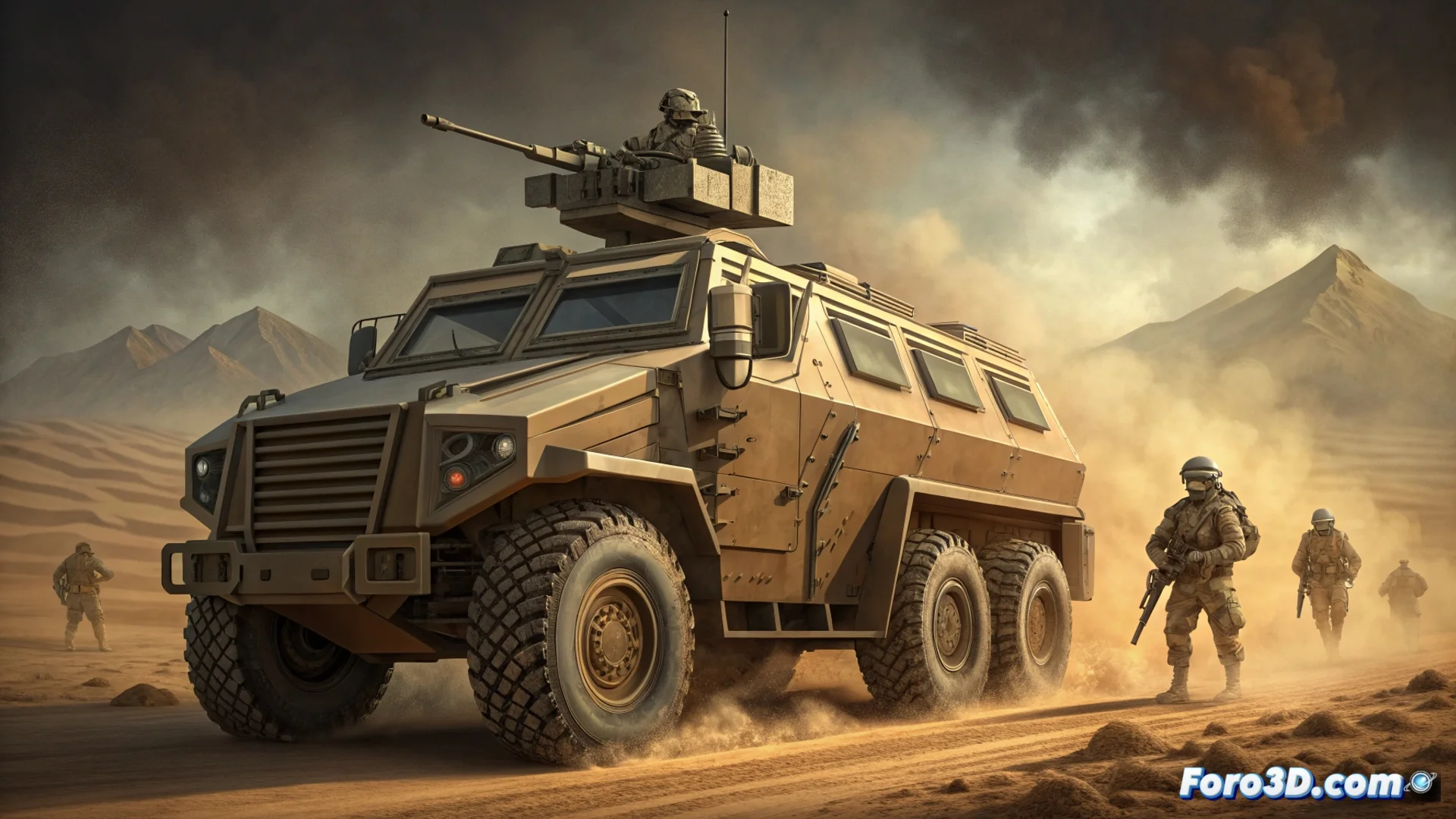
Modeling the Kamaz Typhoon: a Russian Armored MRAP Vehicle
The Kamaz Typhoon represents a pillar of modern Russian protected mobility. It belongs to the MRAP (Mine-Resistant Ambush Protected) category, specifically designed to survive asymmetric threats. Its visual presence communicates robustness and technology, an interesting challenge for any 3D artist. 🛡️
Visual Anatomy for 3D Modeling
Capturing the essence of this vehicle involves understanding its functional geometry. It is not just a truck; it is a mobile fortress. The aesthetics are based on large, angular planes that form the V-shaped hull armor, crucial for deflecting explosion energy. The cabin features an almost flat front with small, thick windows, while the rear compartment is notably voluminous to accommodate the crew.
Key elements to detail:- Chassis and configuration: There are versions with 6x6 (approx. 9 meters) and 8x8 traction. The chassis is high and the wheels are large in diameter, emphasizing its all-terrain capability.
- Surfaces and armor: Additional armor plates create breaks and pronounced angles in the body. The lines are straight and decisive, without soft curves.
- Troop compartment: Inside, individual seats with special suspension are modeled to cushion mine impacts, a detail that adds realism.
For a Typhoon crew, the ideal journey is boring and incident-free, an irony given its stormy name.
Operating Systems and Armament
The Typhoon's tactical role is to transport soldiers safely. However, it has systems to defend itself. On the roof, a remote weapon station is installed, allowing armament to be operated from inside the armored vehicle.
Modelable armament options:- Medium 7.62 mm machine gun for close defense.
- Heavy 12.7 mm machine gun with greater firepower.
- 30 mm automatic grenade launcher, to provide significant fire support.
Tips for the Workflow
When modeling this MRAP, start with the large primary shapes that define its high and wide profile. Use references from both wheel configurations. Pay attention to the transition between the cabin and the troop module, and how the armor integrates into the base structure. Details like reinforced hinges, steps, and armored hatches add authenticity. Finally, remember that its function dictates its form: every angle and plane exists to protect. 🚛