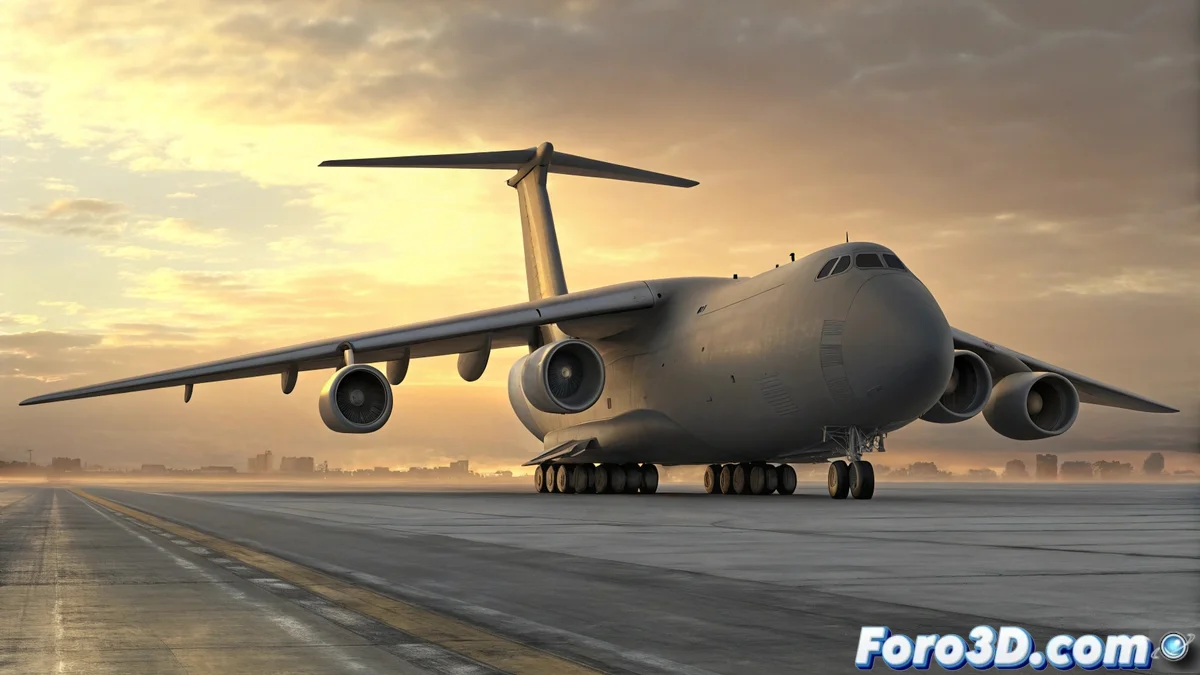
Modeling the C-5M Super Galaxy in 3D: Feature Guide
The C-5M Super Galaxy represents one of the giants of strategic air transport. Operated by the United States Air Force, its primary purpose is to move heavy military equipment across continents. For a 3D artist, capturing its essence involves understanding a machine built around scale and function. ✈️
Dimensions and Physical Presence
This aerial colossus dominates space with measurements that command respect: 75.3 meters long, a wingspan of 67.9 meters, and a height of nearly 20 meters. These proportions place it among the largest military aircraft in existence, a crucial fact for establishing the correct scale in any 3D modeling project.
Distinctive Elements to Replicate:- Massive Cylindrical Fuselage: The main body is bulky and cylindrical, with wings mounted in a high position.
- T-Tail Configuration: Its extremely tall vertical fin, topped by the horizontal stabilizer, is an unmistakable visual identifier.
- Engine Groups: Under each wing, four powerful turbofan engines are aligned, a key element of its silhouette.
Modeling the C-5M is not just about the exterior shape; it's about understanding the function of a global logistics tool.
Mission-Oriented Logistics Design
This aircraft lacks any armament entirely, as its sole objective is transport. Its cargo hold can accommodate everything from main battle tanks and helicopters to numerous vehicles and personnel. Two operational features define its exterior and interior modeling:
Operational Features to Model:- Hinged Nose: The entire nose section lifts upward, allowing vehicles and cargo to be loaded from the front.
- Rear Ramp: The tail section incorporates a ramp that lowers, facilitating simultaneous loading and unloading from both ends and accelerating operations.
- Cavernous Interior: The cargo space is so vast that modeling it presents the challenge of creating an enormous internal volume, which includes the cockpit and an upper deck for the crew.
The Ultimate Challenge for the 3D Modeler
Recreating the C-5M Super Galaxy in 3D goes beyond its external profile. The challenge lies in conveying the overwhelming scale of its fuselage, the functional complexity of its loading systems, and the purely logistical nature of its design. The C-5M version, with modernized engines and avionics, adds contemporary details to an already iconic silhouette, offering an excellent opportunity to practice modeling complex, purpose-driven aircraft. 🛩️