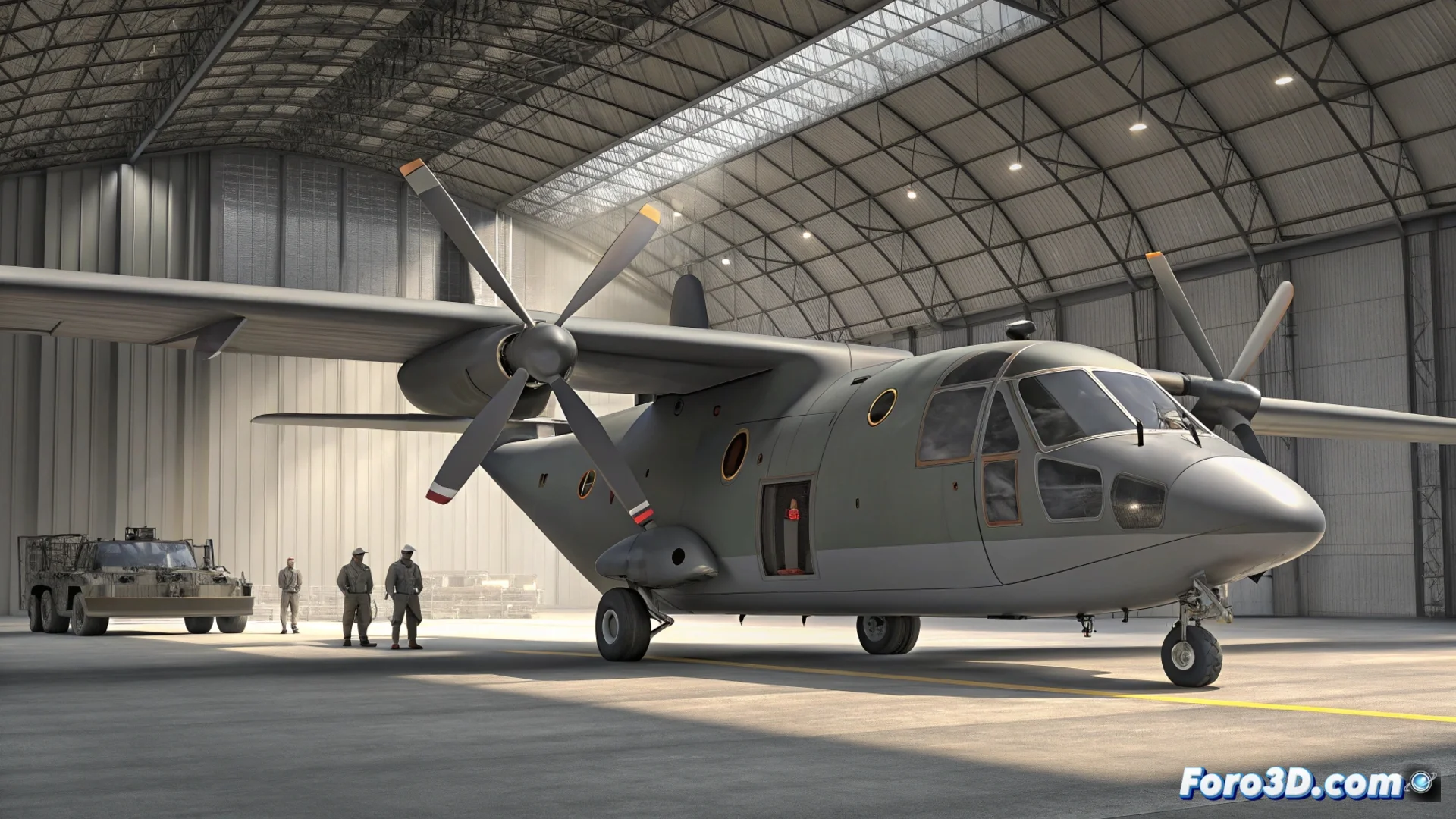
Modeling the AHRLAC: a South African Attack Aircraft with a Unique Design
The AHRLAC (Advanced High Performance Reconnaissance Light Aircraft) stands out in the world of military aviation for its uncommon architecture. Its modern and functional appearance presents an interesting challenge for digital artists seeking to replicate real aircraft. 🛩️
Dimensions and General Architecture
This aircraft has specific measurements: 10.8 meters in length, 12 meters in wingspan, and 4 meters in height. Its most distinctive feature is the pusher configuration, which places the propeller at the rear, between two booms that support the horizontal stabilizers. The cockpit, arranged in tandem, provides the crew with a very wide field of view. The lower section of the fuselage is flat and incorporates a modular ventral bay, designed to house cargo or various systems.
Key points of its structure:- Rear propeller: Located between booms, it defines the rear profile.
- Tandem cockpit: With large glazed surfaces for maximum visibility.
- Angular fuselage: Formed by multiple facets and broken lines.
Capturing the unusual silhouette of the AHRLAC is the first step toward a credible 3D model. Without clear references, one can end up with a design that resembles more a futuristic toy drone.
Armament and Operational Versatility
The aircraft can integrate an automatic cannon of 20 or 30 mm in its belly. Additionally, under the wings, it has several hardpoints to equip armament such as guided missiles (e.g., Mokopa), rocket launchers, and general-purpose bombs. This adaptability allows it to perform armed reconnaissance missions and attacks on ground targets with a relatively low operating cost.
Elements to detail in the 3D model:- Modular ventral bay: A volume integrated into the lower fuselage, with possible panel and hinge details.
- Wing hardpoints: Pylons and rails to simulate armament load.
- Control surfaces and details: Flaps, ailerons, antennas, and other elements that add realism.
Challenges for the 3D Modeler
Recreating the AHRLAC faithfully requires carefully analyzing its proportions and characteristic shapes. The transition between the cockpit and the fuselage, the angles of the tail booms, and the geometry of the ventral bay require meticulous attention. Including these components not only adds complexity but also elevates the realism of the final piece, distinguishing it from a generic interpretation. It is crucial to use blueprints or reference photographs to avoid deviating from the real shapes of this unique aircraft. ✅