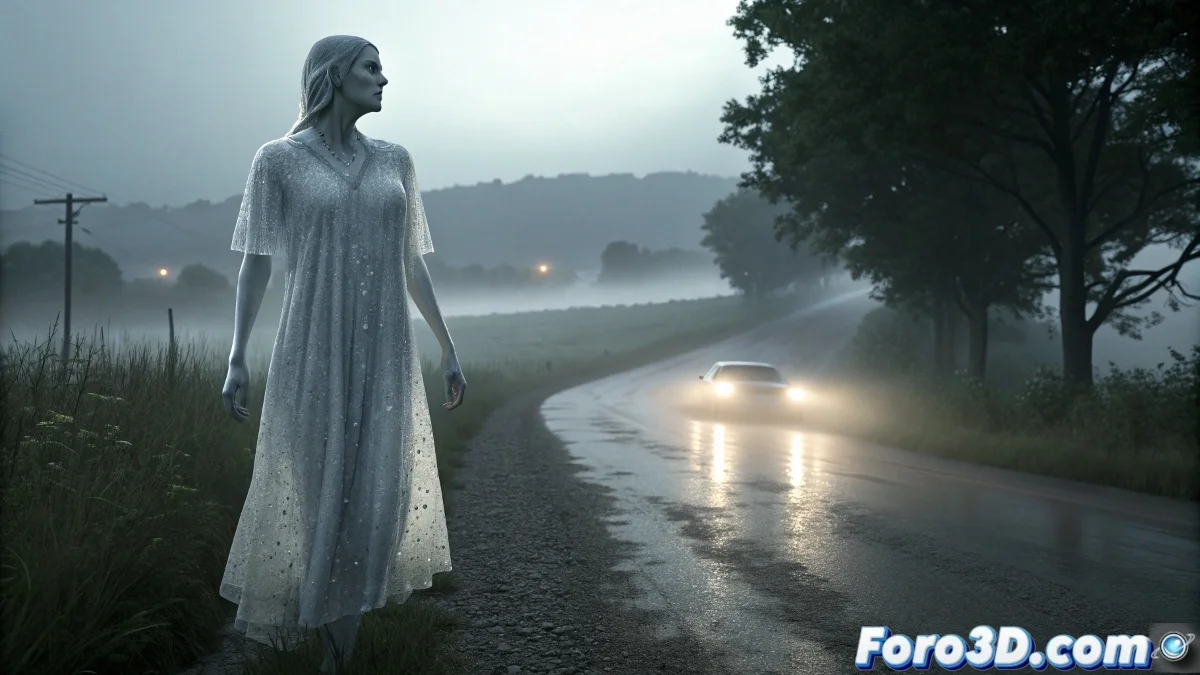
Modeling the Route 41 Fog Woman in Modo for Road Horror
The Route 41 Fog Woman in Wisconsin represents one of the most persistent American road ghost legends, where a spectral female figure dressed in white and soaked appears requesting a ride only to mysteriously disappear, leaving a trail of stagnant water and the unsettling revelation of her supernatural origin, offering a unique challenge for modeling spectral figures in Modo. 👻
Legendary Context and Road Ghost Phenomenon
This Wisconsin legend embodies the "ghost hitchhiker" archetype with specific regional characteristics. The apparition is not aggressive, but its wet nature and post-disappearance revelation create a psychologically disturbing experience that transforms an everyday act (giving a ride) into a supernatural encounter that questions the driver's reality.
Specific Characteristics of the Phenomenon:- Female figure with soaked white dress
- Appearance of having been submerged in water
- Polite but persistent behavior
- Revelation of her ghostly nature during the ride
- Silent disappearance with smell of stagnant water
She tells a story of having died in an accident at that same spot and, upon reaching the destination, disappears - Characteristic encounter pattern
Research on Spectral Anatomy and Water Effects
It is essential to study female anatomy to create a realistic base, the effects of wet clothing on the body, transparency behavior in humid conditions, and the optical properties of water in low-light environments to achieve a credible spectral appearance.
Essential Research Areas:- Female anatomy and proportions for realistic base
- Behavior of wet fabrics and body adhesion
- Optics of transparency and refraction on wet surfaces
- Visual effects of fog and nighttime atmospheric conditions
- Facial expressions of melancholy and supernatural resignation
Step by Step: Modeling in Modo
1. Initial Project Setup
Open Modo 16 and set units to centimeters. Set the grid to 10cm for human scale reference. Create organized mesh layers for: body_base, wet_clothing, water_effects, and spectral_elements.
2. Base Figure Modeling
Build the realistic female anatomy: - Use capsule primitive for base torso - Extrude and scale to create natural proportions - Develop subtle musculature with sculpting tools - Maintain slightly hunched posture for melancholic attitude
3. Wet Clothing System
Create the soaked white dress: - Use cloth simulation for initial natural draping - Apply falloff maps for body adhesion areas - Develop heavy, sagging folds characteristic of wet fabric - Create variable transparencies where fabric clings to the body
4. Water and Moisture Effects
Develop the soaked appearance: - Model suspended droplets with particle geometry - Create running water streams with curve tools - Develop saturation areas with displacement maps - Apply wet skin effects with specular highlights
5. Spectral Transparency and Fade Effects
Implement supernatural properties: - Configure materials with water refraction index - Develop opacity gradients from feet to head - Create subtle subsurface scattering effect - Apply noise patterns for ethereal texture
6. Facial Expression and Attitude
Model the melancholic face: - Create slightly glassy and empty eyes - Develop expression of resigned sadness - Model hair matted by moisture - Apply extreme pallor with bluish tones
7. Integration with Road Environment
Prepare for road composition: - Model hitchhiking posture (extended arm) - Create interaction with road surface - Develop reflections on wet asphalt - Apply car headlight illumination
8. Spectral Materials System
Configure specialized shaders: - Develop wet fabric material with high specular - Create spectral skin shader with subsurface scattering - Configure refraction effects for wet appearance - Apply slight emission for supernatural glow
9. Render Optimization
Prepare for efficient production: - Create LODs for different camera distances - Develop optimized UVs for high-resolution textures - Configure subdivision surfaces for final quality - Prepare proxies for complex scenes
10. Export and Pipeline
Organize for final integration: - Export as USD for modern pipelines - Generate FBX versions with basic materials - Create organized texture sets by channel - Prepare reference scene with basic lighting
Advanced Organic Modeling Techniques
For cinematic results, master the use of MeshFusion for complex joins, use procedural modeling for repetitive effects, and develop advanced UV techniques for moisture effect texturing. 💧
Recommended Advanced Techniques:- MeshFusion for complex organic joins
- Procedural modeling for repetitive effects
- Advanced UV unfolding for moisture textures
- Weight maps for precise material control
Integration with Render Engines
When exporting to Octane or Redshift, configure materials to leverage water refraction properties, develop volume shaders for integrated fog effects, and prepare lighting systems that emphasize the translucent nature of the spectral figure.
Materializing the Road Ghost
Modeling the Fog Woman in Modo explores the intersection between the physical and the spectral, demonstrating that the most effective horror often resides in figures that are almost human but with subtle alterations that place them beyond the natural, creating a presence that is both familiar and deeply unsettling. 🚗