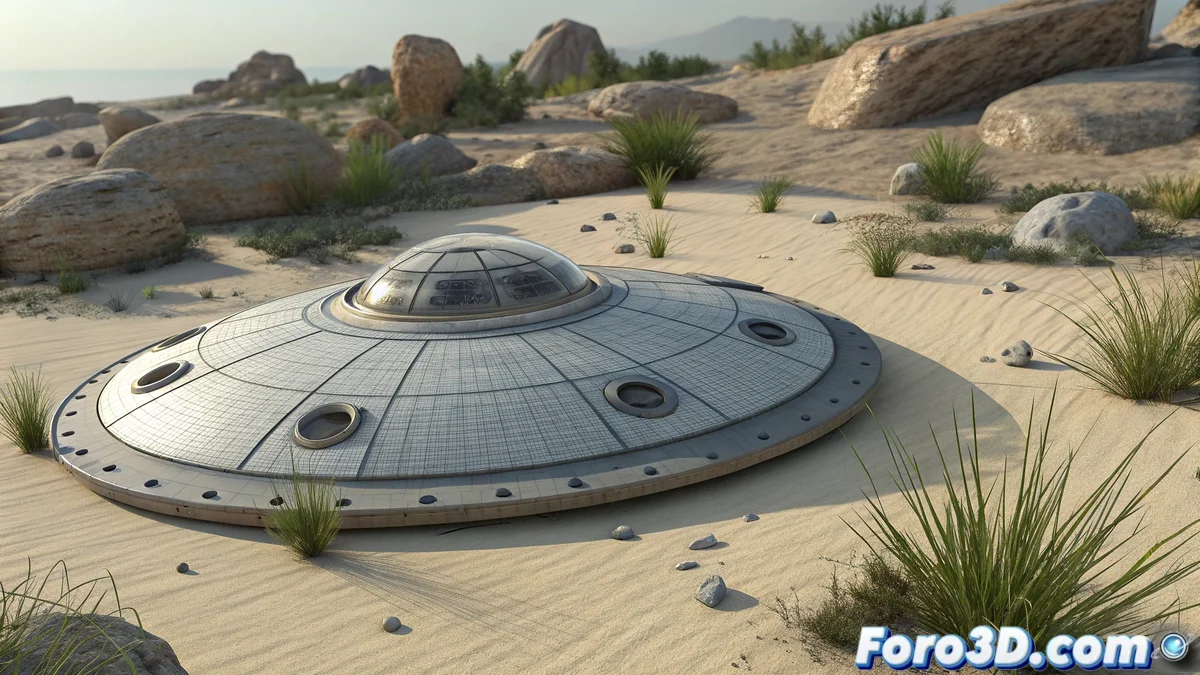
Unveiling Marine Mysteries with Cinema 4D 🌊
Fishermen on the coasts of Japan have rescued an unidentified metallic object from the seabed, capturing the attention of experts analyzing its composition and origin. This enigmatic find—oscillating between historical wreckage and unknown modern technology—finds in Cinema 4D the perfect medium for its digital reinterpretation. The software allows modeling the mysterious structure, applying marine corrosion textures, and placing it in a believable underwater context, all with intuitive yet powerful tools.
Polygonal Modeling of the Mysterious Structure
The process begins with basic primitives—such as cubes or cylinders—that are deformed and combined using polygonal modeling tools. Extrusions, cuts, and vertex displacements create irregular shapes with curved edges or unexpected angles, mimicking the appearance of an object eroded by time and saltwater. The Subdivision Surface modifier smooths the geometry while maintaining control over hard edges with Edge Weighting, ensuring that the object does not lose its irregular character under smoothing. 🔍
Texturing and Marine Corrosion Materials
Metallic materials with reflection and bump channels are applied to simulate years of immersion. By configuring procedural noise in the bump and displacement slots, the typical corrosion and pitting of metals in a marine environment is recreated. Subtle green and blue tones blend with the base metallic color through material layers, emulating oxidation and microorganism growth. The balance between reflectivity and roughness is adjusted to achieve that wet and worn look that suggests a submerged history.
Texturing a mysterious object is like telling a story without words; each oxidation is a chapter under the sea.
Creation of the Underwater Environment
The object is placed on a subdivided plane representing the seabed, with sand and rock textures applied using procedural shaders. To simulate light filtered through water, a dim and bluish illumination is set up with Area Lights at cold color temperature and light Volumetric Fog suggesting suspended particles. Small details like shells, algae, or static bubbles—modeled low-poly—add verisimilitude without overloading the scene.
Composition and Camera Angles
The scene is composed to evoke the moment of discovery:
- Sand-level views that emphasize the fortuitous find
- Overhead shots that show the complete shape of the object
- Extreme close-ups on corrosion details and cuts
- Elongated shadows that suggest depth and mystery
These choices guide the viewer through the visual narrative of the discovery.
Rendering and Post-Production
Cinema 4D's rendering engine—especially with Arnold integration—efficiently handles metallic materials and volumetric effects. Adaptive sampling settings control noise in shadow areas, while reflection and specular passes allow fine-tuning in post-production. A slight vignetting and contrast adjustment in the final composition accentuate the air of mystery.
While Japanese experts analyze the real object, we analyze why the subdivision surface sometimes creates artifacts more mysterious than the object itself. In the end, our render may not solve the enigma, but at least it doesn't require a diving suit to examine it. 😅