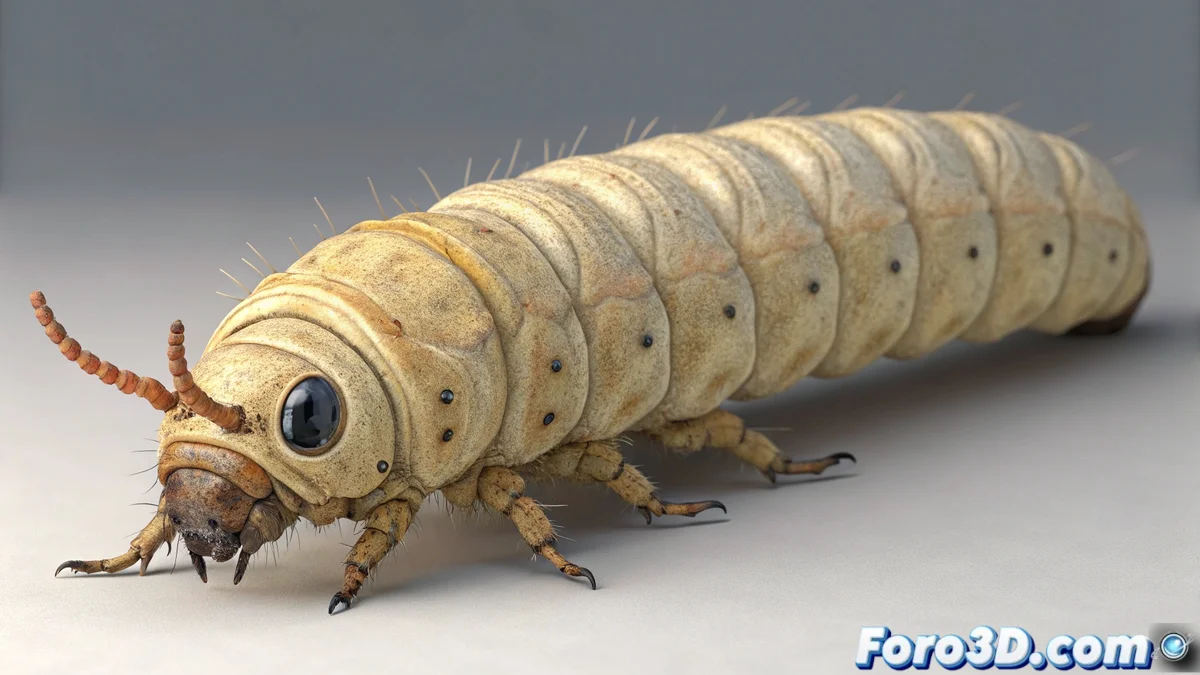
The Challenge of Organic Modeling: Caterpillars in Lightwave
When we want to recreate an insect in 3D, such as wax moths caterpillars (Galleria mellonella), Lightwave offers quite precise organic modeling tools 🐛. The key is to capture the segmented body shape, the smooth skin texture, and small details like legs and antennae, without losing proportion or scale. This process requires patience and attention to anatomical detail to achieve a biologically believable result.
Construction of the Segmented Structure
The modeling begins with the creation of the base shape:
- Base cylinder: Creation of the fundamental body shape
- Subpatches: Activation of subdivision surfaces for organic smoothing
- Segmentation: Division of the body into equal segments
- Individual adjustment: Modification of each segment for natural variation
- Body curvature: Simulation of the caterpillar's natural posture
- Clean topology: Maintain polygon flow for deformations
This structural base is crucial for the model's realism 🏗️.
Anatomical Details and Additional Elements
Fine details make the difference:
- Leg modeling: Tiny cylinders with joints
- Duplicate & Array: Efficient replication of repetitive elements
- Expressive head: Sculpting of frontal parts with personality
- Antennae and hairs: Fine elements with geometry or textures
- Controlled symmetry: Use of mirroring for efficiency
- Geometric optimization: Balance between detail and performance
These elements transform a basic shape into a believable organism 🔍.
Texturing and Realistic Finishing
The final appearance requires texturing work:
- UV unwrapping: UV layout for precise painting
- Export to Substance: Use of Substance 3D Painter for advanced textures
- Organic skin: Smooth gradients and color variations
- Segmented marks: Separation lines between body segments
- Bump/normal maps: Small hairs and rough skin texture
- Final integration: Reimportation of textures to Lightwave
This process adds the final layer of realism to the model 🎨.
Modeling a caterpillar seems simple until you count its segments and legs
In the end, modeling a Galleria mellonella caterpillar in Lightwave demonstrates that true complexity is often found in the smallest creatures. As we struggle to place each leg in its exact position and each segment in its place, we discover that nature is the best teacher of organic modeling... and that we should probably be thankful that real caterpillars don't demand infinite revisions like human clients 😅.