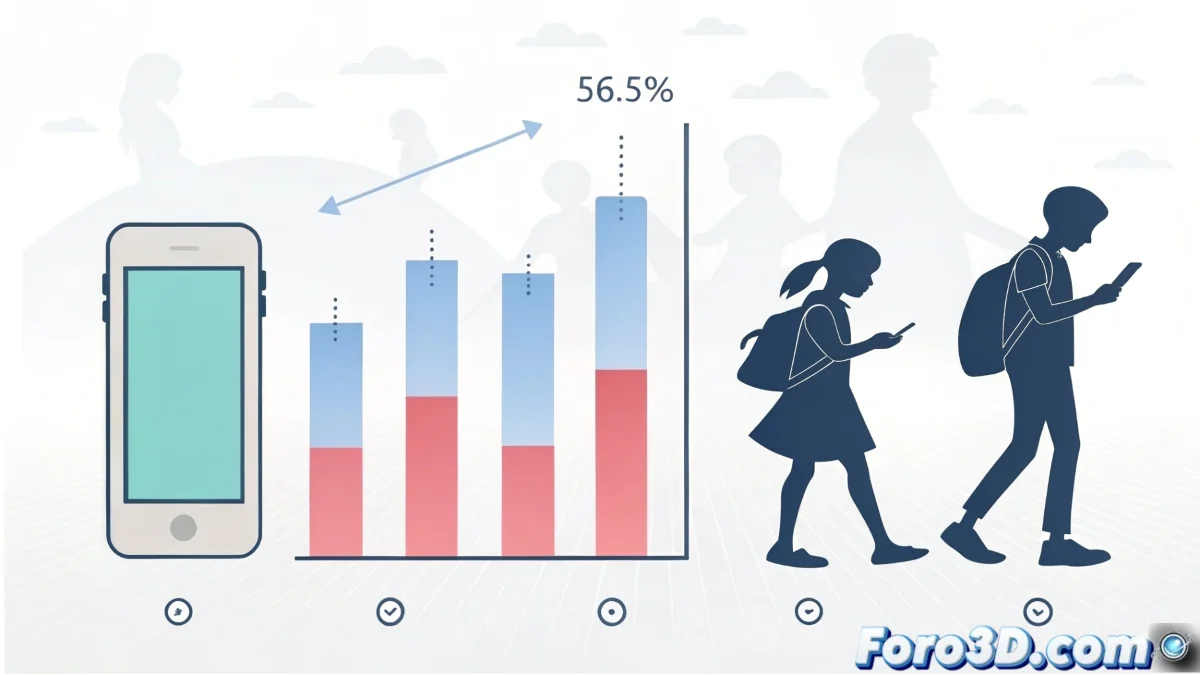
Mobile Phone Bans in Schools: Limited Effect on Student Well-being According to Studies
Mobile phone bans in school settings have not demonstrated significant improvements in students' well-being, anxiety, or depression according to recent research. Although these policies effectively reduce usage within the educational center, the total usage time outside school hours remains unchanged, substantially limiting their overall positive impact. Experts suggest that, for some students who use their mobile as a coping mechanism or social connection tool, the ban could be counterproductive and potentially harmful to their mental health. 📱
Phase 1: Research and Data Collection from the Study
Before opening After Effects, thoroughly research scientific studies on mobile phone bans and their impact on student mental health. Analyze key metrics: anxiety levels pre/post ban, depression indices, compensatory usage hours outside school, and alternative coping mechanisms. Gather visual references for: school environments, psychological data charts, mental health representations, and technology usage behaviors. This foundation will allow you to create a scientifically accurate infographic that effectively communicates the contradictory findings.
Key data to research:- Longitudinal studies on bans and student well-being
- Anxiety and depression metrics in school populations
- Compensatory usage patterns outside school hours
- Coping mechanisms and emotional regulation in adolescents
- Social media usage and digital communication data
- Mental health statistics in educational settings
Phase 2: After Effects Setup and RTX 3070 Optimization
Set up Adobe After Effects 2023 to maximize RTX 3070 performance. Enable Mercury Playback GPU acceleration and configure the memory preference to allocate 6GB to AE. The RTX 3070, with its 5888 CUDA cores and 8GB GDDR6 VRAM, will smoothly handle complex compositions with multiple graphic layers. Set the working resolution to 1080p during development and enable Multi-Frame Rendering for fast previews.
The RTX 3070 transforms complex data animation into an interactive and responsive process.
Phase 3: Storyboard Design and Narrative Structure
Create a detailed storyboard that tells the complete story in 4 acts: 1) The initial problem, 2) Implementation of bans, 3) Unexpected results, 4) Conclusions and alternatives. Design visual transitions that logically connect each section. Establish a psychologically appropriate color palette: calm blues for positive data, cautionary reds for concerning findings, and neutral greens for contextual information.
Phase 4: Creation of Animated Data Graphics
Use Shape Layers and graph tools to create animated data visualizations that show the key findings. Animate comparative bar charts illustrating how anxiety levels remain similar despite bans. Create animated pie charts showing the redistribution of mobile usage time. The RTX 3070 will allow real-time preview of these complex animations while adjusting timing and easing.
Essential data graphics:- Pre/post ban anxiety comparison (animated bars)
- Intra/extra-school usage time distribution (pie chart)
- Depression level evolution (animated timeline)
- Alternative coping mechanisms (flow diagram)
- Mobile usage and well-being correlation (animated scatter plot)
- Impact on different student groups (multivariable chart)
Phase 5: Animation of Abstract Psychological Concepts
Develop animated visual metaphors for abstract concepts like coping mechanisms, mental health, and emotional regulation. Use particle systems to represent stress and anxiety, fluid organic shapes for emotional well-being, and network connections for social support. Animate transitions between emotional states using shape morphing. The RTX 3070 will efficiently handle these complex visual effects during preview.
Phase 6: Integration of School Environment Elements
Incorporate visual elements of educational environments to contextualize the infographic. Create classroom, playground, and common area compositions using stock footage and animated vector elements. Develop consistent educational iconography: student silhouettes, school furniture elements, and educational technology symbols. These elements will help connect abstract data with concrete school life experiences.
Phase 7: Transition Effects and Narrative Flow
Design creative transitions that guide the viewer through the narrative. Use data-based wipe transitions (bars revealing new content), graph morphing, and thematic transitions (like mobile screens transforming into student faces). The RTX 3070 will allow previewing complex transitions without intermediate rendering, significantly accelerating the creative process.
Phase 8: Typographic Animation and Visual Hierarchy
Implement carefully choreographed typographic animation to highlight key points. Use Text Animators to reveal important statistics with impact, animated kerning and tracking for emotional emphasis, and size and color hierarchies to guide attention. Readability is crucial - ensure that the data remains clear despite the animated effects.
Phase 9: Audio Design and Final Render
Integrate audio elements that reinforce the message: subtle mobile notification sounds, school environments, and an emotionally appropriate soundtrack. Set up the final render using Media Encoder with the RTX 3070, selecting H.264 codec for digital distribution. The GPU will significantly accelerate the final encoding, reducing wait times and allowing rapid iterations.
By completing this animated infographic in After Effects with the RTX 3070, you will have created a powerful communication tool that transforms complex educational research data into a compelling visual narrative. The animation will not only show the counter-intuitive findings about mobile bans but will effectively communicate the psychological complexity behind technology use in student populations. This visual approach will help educators, parents, and policymakers understand why simple solutions can fail in the face of complex adolescent mental health issues, thus promoting more nuanced discussions about educational technology policies.