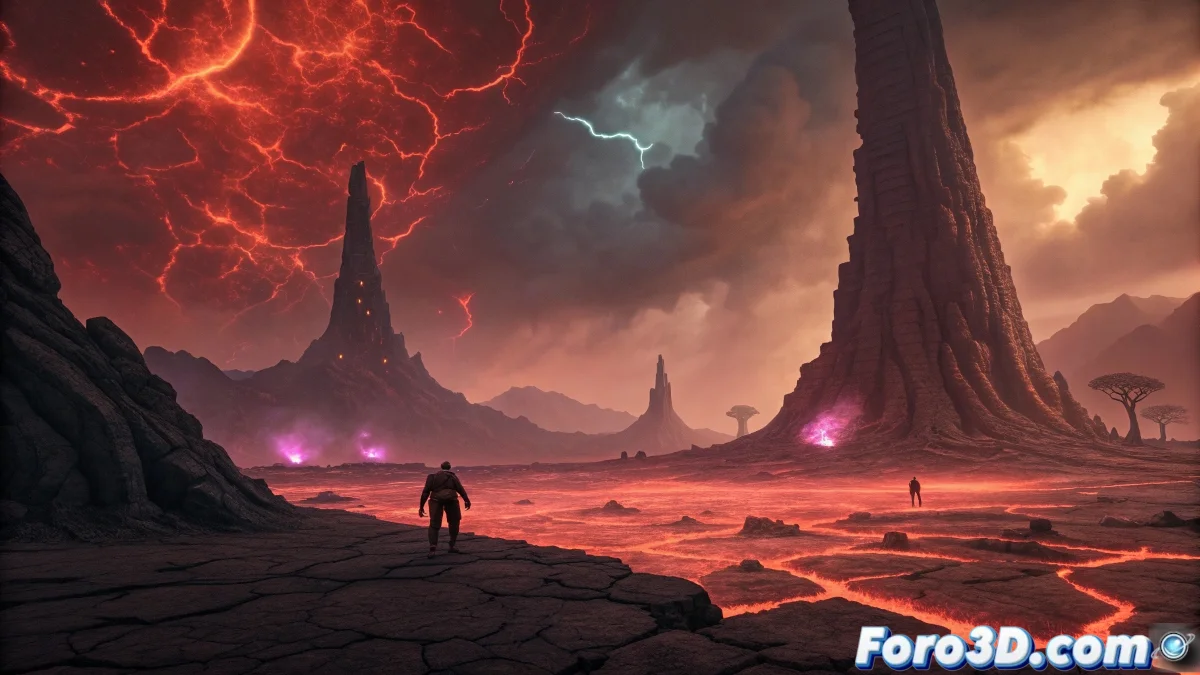
When the Underworld Finds Its Light
The visual representation of the sinners' underworld is experiencing a creative revolution where the strategic blending of real and unreal elements creates an unsettlingly persuasive verisimilitude. Contemporary artists are discovering that the key to making the supernatural believable is not to completely abandon reality, but to carefully anchor it in recognizable elements before introducing the fantastic. This hybrid approach produces images that resonate on a visceral level because they tap into both our knowledge of the real world and our fear of the unknown.
What makes this strategy particularly effective is how lighting becomes the bridge between both realms. Light, that fundamentally physical and measurable element, can be manipulated to suggest alternative realities while maintaining certain visual coherence. A believable underworld is not necessarily poorly lit, but lit in ways that challenge our understanding of how light should behave - creating shadows that move independently, sources of light without apparent origin, or illumination that seems to emanate from the sinners themselves rather than their environment.
Techniques for Building a Verisimilar Underworld
- Integration of real photography with digitally generated elements
- Use of physically incorrect but emotionally resonant lighting
- Manipulation of textures to suggest corruption and spiritual decay
- Composition that balances human recognition with supernatural otherness
The Visual Anatomy of Sin
One of the most fascinating challenges in this representation is finding visual language for abstract concepts like damnation or repentance. The most successful artists avoid literal depictions of punishment in favor of more subtle visual metaphors - perhaps showing sinners trapped in loops of their own actions, or representing their sins as parasitic entities that feed on their essence. This indirect approach often proves more powerful because it allows viewers to project their own fears and understanding of sin onto the image.
The most terrifying underworld is not the most grotesque, but the one that reminds us of something recognizable in ourselves
The color palette plays a crucial role in establishing the emotional tone. Instead of limiting themselves to the traditional reds and oranges of the Christian hell, contemporary artists are exploring more complex combinations - sickly greens that suggest moral rot, deep blues that evoke eternal solitude, or corrupted golds that represent perverted ambition. This chromatic sophistication allows communicating nuances of damnation that the traditional palette cannot capture.
Elements Defining the Modern Underworld Aesthetic
- Architecture combining recognizable structures with impossible geometries
- Distorted human figures still recognizable as such
- Particle effects visualizing spiritual energy or corruption
- Liminal spaces that defy conventional physics laws
This artistic exploration of the underworld reflects a more mature understanding of human nature and the moral condition. Far from being mere macabre entertainment, it represents a genuine effort to give visual form to concepts that have obsessed humanity since we became aware of our own mortality. For artists, the challenge is not just to create striking images, but to build visual bridges between our world and one that, we hope, we never have to inhabit. 🔥
And so, between real photographs and supernatural renders, we discover that the most convincing underworld is not one completely alien to our experience, but one that feels like a distorted version of the reality we already know - because in the end, the greatest terror is not the unknown, but recognizing oneself in what should be completely Other. 👁️