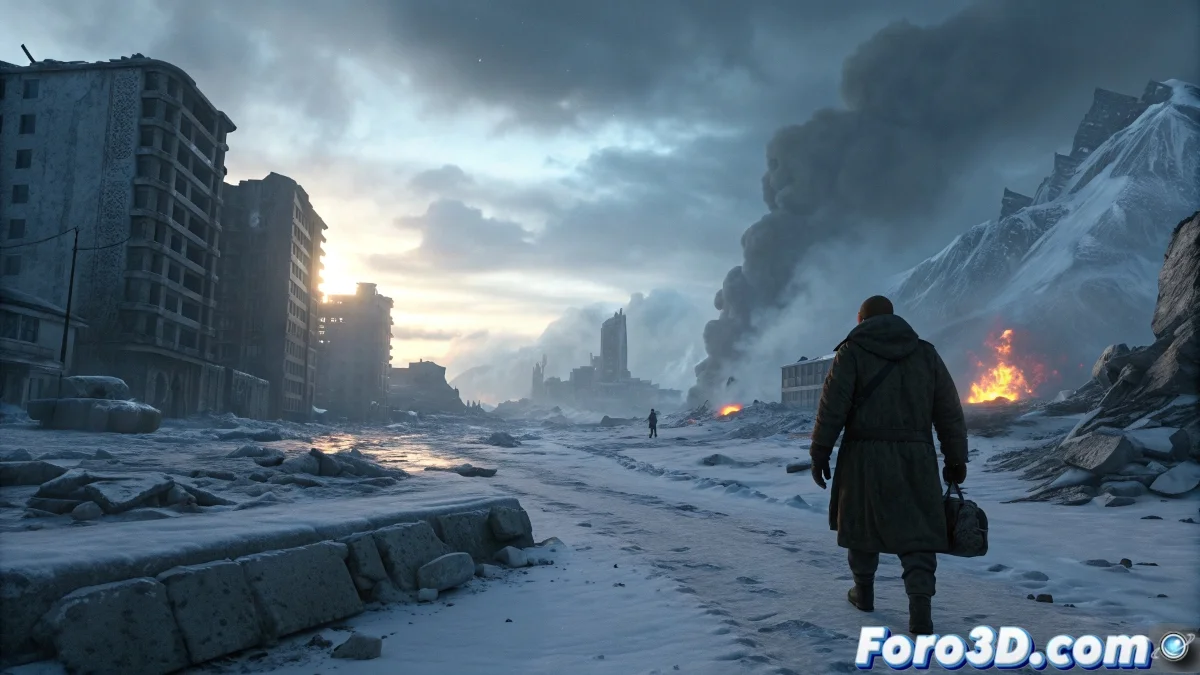
When the Earth Stops Being Home
Greenland 2: Migration raises the bar for contemporary disaster cinema by taking the scale of destruction to almost documentary levels thanks to a monumental technical deployment. The continuation of the Garrity family's story is not simply more of the same, but a deepening into the long-term consequences of an ongoing extinction event. While the first installment focused on the shocking immediacy of the disaster, this sequel explores the raw reality of surviving when the world you knew has ceased to exist and every day is a battle against unleashed elements and a desperate humanity.
What makes this production particularly impressive is how it balances technical spectacle with emotional intimacy. The sequences created with Houdini, Maya, and Unreal Engine do not exist as mere visual spectacle, but serve to amplify the emotional journey of characters with whom the audience has already established a connection. Every fluid simulation, every collapsing structure, every extreme storm functions as a tangible antagonist that tests the resilience of the Garrity family, making the technological advancement in VFX entirely at the service of the narrative.
The Technological Trident Behind the Apocalypse
- Houdini for advanced fluid simulations and large-scale destruction
- Autodesk Maya for detailed modeling of environments and assets
- Unreal Engine for real-time previs and atmospheric effects
- Integrated pipeline between Alchemy 24 and Pixomondo for visual consistency
The Science of Credible Catastrophe
The work of Alchemy 24 and Pixomondo demonstrates a near-obsessive commitment to physical authenticity. The simulations in Houdini are not limited to being visually impressive, but obey credible physical principles that give weight and consequence to every catastrophic event. This attention to scientific detail is what sets Greenland 2 apart from other disaster movies, creating an experience that feels less like fiction and more like a window into a potentially possible future, exponentially multiplying its emotional impact.
In Greenland 2, the visual effects do not decorate the story - they are the story
The integration of Unreal Engine into the pipeline represents a significant advancement in creative efficiency. The ability to preview lighting and atmospheric effects in real time allowed filmmakers to make informed creative decisions during the pre-production phase rather than discovering limitations during post-production. This proactive approach to digital filmmaking results in stronger visual cohesion and execution more faithful to the original directorial vision.
Standout Technical Achievements
- Extreme weather simulations with realistic meteorological behavior
- Procedural destruction of urban environments on an unprecedented scale
- Seamless integration of actors with fully digital environments
- Scale handling that conveys the immensity of the global disaster
Greenland 2: Migration positions itself as a milestone in the evolution of disaster cinema, demonstrating that the genre can mature beyond simple spectacle to become a platform for exploring profound themes about human resilience, family unity, and our relationship with the planet we inhabit. For VFX artists, it represents the kind of challenging project that drives technical innovations that then benefit the entire industry, while for the audience it offers that rare combination of visceral emotion and existential reflection. ❄️
And so, between Houdini simulations and Unreal Engine renders, Greenland 2 demonstrates that the best stories about the end of the world are not about how the planet dies, but about how the human spirit finds reasons to keep going when everything around suggests it should give up - although the Garritys are probably seriously considering trading in those catastrophe points for a vacation on a planet that isn't actively trying to kill them. 🌎