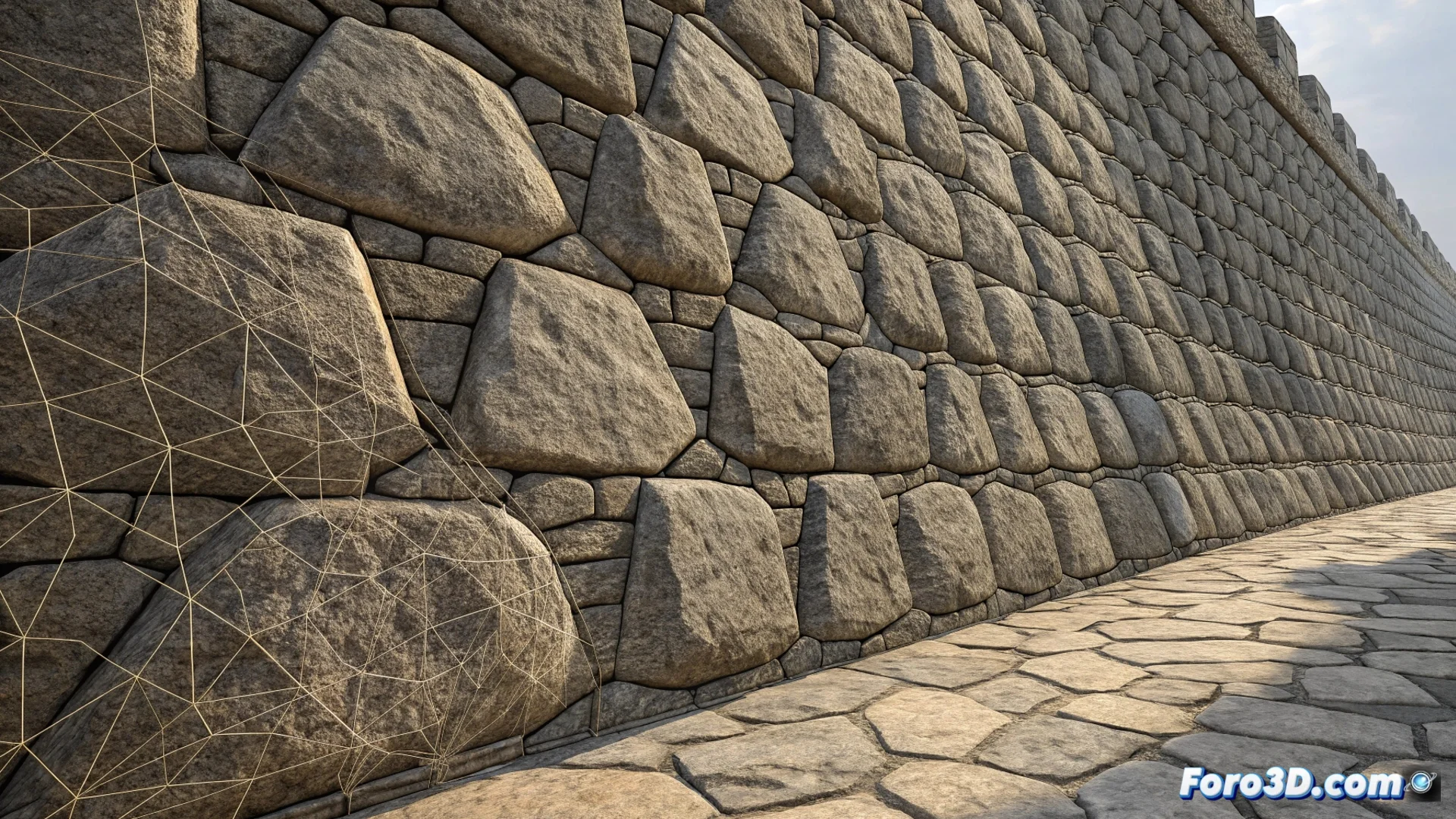
Microvertex displacement: real-time displacement technique
In the search for visual detail without penalizing performance, microvertex displacement emerges. This technique processes a height map and applies it directly to the vertices of a mesh, before the hardware or a shader tessellates the geometry. It represents an ingenious middle ground between simulating and generating real complexity. 🎯
Mechanics and comparison with other techniques
The workflow starts with a low-polygon mesh and a height map. A vertex shader reads this map and displaces each vertex along its normal vector. This adds real geometric complexity without drastically increasing the polygon count. It differs from other approaches:
Comparison of relief techniques:- Parallax Occlusion Mapping: Only simulates relief from the camera's view. It is lightweight but lacks a real silhouette and correct self-shadowing on edges.
- Displacement Mapping with Tessellation: Offers maximum geometric fidelity, but requires a very dense tessellation stage that consumes many GPU resources.
- Microvertex Displacement: Operates at an intermediate stage. It modifies existing vertices, offering an improved silhouette profile and more coherent shadows than parallax, without the high cost of exhaustive tessellation.
It is a practical balance between visual detail and performance in interactive applications where every GPU cycle counts.
Applications and key factors for implementation
This solution is effective in scenarios that require a moderate increase in geometric detail. Its nature makes it ideal for simulating irregular surfaces without saturating the graphics pipeline.
Ideal use cases:- Rocky terrains and landscapes with moderate relief.
- Wrinkled fabrics or organic surfaces with complex texture.
- Architectural details on walls, such as bricks or plaster.
Implementing it in modern graphics engines is relatively straightforward, as it mainly requires modifying the vertex shader. However, its success critically depends on the vertex density of the base mesh. If the initial mesh is too low, the displacement can produce a stepped or "blocky" effect, limiting the final quality.
Final evaluation and considerations
Microvertex displacement is positioned as a valuable tool when you want to avoid activating dynamic tessellation or when the target hardware does not handle it optimally. It promises tangible geometric detail without overwhelming the GPU, although its final result is inherently limited by the resolution of the original mesh. It is like sculpting using only the available vertices: the intention and shape improve, but the ambition for fine detail finds its ceiling in the starting geometry. ⚖️