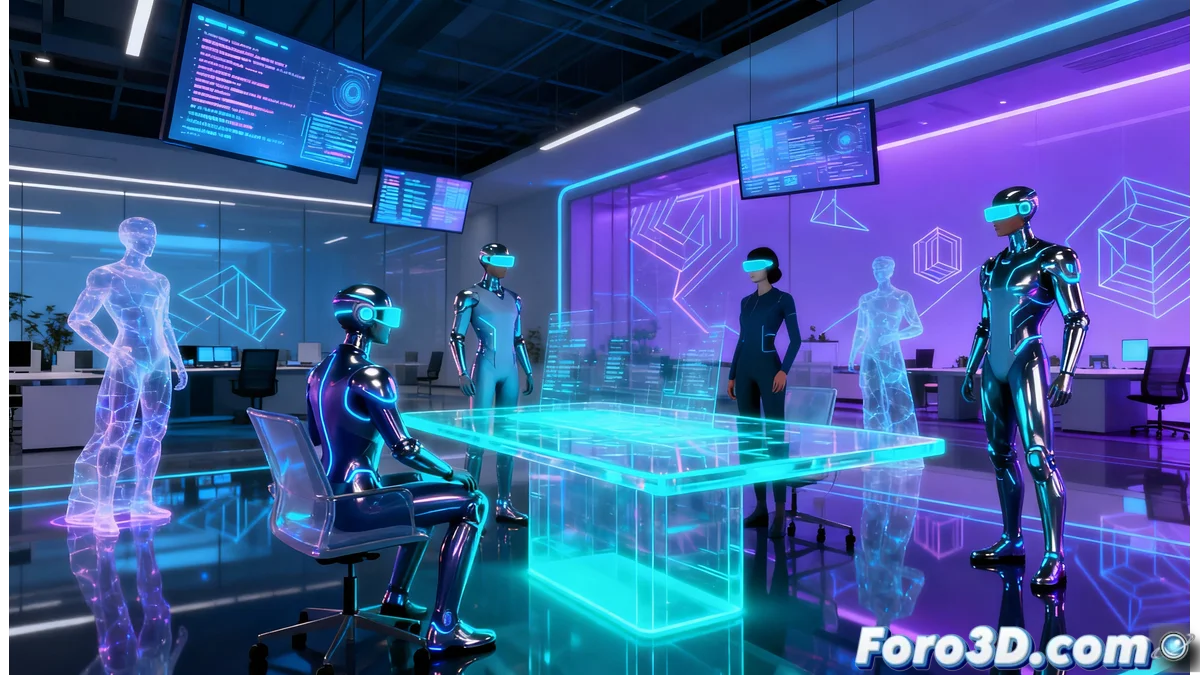
Microsoft Teams Launches Immersive Meetings with 3D Avatars
Microsoft's collaboration platform takes a qualitative leap by introducing its preview version for three-dimensional virtual encounters. This innovation transcends the video grid format, proposing an environment where digital presence is experienced through customized representations. 🚀
Core of the Immersive Experience
The heart of this functionality is the 3D avatars that each user can configure to their liking. These digital characters are not static; they capture and reflect the user's head movements and basic gestures in real time using the webcam. They operate in pre-designed virtual scenarios, from formal boardrooms to informal lounge spaces, fostering a more organic meeting dynamic.
Key features of the new modality:- Spatial interaction: Participants can freely navigate the environment, approach others to form private conversation circles, and use non-verbal gestures through their avatars.
- Tool integration: Essential Teams functions, such as screen sharing, collaborative whiteboard, and chat, are fully incorporated within the 3D space, maintaining practical utility.
- Customization and accessibility: Priority is given to creating an avatar with which the user identifies, although the initial facial tracking technology is limited to head movements, without including details like eyes or mouth.
Microsoft presents this technology not as a substitute, but as a valuable option for internal brainstorming or socialization meetings, where video fatigue is high.
Technical Requirements and Strategic Perspective
To immerse in this experience, certain technical requirements must be met. It is only available on the desktop app for Windows, requiring a processor compatible with the AVX2 instruction. Microsoft recommends using headphones to take advantage of spatial audio, which helps locate interlocutors' voices in the virtual space.
Considerations for the future of work:- Fatigue reduction: By offering an interaction where the webcam can remain off, it seeks to mitigate the fatigue associated with constant video calls, without losing the team's sense of connection.
- Digital humanization: The company's vision is to bring remote interaction closer to a more human and natural experience, where shared presence feels tangible through avatars.
- Pending evaluation: Its true effectiveness in driving deep collaboration and creativity in distributed teams remains to be proven with large-scale adoption by organizations.
A New Dimension for Everyday Interaction
This evolution of Teams promises to transform routine meetings into more dynamic experiences. Imagine your digital representation can express a discreet yawn in the virtual world, synchronized with you, adding a layer of realism (and humor) to the workday. Although it sounds futuristic, it is a concrete step toward work forms that prioritize interpersonal connection beyond the pixel of a camera, exploring the potential of the metaverse in the professional environment. 💼