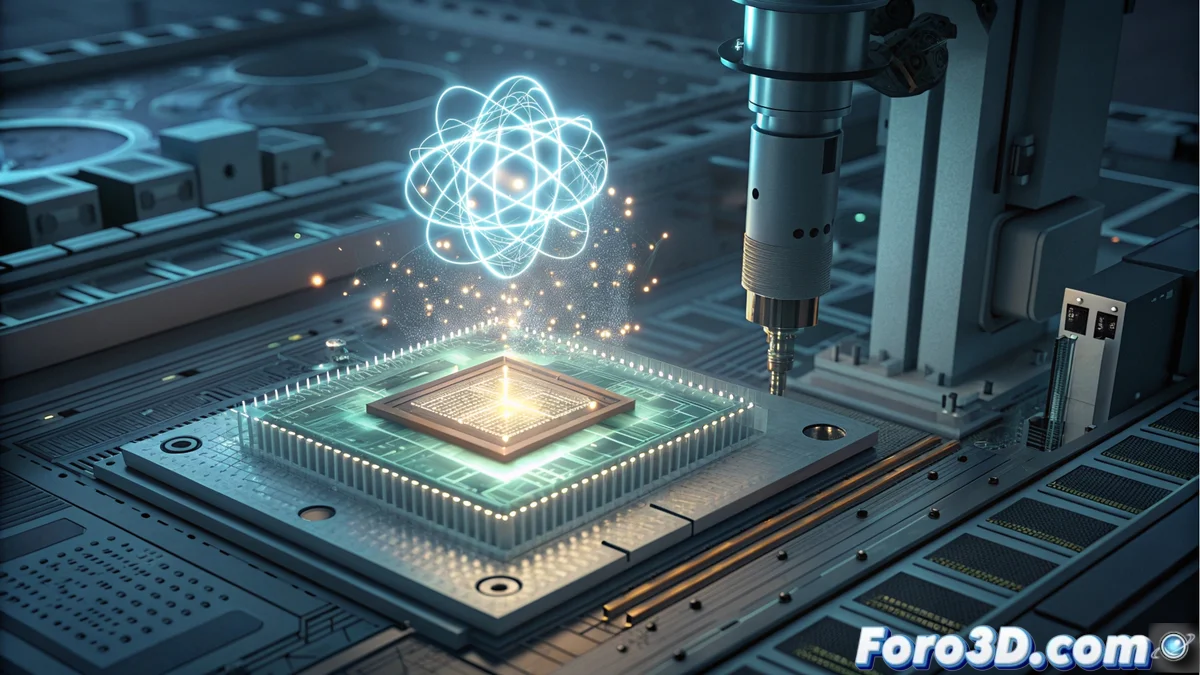
Microsoft Advances in Quantum Computing with Majorana 1 Device
Quantum technology takes a qualitative leap with the development of the Majorana 1 device by Microsoft, a hybrid component made with indium arsenide and aluminum that shows promising indications of hosting Majorana zero modes. These exotic quantum states constitute the fundamental basis for implementing topological quantum computing, a paradigm that offers superior stability and resistance to errors compared to other conventional quantum architectures. 🚀
The Fundamental Significance of Majorana Modes
Majorana zero modes represent extraordinary quantum states that possess the unique property of being their own antiparticles, a characteristic that makes them ideal elements for protecting quantum information against external interference. In the specific context of Majorana 1, these modes emerge naturally at the interface between materials superconductors and semiconductors that make up the device. Their presence theoretically enables quantum computing operations with greater stability, as the information is stored non-locally, drastically reducing quantum decoherence and errors that affect traditional quantum systems.
Main characteristics of Majorana modes:- Behavior as their own antiparticles, a unique property in quantum physics
- Intrinsic protection against external perturbations and decoherence
- Emergence at interfaces of superconductor-semiconductor materials
The detection of Majorana particles could unlock the path to more robust and scalable topological qubits, marking a turning point in quantum technology.
Impact on the Current Technological Landscape
This significant advance positions Microsoft in a competitive stance within the global technological race, where corporations like IBM and Google also vie for dominance in the next generation of computing. Topological quantum computing, if fully realized, has the potential to solve complex problems in areas such as pharmaceutical discovery, advanced materials science, and cryptography that are unapproachable for classical computers. Majorana 1 constitutes not only a remarkable scientific achievement but a crucial milestone toward the realization of practical topological qubits, although an extensive path of experimental verification and engineering development remains before this technology reaches maturity for commercial applications.
Potential applications of topological quantum computing:- Accelerated drug discovery through complex molecular simulation
- Revolutionary advances in materials science and nanotechnology
- Development of ultra-secure cryptographic systems and advanced algorithms
Future Challenges and Industrial Perspectives
While the international scientific community celebrates this progress, engineers are already focusing their efforts on how to industrially scale the manufacturing of these devices, a technological challenge that makes building with Lego blocks seem simple by comparison. The transition from laboratory prototypes to viable commercial systems will require overcoming significant obstacles in manufacturing, quality control, and systematic integration. The path to practical quantum computing continues, but each advance like Majorana 1 brings this revolutionary technology closer to applied reality. 🔬