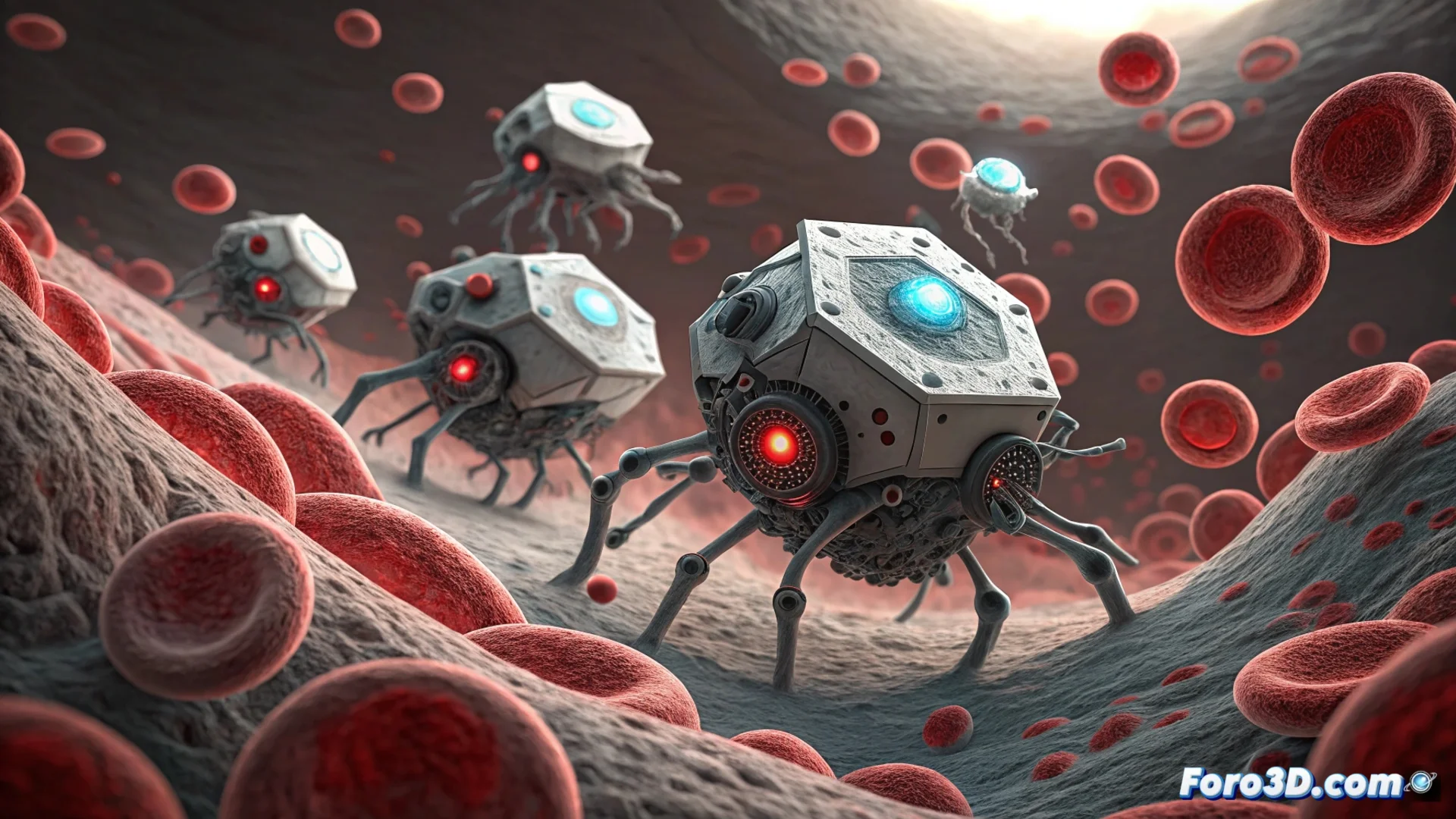
Microscopic Robots that Think and Swim Without Moving Parts
Robotics takes a leap into the imperceptible. A scientific team has succeeded in designing robotic devices smaller than a grain of salt, capable of processing information and moving without relying on traditional mechanical components. This innovation redefines the limits of miniaturization and autonomy at the microscale 🤖.
A Design that Fuses Action and Thought
The core of these microdevices, which measure less than 0.1 millimeters, lies in their simplified architecture. Instead of motors or gears, they use piezoelectric materials. These materials deform in a controlled manner when electricity is applied, generating the thrust needed to move. The true revolution is integrating electronic circuits directly into their structure, allowing them to perceive stimuli and act autonomously accordingly.
Key Features of Their Operation:- Vibration Propulsion: A piezoelectric material vibrates at specific frequencies when receiving an electrical signal, propelling the robot through a fluid.
- Integrated Brain: A tiny circuit acts as a control unit, executing simple instructions stored in memory.
- Basic Behaviors: They can advance, turn, or stop upon detecting an obstacle, all without separate moving parts.
Perhaps the future of surgery is not in the hands of a giant robot, but in a swarm of these, which, once inside, decide for themselves.
Applications in the Field of Medicine
The most immediate potential of this technology lies in the medical field. Their minuscule size would allow them to navigate the bloodstream or body tissues to perform specific tasks. This opens the door to new ways of administering treatments with unprecedented precision.
Possible Medical Uses:- Targeted Drug Release, delivering medication exactly where needed, such as a tumor.
- Act as tools for minimally invasive diagnostics, collecting data from inside the body.
- Scientists are experimenting with different shapes to optimize their movement in complex and viscous biological environments.
The Path to Micro-Autonomy
This development represents a fundamental advance toward less invasive medical tools and autonomous robots at previously unthinkable scales. By combining propulsion, sensing, and processing capability in a single microscopic entity, the foundations are laid for