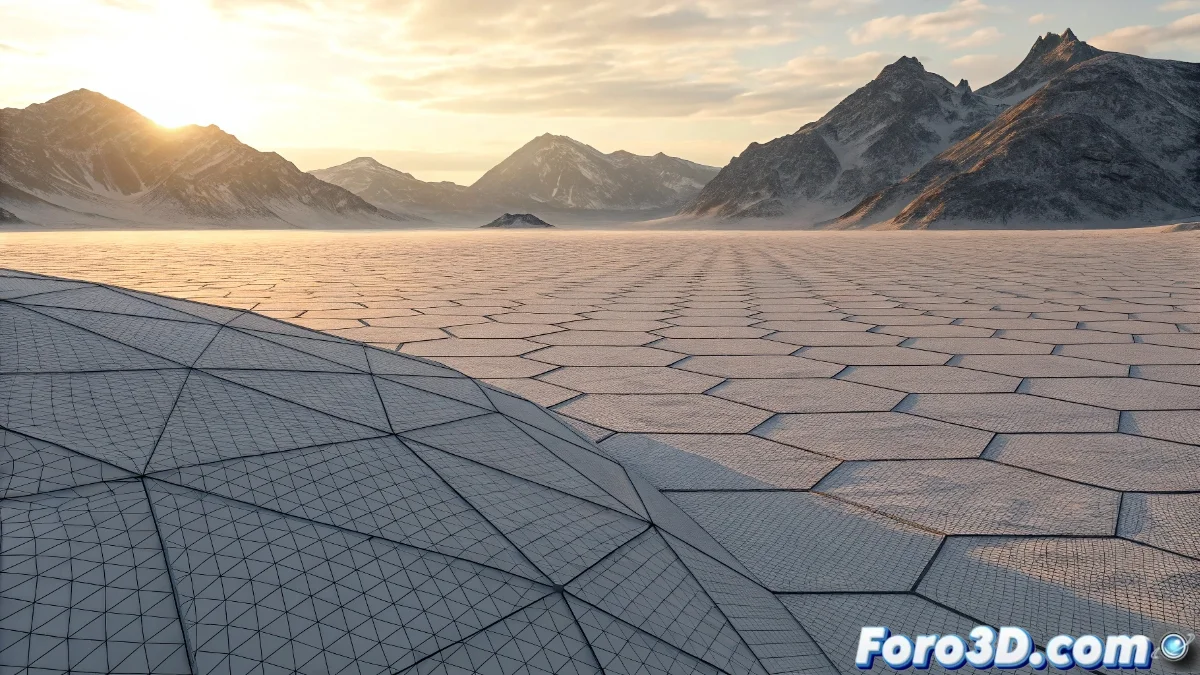
Mesh Displacement in 3D Modeling: Essential Technique for Detailed Geometry
Mesh displacement represents a fundamental methodology in the realm of three-dimensional modeling that radically transforms object geometry through the application of specialized texture maps or curves. This technology operates by interpreting intensity values that displace the mesh vertices according to the provided graphical or mathematical information, generating sophisticated relief and intricate surface details without requiring exhaustive manual modeling 🎨.
Advanced Configuration of Technical Parameters
To maximize the potential of geometric displacement, it is essential to master the parameters governing this process. The displacement intensity regulates the magnitude of the vertex-by-vertex movement, while the direction controls whether the deformation occurs towards the interior or exterior of the model. The density of the base mesh is crucial, as inadequate subdivision generates visual artifacts and harsh transitions. The UV | Object | World coordinate systems determine how the displacement information is projected onto the surface, directly influencing the final result 🌟.
Essential Parameters to Control:- Displacement intensity and direction for controlled deformations
- Mesh subdivision level to avoid visual artifacts
- Coordinate system that determines texture projection
Mesh displacement transforms flat surfaces into three-dimensional landscapes rich in detail, revolutionizing the workflow of digital artists.
Practical Implementation in 3D Projects
In real production environments, mesh displacement is efficiently integrated into various creation pipelines. Professionals use it to develop realistic terrains based on elevation maps, simulate erosion and deterioration on industrial surfaces, or incorporate micro-details like skin pores and roughness in natural materials. By using animated displacement curves, it is possible to create progressive transitions and temporally controlled morphings. Overlapping multiple displacement layers with different textures allows achieving levels of organic detail that would be prohibitively time-consuming using traditional manual techniques 💫.
Main Creative Applications:- Generation of landscapes and terrains from height maps
- Simulation of wear and aging in materials
- Creation of microscopic details on organic surfaces
Technical Considerations and Best Practices
Mesh displacement can present unforeseen challenges when fundamental technical aspects are not considered. A common mistake involves neglecting the scale of the applied textures, which can turn simple geometries into distorted shapes that defy visual logic. Proper management of resolution and sampling ensures that the generated details maintain aesthetic coherence and technical precision. Mastering this technique requires understanding the interaction between base geometry, displacement textures, and render parameters, creating a perfect balance between visual detail and computational efficiency ⚡.