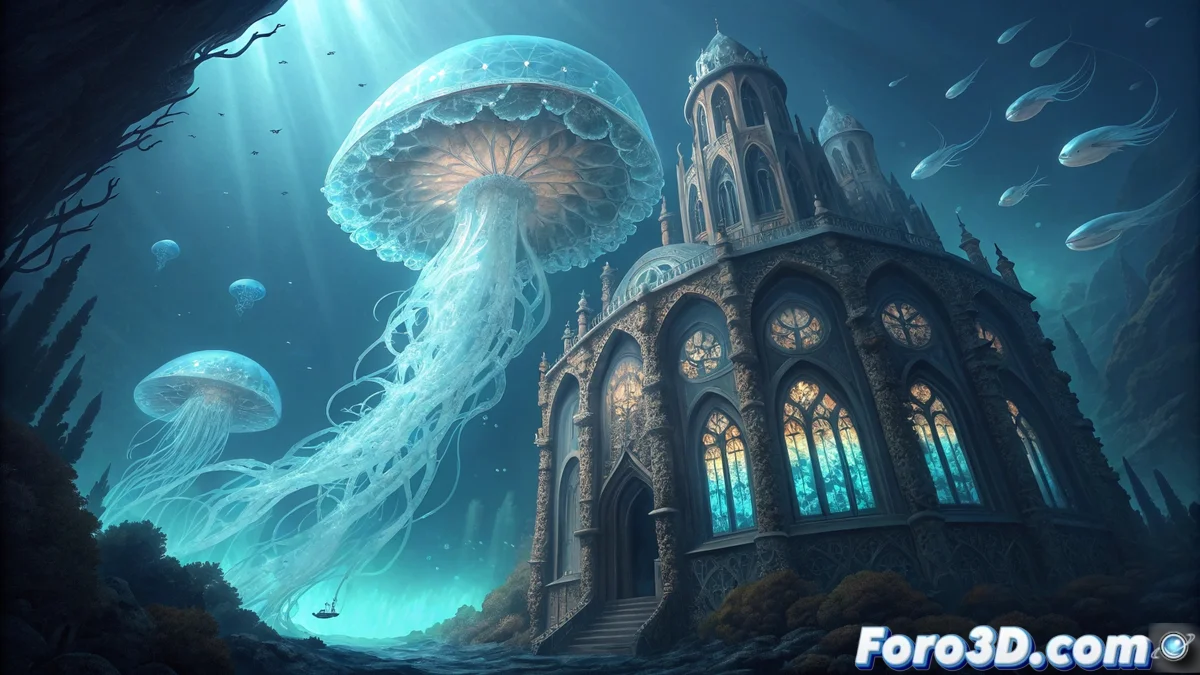
Merging Disparate Images to Create Original Visual Concepts
This visual exercise challenges you to combine two images that have no logical connection to generate a completely new concept. Instead of copying a single reference, two are taken, such as a jellyfish and a Gothic cathedral, and their architectures, textures, and forms are fused into a single coherent drawing. This process forces you to think differently and solve unexpected visual problems, breaking the dependence on a single source and stimulating pure creation. 🎨
The Process of Synthesizing Two Worlds
The work does not consist of putting two things together, but of giving birth to a third entity. First, each reference is analyzed separately: lines of force, key textures, and defining structural elements are identified. Then, forced connection points are sought. For example, the jellyfish's tentacles can be translated into Gothic flying buttresses or the stained glass transformed into a translucent and gelatinous skin. The final result is a creature or scenario with its own internal logic, where every part seems to belong to a unified and believable whole.
Key Steps for Merging:- Analyze each reference to extract its most powerful visual elements.
- Seek forced analogies between disparate forms, textures, and structures.
- Draw with the goal of creating a new entity, not a collage of two parts.
The real challenge is not drawing well, but explaining that this architectural creature is the fruit of a perfectly logical method.
Advantages of Contaminating Visual Sources
This practice trains the ability to synthesize ideas and think abstractly. By facing such different references, the brain must seek solutions that are not present in either image separately. This helps to develop a more personal style, less tied to directly replicating what is seen. It becomes a powerful antidote against creative block, as the starting point itself is a challenge that boosts imagination.
Practical Benefits of the Method:- Trains abstract thinking and visual problem-solving.
- Helps build a unique and less derivative artistic style.
- Serves as a technique for designing creatures, scenarios, or fantastic architectures with solid visual bases but unpredictable results.
Application and Final Result
The technique is especially useful for concept artists and designers who need to produce original ideas consistently. The resulting image is not a hallucination, but the product of an analytical and creative process. The tension between two opposing worlds generates a radically new concept, demonstrating that originality often arises from restriction and intelligent fusion. This method proves that to create, sometimes you have to unlearn copying and learn to recombine. ✨