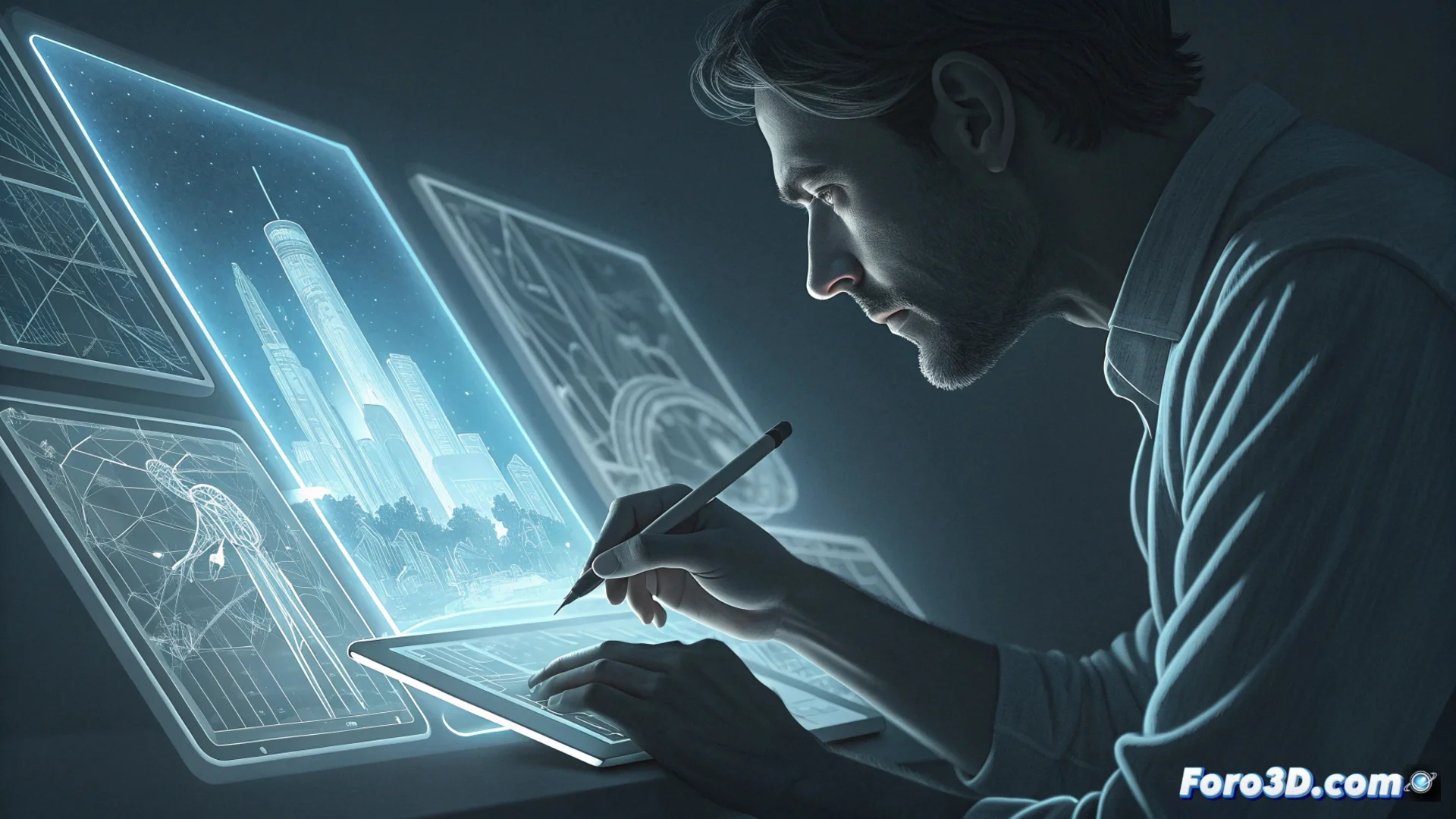
Mental Canvas Redefines Drawing in a Digital Environment
This program transforms the way digital illustrations are created by allowing drawing directly in a three-dimensional space. Instead of a flat canvas, you can position multiple planes in any orientation and position, as if sculpting with pencil or brush strokes. The final experience fuses traditional art with the freedom to navigate a 3D model, giving rise to visual stories that the viewer can explore at their own pace. 🎨
The Core is Telling Stories Immersively
The application is not designed to produce photorealistic renders or complex animations. Its main strength lies in building narratives and presenting concepts in an engaging way. Professionals like architects or concept artists can sketch a complete scene from various angles within the same coherent environment. Later, they can guide a client through that space in real time, offering immediate understanding of the project.
Main Use Cases:- Architecture and Conceptual Design: Sketch spaces from inside and outside, allowing a virtual walkthrough of a building not yet constructed.
- Narrative Illustration: Create scenarios where the audience explores and discovers hidden details from the front view, deciding their own pace.
- Idea Presentation: Communicate complex concepts visually and dynamically, beyond static images.
The real challenge is remembering that you've drawn in all dimensions. A line that seems to float in the air from one angle is the perfect edge of a building from another.
How the Spatial Workflow Works
The process focuses on manipulating and drawing on canvases positioned in 3D space. The user adds planes, duplicates them, rotates or moves them to draw on different faces of an imaginary object. The tools emulate traditional media like graphite pencil, ink, or watercolor, maintaining the organic feel of hand drawing.
Key Elements of the Process:- Positionable Canvases: Independent planes that act as drawing surfaces in 3D space.
- Multi-Perspective Drawing: You can change your viewpoint to draw on a canvas from the side you need.
- Unified Camera View: When activating this mode, all scattered strokes merge into a coherent scene that you can explore smoothly.
Perspective is Experienced Literally
The magic and challenge of Mental Canvas arise when switching between drawing mode and exploration mode. What you draw on a separate plane visually integrates when navigating, creating the illusion of a drawn but three-dimensional world. This forces the artist to think spatially and anticipate how the strokes will connect from all possible angles. The tool does not generate traditional 3D geometry, but builds the perception of depth and volume from intelligently arranged 2D illustrations. The result is a virtual walkthrough through a drawing, a completely new way to experience and tell stories with images.