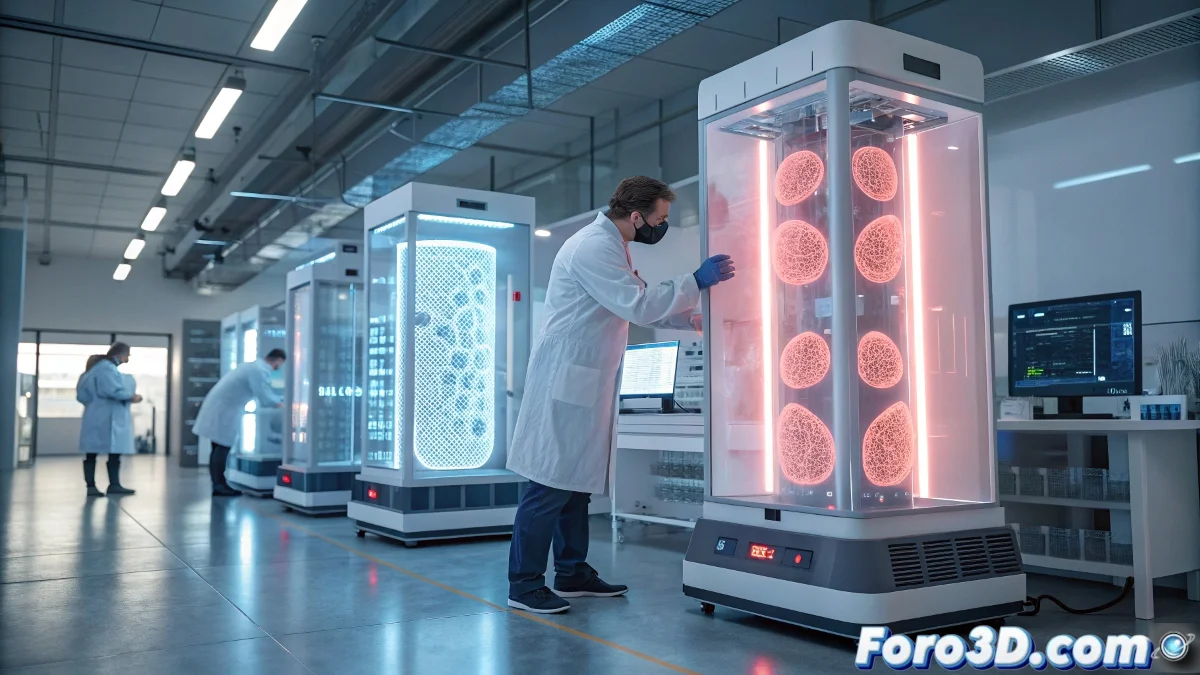
When 3D Printing Learns to Breathe
In HKU laboratories, the boundary between digital and organic fades: now they print respiratory structures that not only mimic human anatomy, but perform real biological functions. A milestone where 3D technology and cell biology join hands like old friends 🖨️🧬.
The Process That Challenges Science Fiction
From the patient's mouth to functional organs:
- Painless biopsy: Buccal swab to obtain stem cells
- Organoid culture: Mini-lungs in the laboratory
- Custom 3D design: Precise anatomical modeling
- Bi-printing: Biocompatible resins + living cells
Key Technologies That Make It Possible
The magic happens in this synergy:
- Medical modeling software (similar to anatomical ZBrush)
- High-precision 3D printers with multiple bio-inks
- Hitachi automated system for mass production
- Advanced microscopy for cellular quality control
"We don't build prostheses, we cultivate living solutions. Each printed structure contains the patient's 'biological memory' in its cells." - Prof. Michael Chan
Applications That Will Change Medicine
Beyond transplants:
- Personalized pharmaceutical testing: Your "mini-you" testing treatments
- Airway repair: For burns or cancer
- Living educational models: Anatomy that responds like the real one
- Organ bank: No waiting lists
The Future Is Already Here
What's coming in bioprinting:
- Complete vascular integration for complex organs
- Artificial intelligence optimizing anatomical designs
- Bio-inks with nanotechnology
- Industrial-scale automation
While 3D artists continue debating topology and retopology, these scientists are rewriting the rules of modeling with polygons that not only render... but regenerate! An era where the most powerful "Ctrl + Z" might be our own cellular recovery capacity. 🌱✨