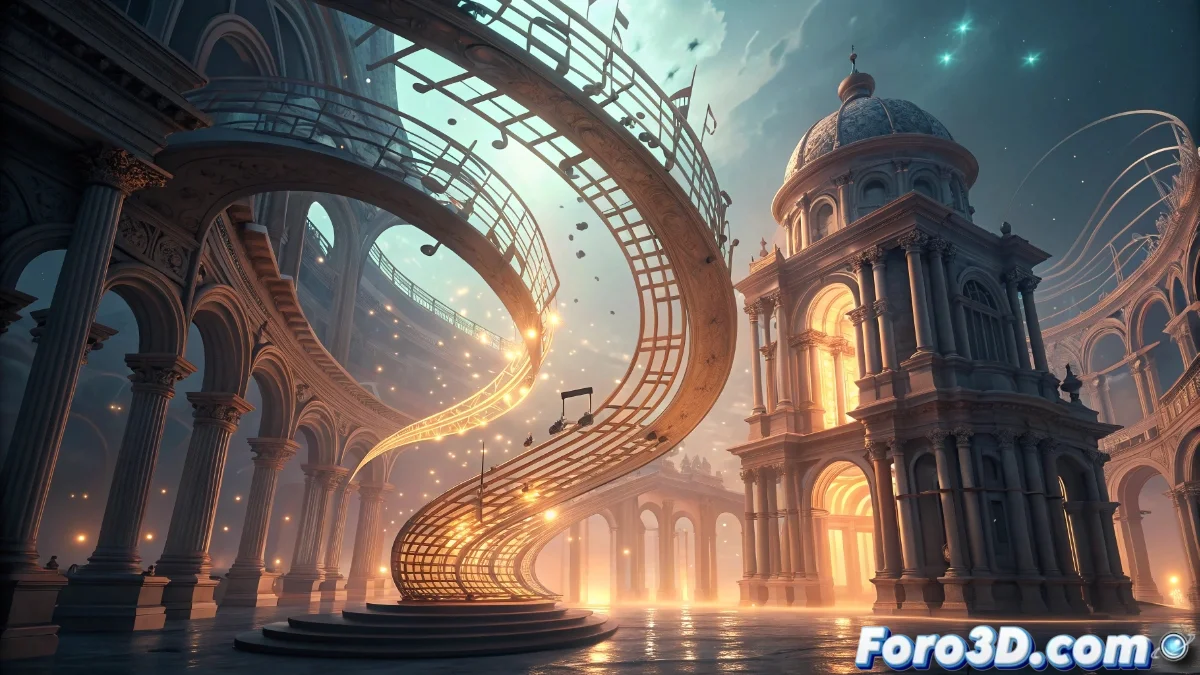
Media Translation as the Creative Frontier in 3D Art
Media translation constitutes an exciting artistic intersection where creators transform non-visual works into immersive three-dimensional experiences. This methodology explores the fundamental essence of musical compositions, literary texts, and even abstract data, reinterpreting them as visual forms that encapsulate their internal structure, rhythm, and essential emotional qualities. Artists use this approach as a sensory bridge between different creative modalities, allowing the audience to experience familiar works through completely novel dimensions 🎨.
Multisensory Interpretation Systems
Creators develop precise mapping methodologies where they assign specific components of the original medium to visual elements within the three-dimensional space. A musical score can be transformed into a complex architectural structure where notes determine heights, tempo establishes rhythmic patterns of shapes, and instruments define materials and color palettes. In literary text translations, characters' emotions frequently manifest through ambient lighting, while the narrative becomes spatial progression within the scene. This process demands deep understanding of both the source medium and 3D design principles.
Examples of creative mapping:- Musical compositions converted into three-dimensional architectural landscapes with procedural geometry
- Literary texts transformed into immersive environments where the plot guides spatial exploration
- Abstract data represented through particle systems and complex generative structures
The real magic happens when you manage to make others experience Beethoven's Fifth Symphony as an architectural journey through space, even though some insist on seeing only a broken vase
Advanced Technologies and Workflows
The implementation of these translations employs specialized software such as Blender, Autodesk Maya, and Houdini, combined with advanced scripting techniques and procedural generation. Many artists program custom systems using Python and VEX that automate data conversion into geometry, while others prefer more organic approaches through manual digital sculpting. Geometry nodes, particle systems, and complex shaders become the visual vocabulary for expressing abstract concepts, creating representations that function as autonomous artworks and faithful interpretations of the original material.
Essential tools:- 3D modeling and animation software with advanced scripting capabilities
- Particle systems and dynamics for representing abstract and emotional elements
- Complex shaders and lighting systems to convey sensory qualities
The Challenge of Artistic Interpretation
It is fascinating how after dedicating hours to translating a symphony into complex geometry, the greatest artistic achievement may be explaining that it is not a "pretty drawing" but a three-dimensional representation of Beethoven's Fifth Symphony using Fourier algorithms and emotional mapping. This anecdote perfectly illustrates the communicative challenge that artists face when working on this creative frontier, where the most sophisticated interpretations can be perceived in completely unexpected ways by the general public 🎭.