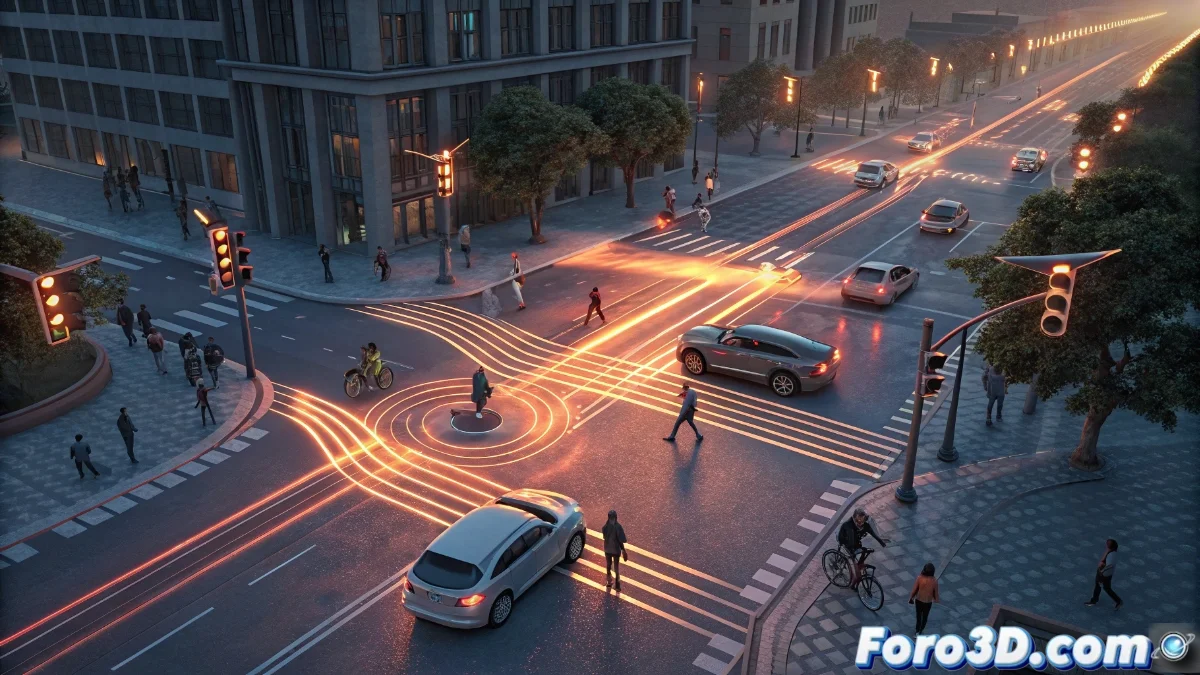
MDG: Masked Denoising Generation System for Multi-Agent Modeling
The MDG (Masked Denoising Generation) technology marks a milestone in the modeling of collective behavior of multiple entities through artificial intelligence, completely rethinking the traditional multi-agent simulation approach. 🚗🤖
Revolution in Mobility Simulation
This innovative system conceptualizes the problem as a sequence reconstruction where noise is introduced specifically both per individual agent and per temporal moment, enabling precise trajectory generation with unprecedented computational efficiency. The ability to produce results in one or few steps eliminates the tedious iterative processes that have historically hindered this type of application. ⚡
Transformative applications in real environments:- Advanced traffic simulators that predict with extraordinary precision the movement of vehicles and pedestrians at complex intersections, allowing automatic traffic light adjustments and route optimization
- Intelligent autonomous vehicles that anticipate maneuvers of other cars to plan safe trajectories in real time, radically improving decision-making in dynamic environments
- Urban management systems that optimize vehicular flow through continuous predictive analysis, reducing congestion and improving overall mobility
The irony lies in the fact that while humans remain stuck in daily traffic, these artificial intelligences are already finding the most efficient routes to avoid it, although they still can't complain about the driver in front like we do.
Competitive Advantages in Trajectory Generation
The fundamental advantage of MDG lies in its ability to generate multiple realistic trajectories for all agents simultaneously, with speed and consistency far superior to conventional methods. This system demonstrates exceptional value by being completely reusable for diverse tasks such as simulation, prediction, or planning, without the need to train specific models for each particular application. 💡
Key computational benefits:- Unprecedented efficiency in processing that enables real-time responses for critical applications where latency is determinant
- Operational versatility that facilitates adaptation to different scenarios and requirements without structural modifications to the base model
- Guaranteed consistency in results that ensures coherent and physically plausible trajectories in all simulations
Impact on the Future of Intelligent Mobility
The computational efficiency achieved by the MDG system opens new possibilities in the development of intelligent transportation systems where response time is critical. This technology not only represents a technical advancement but also establishes new standards in how we approach multi-agent movement planning and simulation, promising to fundamentally transform our interaction with future transportation environments. 🌐