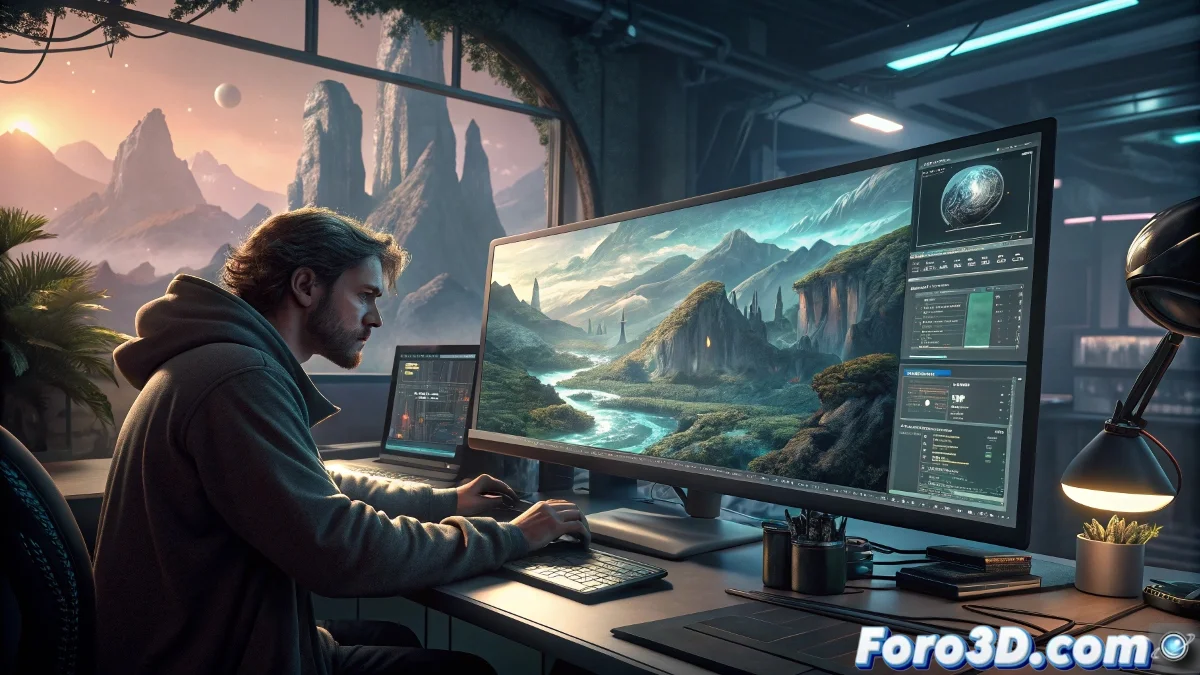
The Digital Renaissance of Matte Painting Art
Matte painting is experiencing a quiet but profound revolution, where digital tools are exponentially expanding the creative possibilities of these specialized artists. What began with oil paintings on glass and rear-screen projections has evolved into a hybrid workflow that combines photography, 3D modeling, artificial intelligence, and virtual reality. Contemporary matte painters are no longer limited by the physical dimensions of their canvas, but can create entire worlds that exist only in digital space yet feel tangibly real.
What makes this evolution particularly exciting is how new technologies are preserving while expanding the fundamental techniques of the craft. The principles of composition, perspective, and lighting that defined classical matte painting remain relevant, but now they are applied in immersive environments where artists can literally walk inside their creations. This fusion of tradition and innovation is producing cinematic environments of a richness and scale that would have been unthinkable even a decade ago.
Tools Transforming the Craft
- Digital painting software with brushes that simulate traditional media
- Virtual reality platforms for immersive 3D creation
- Artificial intelligence for generating textures and base elements
- Seamless integration with game engines for real-time previsualization
When the Brush Meets the Algorithm
One of the most significant developments is how matte painters are integrating artificial intelligence into their creative workflows. Rather than replacing artists, AI is functioning as an incredibly capable assistant that can generate bases upon which humans apply their artistic judgment. An artist can request an AI system to generate dozens of variations of rock formations, skies, or architectures, then select the most promising ones and refine them with their traditional expertise, dramatically accelerating the process without sacrificing artistic quality.
Modern matte painting demonstrates that technology does not replace creativity, but expands its vocabulary
The adoption of virtual and augmented reality is fundamentally changing the artist's relationship with their work. Where before they worked on flat screens, now matte painters can sculpt digital landscapes from within, evaluating scale and composition from the final viewer's perspective. This ability to "inhabit" the environment during the creative process is resulting in more coherent and cinematically believable designs, as artists can directly experience what it would feel like to be physically present in the world they are creating.
Applications in Contemporary Productions
- Creation of epic-scale science fiction and fantasy worlds
- Historical reconstruction of places that no longer exist
- Extension of practical locations with digital elements
- Development of environments for virtual production
This expansion of the matte painter's toolkit comes at a time of unprecedented demand for visually spectacular content across film, television, and streaming. The ability to create convincing worlds efficiently is enabling productions with moderate budgets to achieve visual ambitions that were previously reserved for blockbusters. For artists, it means a more diverse and challenging career where the only real limitations are imagination and the willingness to master constantly evolving tools. 🎨
And so, between digital brushes and creative algorithms, matte painters demonstrate that the largest canvas is not made of canvas or pixels, but of the human capacity to imagine worlds and the tools to make them real, even if only on screen. 🌄