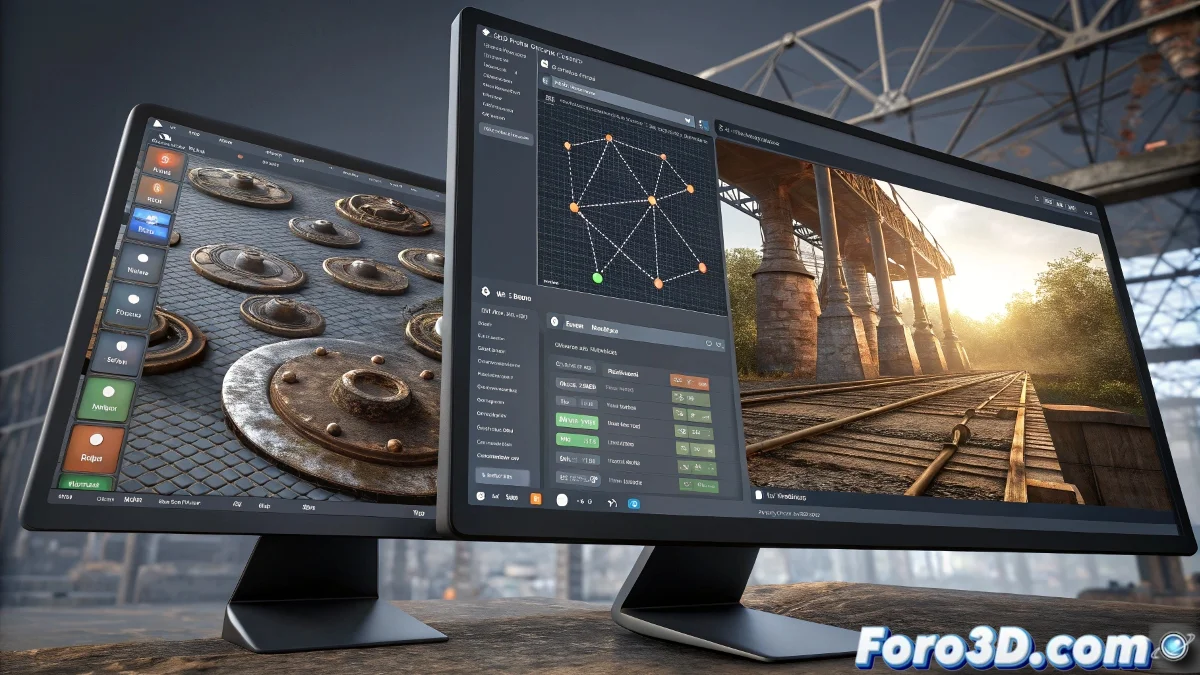
The Procedural Revolution Arrives in Material Creation
Material Maker 1.4 marks a significant milestone in the evolution of this free procedural material creation application, introducing substantial improvements that bring it closer to high-cost professional tools. This update transforms the workflow of technical artists and material designers through an expanded node system, faster rendering, and new export capabilities that cover virtually any modern production pipeline. What began as a specialized tool is now consolidated as a comprehensive solution for PBR texture generation.
Version 1.4 is not just an incremental iteration but a deep overhaul of the core architecture, offering notable performance improvements even on modest hardware. Users report bake times up to 40% faster and an optimized memory management that allows working with more complex node graphs without compromising interactivity. The interface has been refined to reduce creative friction and speed up repetitive processes.
When free tools surpass professional ones in usability, we all win
New Node System and Operators
The heart of Material Maker 1.4 is its completely revamped node system, which introduces over 25 new operators specialized in different aspects of material creation. The procedural transformation nodes allow complex deformations of patterns, while the advanced blending operators offer unprecedented control over how different material layers are mixed. The new smart masks system automatically generates credible transitions between different materials.
Among the most celebrated additions are the dirt and wear generation nodes that simulate natural erosion, dust accumulation, and usage degradation. These are not simple layer effects, but complex procedural systems that respond to parameters like environmental exposure, rain direction, and frequent contact points. Artists can create storytelling materials through credible wear.
- 25+ new specialized nodes
- Advanced procedural transformations
- Non-destructive material blending
- Automatic generation of wear and dirt
Rendering and Real-Time Preview
The rendering engine has been completely rewritten to leverage modern OpenGL and Vulkan capabilities, resulting in an almost instant preview even with extremely complex node graphs. Users can now work with 4K and 8K materials without experiencing significant delays, thanks to an intelligent texture streaming system that loads only the mipmaps necessary for the current view.
The preview lighting now includes HDRI environment mapping with real-time rotation, multiple configurable directional lights, and the ability to import custom HDRIs. The new reference materials system allows comparing the material under development against industry-proven standards, ensuring physical coherence and professional quality.
Seeing changes in real time is not a luxury, it's the foundation of effective creative iteration
- Optimized Vulkan/OpenGL rendering
- Intelligent streaming for 4K/8K textures
- HDRI lighting with customizable environments
- Reference materials for quality control
Improved Workflows and Integration
Material Maker 1.4 introduces a project template system that greatly accelerates the start of new jobs. Artists can choose from preconfigured templates for different types of materials—metals, woods, fabrics, natural stones—each with optimal settings and commonly used nodes pre-connected. The revamped project browser allows organizing and searching materials via smart tags and thumbnail previews.
Integration with other software has been significantly expanded, with native exporters for Blender, Godot, Unity, and Unreal Engine 5. Each exporter generates not only the textures but also the native materials for the target engine with all parameters correctly configured. The new export presets system allows defining custom configurations for different projects or technical requirements.
New Resource Libraries and Examples
The update includes an expanded library with over 200 professional starter materials that serve both for immediate production and for study and reverse-engineering. Each material is fully documented with annotations explaining the purpose of each node and how to adjust parameters for different results. The advanced examples gallery demonstrates complex techniques like anisotropic materials, procedural subsurface scattering, and iridescence effects.
Users also gain access to a collection of professional HDRIs and reference curvature maps for testing, along with utility scripts that automate common tasks like batch processing, normal map correction, and material variation generation.
- 200+ professional starter materials
- Integrated documentation with annotations
- Advanced examples of complex techniques
- Testing resources and utilities
Performance and Stability Optimizations
Under the hood, Material Maker 1.4 features significant architectural improvements that translate into a smoother user experience. The multi-level caching system avoids unnecessary recalculations, while proactive memory management prevents leaks even in prolonged sessions. Users with modest hardware will appreciate the performance scaling options that allow sacrificing preview quality for speed when needed.
Overall stability has been a priority, with fixes for hundreds of edge cases reported by the community. The auto-recovery system protects work in progress against unexpected crashes, automatically saving backup versions at configurable intervals.
The best tool is the one that disappears and lets creativity flow
Community and Learning Resources
The release of Material Maker 1.4 coincides with the expansion of educational resources available. The official documentation now includes step-by-step tutorials for specific workflows, from creating organic materials to complex technical substances. The active community on Discord and GitHub provides real-time support and constantly shares new custom nodes and innovative techniques.
For new users, the integrated onboarding course guides through the fundamental concepts of procedural texturing, while experienced artists can jump straight to the advanced features through practical examples and detailed technical documentation.
The Future of Material Authoring
With Material Maker 1.4, the developers have demonstrated that free tools can rival expensive commercial solutions in terms of capabilities and workflow. This update not only improves the existing application but sets a new standard for what the community can expect from community-sponsored open-source software.
The ongoing commitment to improvement and agile response to user feedback suggests that Material Maker will continue evolving to meet the changing needs of artists and studios, regardless of their size or budget.
Material Maker 1.4 proves that sometimes the best things in life are free—especially when they come with a revolutionary node system 🎨