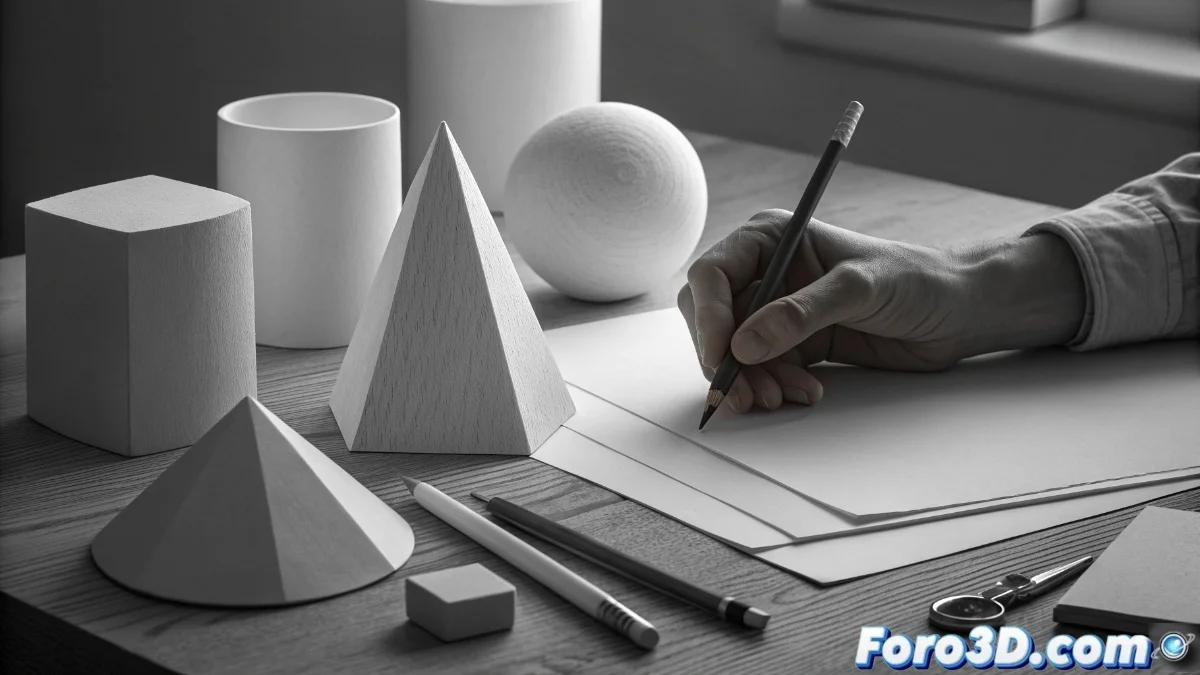
Mastery of Tonal Values for Realistic Drawings
Proper handling of tonal values is a fundamental skill for any artist aspiring to create works with three-dimensional volume and realistic appearance. This technique is based on the understanding and correct application of the complete grayscale, which ranges from absolute white to deep black, including all intermediate nuances. When you master this tonal progression, you can faithfully represent how light interacts with objects, generating defined shadows, illuminated areas, and progressive transitions that bring your creations to life 🎨.
Progressive Construction of the Tonal Scale
You begin the process by developing a value scale of 9 levels that incorporates pure white, intense black, and 7 equidistant gray tones. You practice filling delimited areas using graphite pencil or charcoal, ensuring that each value maintains uniformity and is clearly distinguishable from its adjacent ones. This seemingly basic training develops your visual sensitivity to detect subtle luminosity differences and perfects your control over the pressure applied with the drawing instrument. Tonal consistency is crucial as it prepares you for more advanced applications where you need to maintain constant values in large sections of your composition.
Key Elements of the Tonal Exercise:- Creation of 9 differentiated values from white to black
- Development of control over instrument pressure
- Training of visual perception of luminosities
The tonal scale is the visual alphabet that allows writing with light and shadow in the language of three-dimensional volume
Practical Application on Geometric Shapes
Once the fundamental scale is internalized, you apply these tonal values to represent basic geometric bodies such as spheres, cubes, and cylinders under directional lighting. You carefully observe how light generates highlights on the most exposed surfaces, midtones in transition areas, and deep shadows in less illuminated areas. You particularly practice the technique of smooth blending between different values to create realistic gradations, avoiding abrupt transitions that flatten the forms. This systematic training equips you later to tackle organic objects and human figures with the same understanding of how light defines three-dimensionality.
Tonal Application Process:- Analysis of the direction and intensity of the light source
- Identification of highlight, midtone, and shadow areas
- Execution of gradual transitions between different values
Perceptual Integration of the Tonal Scale
With continuous practice, you internalize the value scale so deeply that you begin to perceive the world in terms of tonal relationships, mentally analyzing each object and surface according to its position in the grayscale progression. This developed tonal sensitivity becomes a perceptual tool that permanently transforms your way of observing and representing reality, allowing you to create drawings with convincing volume and professional quality ✏️.