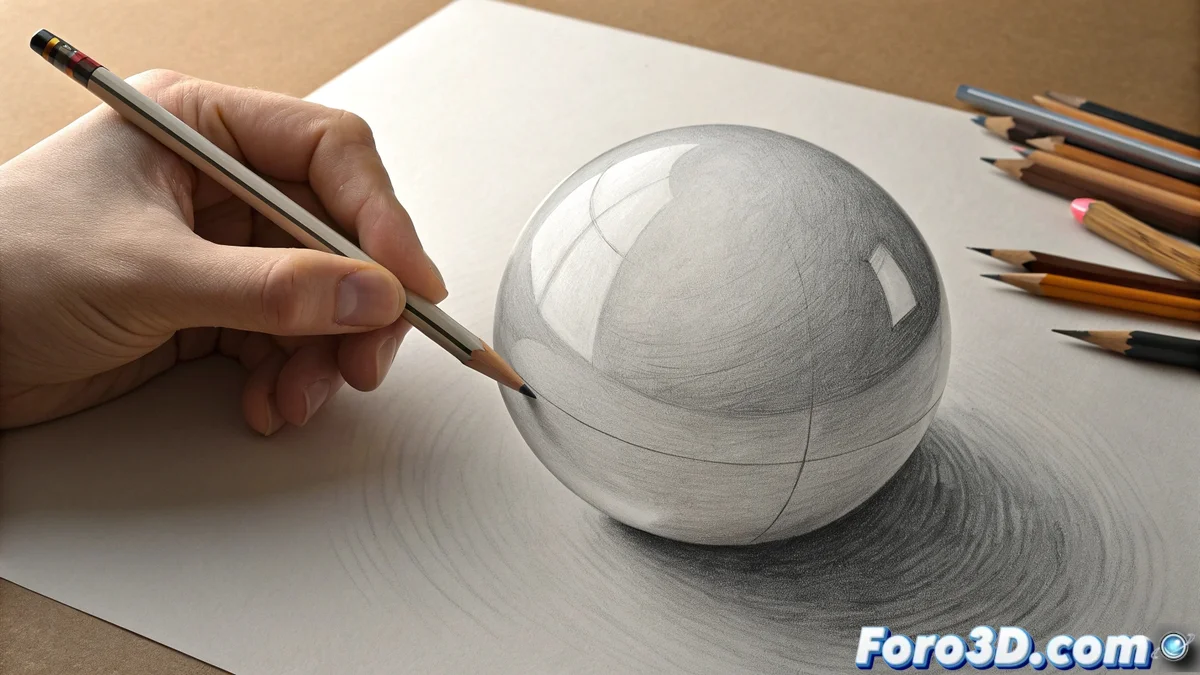
Mastering Shading for Three-Dimensional Illustrations
Artistic shading is an essential skill that transforms two-dimensional representations into convincing volumetric creations. 🎨 By exploring various methods such as parallel lines, cross-hatching, or progressive gradients, you develop the ability to interpret how light interacts with three-dimensional surfaces and shapes.
Fundamentals of Linear Techniques
You begin your practice with parallel line shading, where you execute multiple strokes in the same direction while maintaining uniform spacing. This basic approach allows you to perfect control over the instrument's pressure and stroke density to generate scaled tonal values. You then evolve to cross-hatching, superimposing layers of parallel lines at varying angles that enable building more intense and textured shadows.
Specific applications of each technique:- Parallel lines: Ideal for uniform surfaces and basic control practice ✏️
- Cross-hatching: Perfect for rough textures and deep shadow areas
- Angular combination: Allows greater tonal intensity and complex dimensional effects
Patience in shading is comparable to waiting for ink to dry in digital illustration, as rushing the process creates gray smudges that look like printing errors rather than intentional shading.
Mastering Smooth Transitions
Tonal gradients represent the next evolutionary stage in your shading learning, where you practice imperceptible transitions from the white of the support to the most intense blacks. You develop this skill by starting with subtle pressure and progressively increasing the force applied to the pencil, creating a fluid tonal progression. You complement this method with blending tools like tortillons or your own fingers to soften transitions between different values.
Tools and methods for blending:- Professional tortillons for controlled blending
- Fingers for organic and natural blending
- Papers of different textures for varied effects 📄
The Illusion of Three-Dimensionality
Consistent practice of these techniques allows you to create smooth transitions between lit and shaded areas, generating that illusion of depth that makes your illustrations appear to emerge from the two-dimensional plane. Although these methods may seem initially simple, mastering them requires meticulous dedication similar to that needed in digital artistic processes, where each stage must be respected to avoid undesired results that compromise the final quality of your work. 🖼️