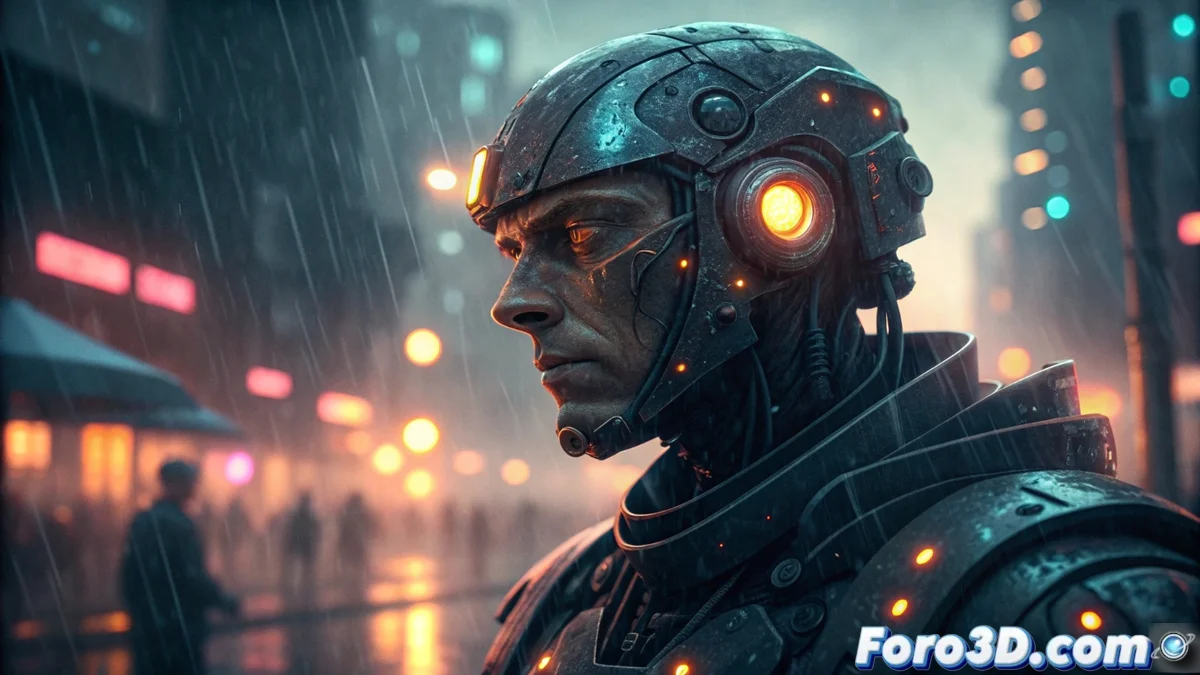
Mastering Selective Focus in Digital Illustration and 3D Rendering
In the vast universe of visual creation, there exists a powerful principle that separates flat images from those that breathe: selective focus. This technique, fundamental in photography, has become an indispensable pillar for digital illustrators and 3D artists. Its essence lies in intentionally guiding the viewer's gaze to the heart of the narrative, creating hierarchy, depth, and an unmistakable air of professionalism. It's not just about blurring; it's the art of telling a visual story. 🎯
Implementation Strategies in Creative Software
Applying this concept requires a strategic approach that varies by discipline. In the realm of 3D rendering, artists have sophisticated tools at their disposal. A highly effective methodology is render-by-passes, extracting a depth pass (Z-Depth) that is then used in compositing software like Nuke or After Effects to apply blurs and adjustments in a non-destructive way with millimeter precision. The alternative is to use depth of field directly in the render engine (such as Cycles, V-Ray, or Arnold), realistically simulating camera lens behavior through aperture and focal length. For digital illustrators, the process is more manual but equally expressive, using adjustment layers, masks, and brushes with variable opacity to blur and reduce contrast in areas that should recede in the composition.
Key Methods for Applying Selective Focus:- Render Passes (AOVs): Rendering a depth mask or Z-Depth pass allows for extremely precise post-processing in digital compositing programs, isolating specific planes.
- Depth of Field in 3D Engine: Configuring the virtual camera within the 3D software to mimic real optical blur, controlling parameters like focal length and f-number.
- Manual Techniques in 2D: In illustration, using Gaussian blur tools, layers with blend modes, and manual reduction of saturation and sharpness in peripheral areas.
Selective focus is the compass that guides the viewer through the visual map of your creation, preventing them from getting lost in a sea of irrelevant details.
Advantages Beyond Aesthetics
The benefits of this technique are both artistic and practical. Technically, it is a great optimizer. By concentrating GPU/CPU calculation resources only on the area of maximum interest, render times can be significantly reduced in complex scenes without compromising quality where it matters most. Artistically, it gives the creator absolute narrative control. It allows emphasizing emotion in a gaze, highlighting a crucial plot object, or simply establishing a compositional balance point that brings harmony. It reinforces the idea that what is suggested in the shadows and backgrounds can be as powerful as what is shown with total clarity.
Main Benefits of Its Use:- Resource Optimization: Speeds up render times by allocating higher sampling quality only to the focal area, saving valuable production time.
- Narrative Control: Directs the visual story, highlighting key emotional or narrative elements and establishing a clear visual hierarchy.
- Depth and Realism: Mimics the natural perception of the human eye, adding a three-dimensional and realistic sensation to 2D images and 3D renders.
Balance is the Key to Success
However, like any powerful tool, it requires moderation. The main risk is over-blurring, turning a carefully crafted work into an exercise in visual frustration where the viewer strains their eyes to decipher the background. The right dose is fundamental. A subtle and natural gradient must be sought that isolates the subject without completely nullifying the context, which usually provides valuable information and atmosphere to the scene. The selective focus technique, in its essence, is an elegant reminder that in the art of composition, often less is more. Its conscious application makes the difference between a simple image and a memorable visual experience. ✨