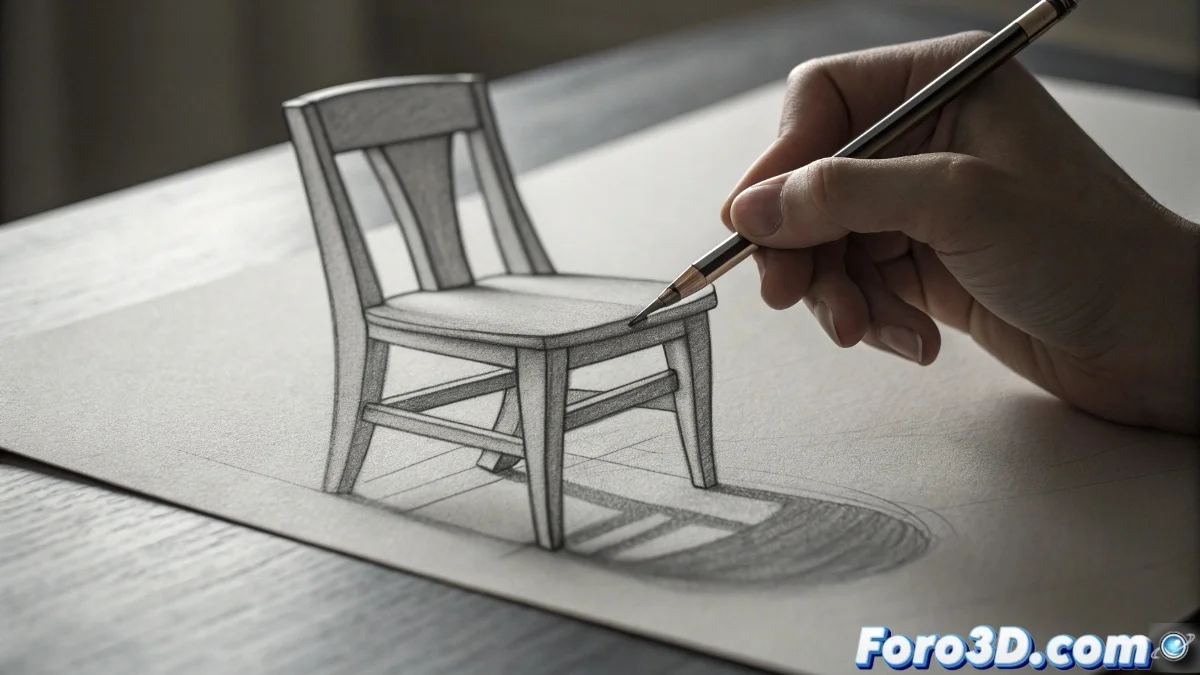
Mastering Drawing Through Negative Space
The negative space is an artistic strategy that revolutionizes our way of interpreting and rendering objects on the canvas. Instead of observing the figure directly, we focus on the empty spaces surrounding it, which helps us overcome preconceived ideas and capture contours and dimensions with greater fidelity. 🔍
Advantages of Using Negative Space in Art
By focusing on these empty areas, our brain analyzes the information more neutrally, avoiding simplistic or stereotypical representations. This is key to correcting common errors, such as disproportions or misalignments. Drawing the blank spaces around the subject allows its true form to emerge naturally, as the boundaries of the object and the negative space are interdependent. This practice also sharpens the perception of sizes and distances, resulting in more harmonious and believable works. Additionally, it cultivates patience and meticulousness, essential traits in any artistic discipline.
Key benefits of this technique:- Greater accuracy in proportions and alignment of elements
- Development of sharper and more objective visual observation
- Increase in the ability to create balanced compositions
The empty space around the object deserves as much attention as the object itself, for it defines its essence more clearly.
Practical Guide to Integrating Negative Space
To implement this methodology, choose an element with well-defined contours and a contrasting background, such as a table against a light wall. Instead of focusing on the table, examine the gaps between its components: the legs, the tabletop, etc. Draw these negative shapes first, considering them as independent entities with their own edges. As you progress, you'll notice that the table's profile appears on the paper with surprising precision. Maintain a relaxed gaze and avoid concentrating on the main object; if you catch yourself thinking about the table, redirect your attention to the empties. With practice, this approach becomes internalized and can be extended to intricate scenarios, such as landscapes or portraits, where fidelity in proportions is vital for a convincing visual impact.
Essential steps to apply the technique:- Select an object with clear shapes and contrasting background
- Observe and draw the surrounding empty spaces first
- Keep attention on the empties to avoid distractions with the main object
Final Reflections on the Power of Emptiness
Sometimes, the most challenging thing is not tracing the figure, but remembering that negative space has as much value in the composition as the subject itself. That's why these empties are often the great ignored in our drawings, despite being the ones that best outline what we aspire to represent. Adopting this perspective not only elevates the technical quality of your work, but also enriches your artistic gaze, allowing you to appreciate the beauty and function of what is not drawn. 🌟