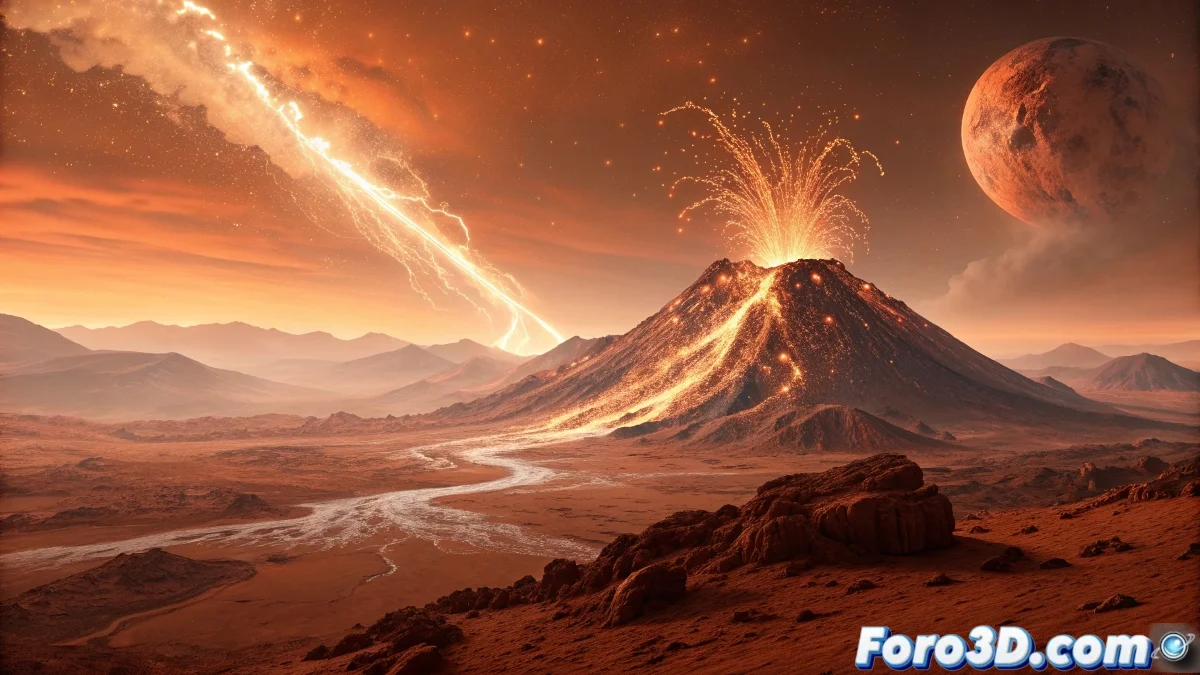
Martian volcanoes may have transported ice to the planet's equator
Volcanic activity in ancient Mars may have been key to redistributing large amounts of ice from the polar regions to the Martian equator. Using Sony Vegas, we will create a video sequence that visually explains this fascinating geological process through layer compositing and special effects. 🚀
Initial project setup in Sony Vegas
We begin by preparing the project structure with the timeline organized to handle multiple video layers and effects that represent the different elements of the scientific process.
Sony Vegas project preparation:- Set up 4K project at 30 fps with Rec. 709 color space for broadcast quality
- Organize video tracks: Martian background, volcanoes, particles, text, and overlays
- Set temporal markers for each phase of the scientific process
Sony Vegas allows efficient non-linear compositing to organize multiple visual elements that explain complex scientific processes
Composition of the Martian background and base terrain
We create the visual base of the planet using NASA images and generated textures that show the Martian topography with its distinctive features.
Martian environment elements:- Import MRO and Mars Express images as background layers on the main track
- Apply color correction to achieve the characteristic reddish tone
- Use track motion to create camera movement over the surface
Animation of the volcanic eruption and ejection
The eruptive sequence is built using particle effects and compositing to show how volcanic heat mobilizes ice into the atmosphere.
Volcanic eruption effects:- Use Boris Continuum to generate realistic volcanic plumes
- Apply NewBlue FX to simulate vapor ejection and ice particles
- Keyframe animation to control the growth and dispersion of the eruptive column
Simulation of atmospheric transport
We represent the ice journey through motion effects and transitions that show transport from the poles to the equator.
Visual transport techniques:- Create ice cloud layers with opacity and blending mode adjustments
- Use pan and crop with keyframes to simulate global atmospheric movement
- Apply displacement effects to show air currents and wind patterns
Formation of equatorial deposits
The deposition sequence shows how ice accumulates at the equator using accumulation effects and geometric transformations.
Ice accumulation effects:- Use animated masks to progressively reveal ice deposits
- Apply glow and reflection effects to simulate icy surfaces
- Create dissolve transitions between pre- and post-deposition states
Integration of educational elements and text
We incorporate scientific information through animated texts and diagrams that explain the physical mechanisms behind the phenomenon.
Educational elements:- Animated titles with Sony Titler Pro to explain each phase of the process
- Flow diagrams using shapes and vector drawing tools
- Callouts with specific scientific data on timings and quantities
Audio and narrative rhythm
The sound design complements the visual narrative creating an immersive experience that reinforces understanding of the scientific phenomenon.
Audio elements:- Ambient music that reflects the epic scale of the geological process
- Sound effects for eruptions, Martian wind, and ice formation
- Narration with voice-over explaining key scientific concepts
Final post-production and export
The finishing process includes global color correction and mastering to create a cohesive video that effectively communicates this revolutionary scientific theory.
Final production stage:- Apply consistent color correction across all scenes
- Optimize audio levels and mix sound tracks
- Export in multiple formats for different distribution platforms
Educational and outreach result
The final video produced in Sony Vegas not only shows a complex scientific phenomenon in an accessible way, but also demonstrates how video editing tools can be powerful instruments for scientific outreach and planetary education. The combination of visual effects, clear narrative, and pedagogical structure makes one of the most fascinating processes in Martian geology comprehensible. 🌌