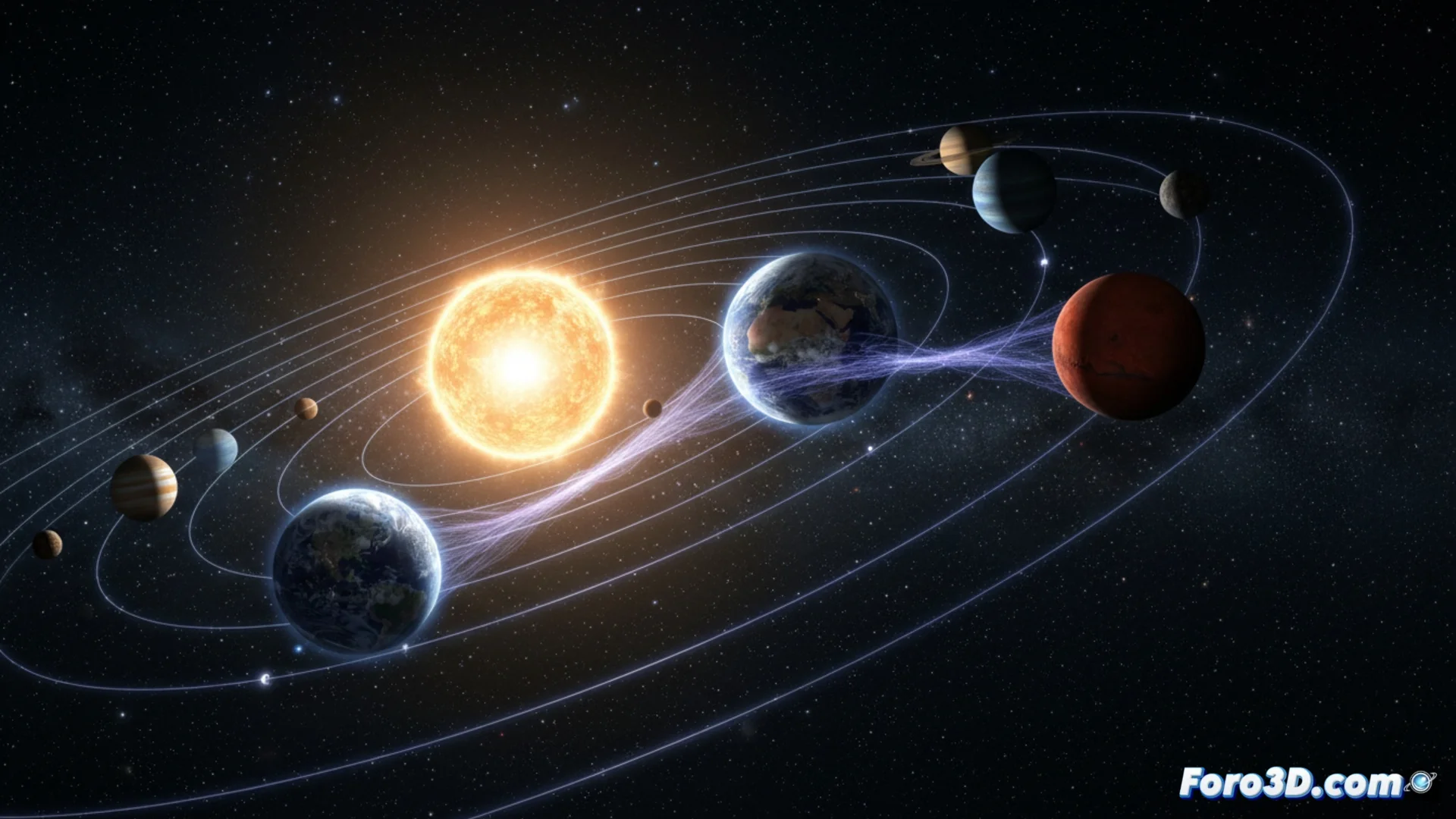
Mars' Gravity Modulates Earth's Climate Cycles
A new scientific study confirms that the gravitational pull of the red planet exerts a measurable effect on how Earth moves in space over extremely long timescales. Although Mars is smaller, its gravitational force subtly perturbs our planet's trajectory around the Sun. 🪐
The Astronomical Cycles That Govern Climate
These perturbations modify three fundamental orbital parameters: the elliptical shape of Earth's orbit, the axial tilt angle, and the moment when Earth is closest to the Sun (perihelion). Together, these factors constitute the Milankovitch cycles, which dictate the amount and distribution of solar radiation our planet receives over periods of tens to hundreds of thousands of years.
Impact of Milankovitch Cycles:- They control long-term climate patterns, including the onset and end of ice ages.
- Computer simulations reveal that, if Mars' influence is removed, some of these cycles would disappear or change substantially.
- They demonstrate that Earth's climate does not depend solely on internal or solar factors, but also on an interplanetary gravitational ballet.
Without Mars' gravitational pull, Earth's climate rhythm would be noticeably different.
The Weight of a Small Neighbor in Planetary Evolution
This finding highlights a crucial principle: a celestial body of modest size can alter the climate evolution of another world over eons. This expands how we understand complex planetary systems and how interactions between planets can sculpt environmental conditions on geological scales.
Implications of the Discovery:- It reinforces the idea that planets are not isolated, but connected by invisible forces that shape their long-term destiny.
- It provides a more complete framework for interpreting Earth's ancient climate record.
- It suggests that to understand a planet's climate, sometimes we must look beyond its atmosphere and immediate orbit.
A Distant Choreographer in the Sky
Thus, the next time you observe the red dot in the firmament, think that it is not just a celestial neighbor. It is an ancient choreographer that, from afar, helps mark the slow tempo of glaciations and the great climate changes that have defined our planet's history. 🔴