Mari, the Basque Goddess Who Rules Nature from Mount Anboto
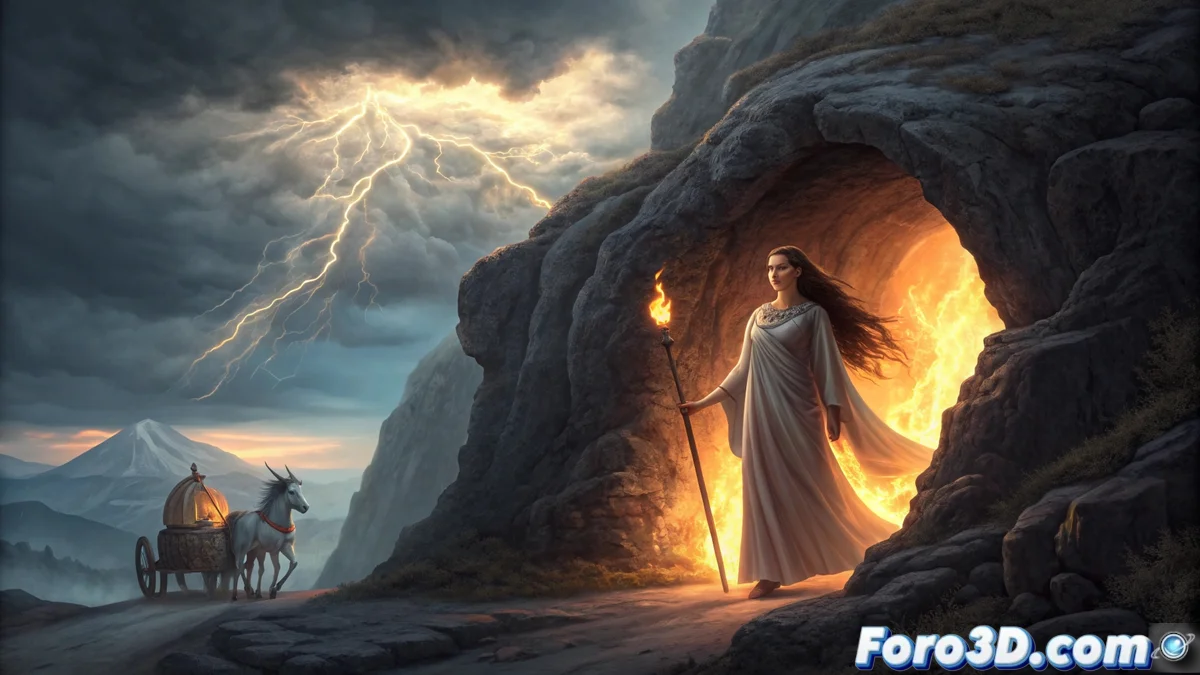
In the heart of Basque mythology resides a powerful figure: Mari. This deity personifies the Earth itself, and her main abode is a cave at the summit of Mount Anboto. From this rocky throne, she exerts her dominion over the natural world, described as a woman of extraordinary beauty who sometimes appears surrounded by flames or traveling in a carriage pulled by rams. Her influence is absolute over the weather and the fertility of the land. 🌄
Absolute Power over the Elements
Mari does not merely inhabit the earth; she commands it. Her will decides whether storms ravage the valleys or the sun warms the fields. Popular tales detail her ability to summon impenetrable mists, unleash hurricane-force winds, or hurl lightning bolts. Farmers and shepherds have paid her homage for centuries, seeking her favor for timely rains and abundant harvests. Her cave in Anboto is more than a simple grotto; it is perceived as a direct portal to the vital core of the planet. When Mari moves to other peaks like Oiz, the region she leaves behind suffers drought and bad weather, demonstrating her direct control over the environment.
Manifestations of her dominion:- Climate control: She governs rains, storms, winds, and mists, directly influencing the well-being of communities.
- Mobility between mountains: Her change of residence between Anboto, Oiz, and other summits immediately alters the weather conditions in the area.
- Symbolic representations: She is visualized as a woman of fire or traveling in a chariot pulled by rams, symbols of her supernatural power and connection to wild nature.
The legend warns that trespassing on her domains or disrespecting nature provokes her wrath, which manifests in devastating storms and misfortunes.
A Legend with Profound Ecological Teaching
Mari's myth transcends simple folkloric tale to function as a code of ethics and ecology. It embodies the idea that nature is a living entity, with consciousness and will, that demands respect. The narrative serves to dissuade harmful actions, conveying that clear-cutting forests without measure, polluting waters, or overhunting can awaken the goddess's displeasure. Thus, this mythological figure stands as a cultural mechanism to preserve the balance between humans and their environment, reminding people of their total dependence on a world they must honor.
Key lessons from the myth:- Respect for the environment: The story teaches not to perceive nature as an inert resource, but as a being with rights that deserves consideration.
- Consequences of human action: Acts of irresponsible exploitation, such as deforestation or pollution, are presented as direct offenses to Mari, with dire consequences.
- Balance and sustainability: Mari's figure promotes a model of coexistence where the human community must live in harmony with its surroundings to prosper.
A Reminder in the Sky
The legend endures with a touch of practical humor. It is said that if someone sees Mari crossing the sky in her chariot of fire, the sensible thing is not to make a wish, but to make sure the windows are closed properly. The weather she brings is rarely suitable for hanging laundry. This final warning reinforces the constant and capricious presence of the divine in the everyday, uniting the mythical world with the practical concerns of life, and underscoring that the power of nature, personified in Mari, is a force always present that must be taken seriously and with respect. ⚡