When the Eighth Is Not the Last, But the Next
Marc Márquez has done it again: the Spanish rider has conquered his eighth MotoGP world title in the 2025 season, establishing himself not only as a living legend of motorcycling, but as that sports phenomenon that appears once per generation. 🏆 His decisive victory at the Aragón Grand Prix closes a season that will be remembered by new generations as an example of how determination, talent, and that spark of controlled madness can overcome any adversity. By now, we should be used to Márquez's records, but each new title tastes different, especially when it comes after seasons of injuries and doubts that would have ended less brilliant careers.
The Comeback That Wrote Another Chapter in History
The 2025 season will be studied in sports schools as an example of adversity management. Márquez did not arrive as the absolute favorite; he had to deal with mechanical problems, questionable team strategies, and younger, hungrier rivals. 🏍️ However, like the great champions, he knew how to transform every obstacle into an opportunity, every criticism into motivation, and every mistake into learning. The decisive races demonstrated that, when pressure reaches its maximum point, Márquez does not break, but elevates his level to territories that only he seems capable of inhabiting.
Key Moments of the 2025 Season:- Victory in Jerez after coming back from tenth position
- Double victory in Misano under extreme weather conditions
- Master strategy in Phillip Island with worn tires
- Decisive race in Aragón with impossible overtakes
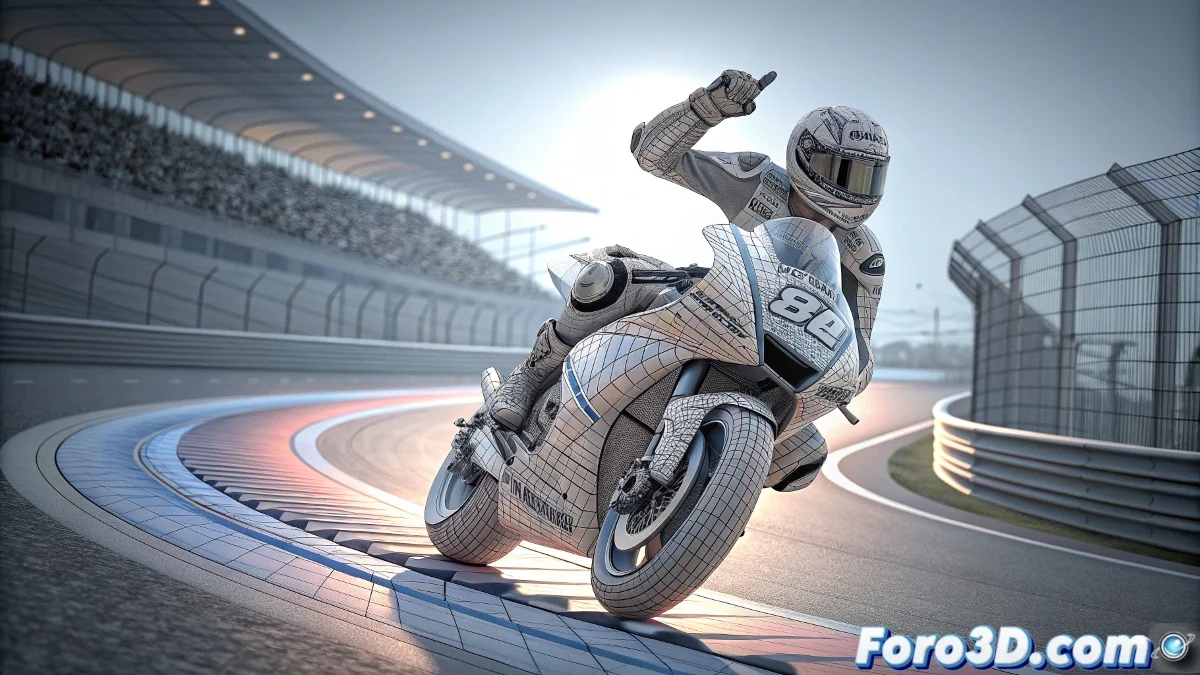
Recreation in Cinema 4D: When 3D Celebrates the Champion
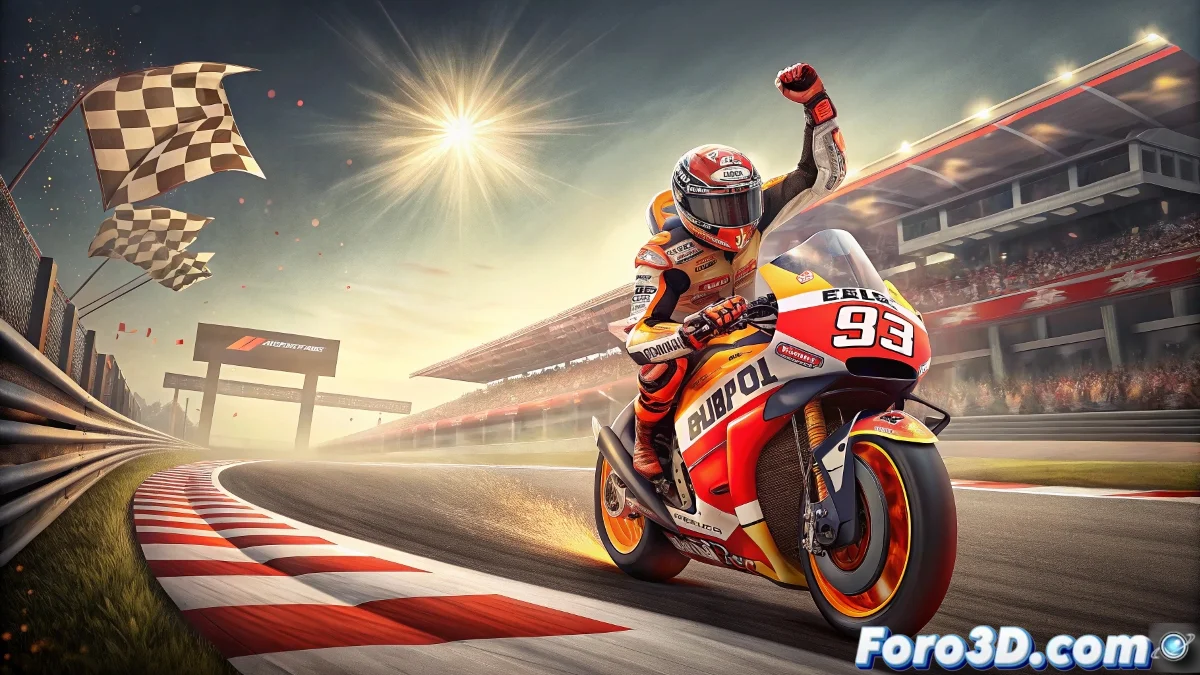
Recreating this historic moment in Cinema 4D offers the perfect opportunity to explore advanced techniques in organic modeling, vehicle animation, and crowd creation. The key is to capture not only the physical appearance of the scene, but also the emotional charge of the moment: that mix of relief, triumph, and legacy seen in Márquez's eyes as he crosses the finish line. 🎬 Every element, from the reflection on the bike's fairing to the rider's facial expressions, contributes to telling a story that transcends the mere sporting result.
Practical Guide: From Empty Project to Virtual Podium
The process in Cinema 4D begins with meticulous scale setup, crucial when working with competition vehicles where every millimeter counts aerodynamically. Modeling the bike requires special attention to complex curves and technical components that distinguish a MotoGP from a street bike. 🏁 Creating the rider involves not only correct anatomy, but also that characteristic Márquez posture on the bike, almost like an extension of the machine rather than a simple driver. The Aragón circuit, with its emblematic curves, sets the perfect stage for the visual narrative.
Essential Workflow in Cinema 4D:- High-precision modeling of the 2025 MotoGP bike
- Creation of Márquez's character with deformers for animation
- Construction of the Aragón circuit with real references
- Setup of realistic sports lighting
Texturing: The Details That Tell the Story
The textures in this recreation do much more than define materials; they visually narrate the intensity of the season. The bike must show the race wear: small marks on the fairing, dirt on the tires, even remnants of rubber from the skid at the start. 🔧 Sponsor logos must be perfectly integrated, reflecting the commercial reality of elite sport. Márquez's suit needs to show that balance between protective rigidity and flexibility for movement, with materials that react credibly to the circuit's lighting.
Animation: Capturing the Essence of Márquez's Movement
Animating Márquez on the bike is perhaps the most complex technical and artistic challenge. His unique style, with that spectacular leaning in corners and ability to save impossible situations, requires meticulous study of real footage. 💫 The bike's physics must balance realism and spectacle, showing the incredible G-forces that riders endure while maintaining visual credibility. Particle systems for dust, braking smoke, and occasional sparks add that layer of realism that differentiates a good animation from an exceptional one.
Advanced Techniques for Sports Realism:- Use of rigid dynamics for realistic bike behavior
- Facial animation to capture emotion under the helmet
- Particle systems for atmospheric and track effects
- Cinematographic motion blur to convey speed
Lighting and Rendering: The Stadium as a Character
The lighting of the Aragón circuit is another character in this story. The track lights, the stands' spotlights, even the giant screens contribute to creating that unique MotoGP atmosphere. 🌟 The render setup must preserve all these elements while efficiently handling complex scenes with multiple light sources. Redshift or Cinema 4D's native engine allow achieving that photorealistic realism that makes the viewer feel like they are watching real footage instead of a digital recreation.
Records are meant to be broken, but legends are meant to be remembered, and Márquez is already both
Conclusion: When Numbers Tell a Human Story
Marc Márquez's eighth title represents much more than a number in the record; it is the culmination of a symbiotic relationship between a rider, a machine, and a sport that demand absolute excellence from each other. 🏆 Recreating this moment in Cinema 4D is not just a technical exercise, but an opportunity to visually explore what makes some athletes transcend their discipline to become cultural icons. After all, in a world of data and statistics, sometimes the best way to understand greatness is to see it in motion, even if it's in pixels. And who knows, perhaps the ninth title is already on the horizon, waiting for its own digital recreation. 😄